QUESTION IMAGE
Question
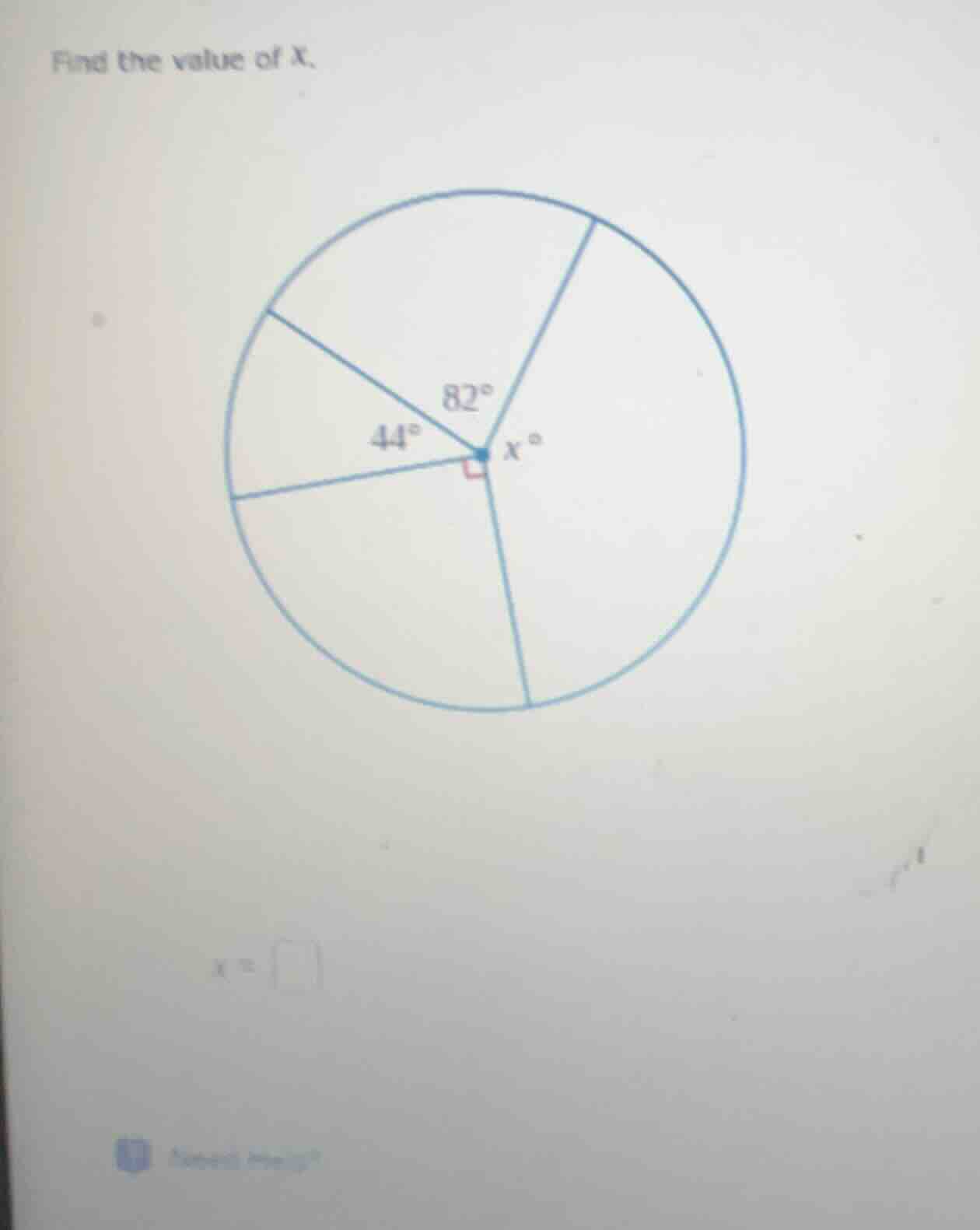
find the value of x. (there is a circle with several angles at the center: 44°, 82°, a right angle, and x°)
Step1: Recall total angle at center
A full circle has a central angle of \(360^\circ\), and here we also have a right angle (\(90^\circ\)) among the angles. So the sum of all central angles ( \(44^\circ\), \(82^\circ\), \(90^\circ\), and \(x^\circ\)) should equal \(360^\circ\)? Wait, no, wait. Wait, looking at the diagram, there are four angles? Wait, no, the right angle (the red square) is \(90^\circ\), then \(44^\circ\), \(82^\circ\), and \(x^\circ\), and is there another angle? Wait, no, maybe I miscounted. Wait, the central angles around a point sum to \(360^\circ\). So let's list the angles: \(44^\circ\), \(82^\circ\), \(90^\circ\) (the right angle), and \(x^\circ\), and is there another angle? Wait, no, maybe the diagram has four sectors? Wait, no, the user's diagram: let's see, the center has a right angle ( \(90^\circ\) ), \(44^\circ\), \(82^\circ\), and \(x^\circ\), and maybe another angle? Wait, no, maybe I made a mistake. Wait, the sum of angles around a point is \(360^\circ\). So let's calculate the sum of the known angles: \(44 + 82 + 90\) (the right angle) plus \(x\) should equal \(360\)? Wait, no, wait, maybe the right angle is one, \(44\), \(82\), and \(x\), and another angle? Wait, no, maybe the diagram has four angles? Wait, no, let's check again. The problem is to find \(x\) where the central angles are \(44^\circ\), \(82^\circ\), a right angle ( \(90^\circ\) ), and \(x^\circ\), and the sum is \(360^\circ\). So:
Step1: Sum of known angles
First, calculate the sum of the given angles: \(44^\circ + 82^\circ + 90^\circ\). Let's compute that: \(44 + 82 = 126\), then \(126 + 90 = 216\).
Step2: Solve for \(x\)
Since the total around a point is \(360^\circ\), we have \(216 + x = 360\)? Wait, no, that can't be, because \(360 - 216 = 144\), but that seems high. Wait, maybe I miscounted the angles. Wait, maybe the right angle is not \(90^\circ\)? Wait, no, the red square is a right angle, so \(90^\circ\). Wait, maybe there are three angles? No, the diagram shows four? Wait, no, let's re-express. Wait, maybe the angles are \(44^\circ\), \(82^\circ\), \(x^\circ\), and \(90^\circ\), and another angle? Wait, no, maybe the user's diagram has four sectors: \(44\), \(82\), \(90\), and \(x\), and the sum is \(360\). So:
\(44 + 82 + 90 + x = 360\)
Wait, \(44 + 82 = 126\), \(126 + 90 = 216\), so \(216 + x = 360\), so \(x = 360 - 216 = 144\)? Wait, that seems off. Wait, maybe I made a mistake. Wait, maybe the right angle is not included? Wait, no, the red square is a right angle, so it's \(90^\circ\). Wait, maybe the diagram has three angles? Wait, no, the problem is to find \(x\), so let's check again.
Wait, maybe the sum is \(44 + 82 + x + 90 = 360\)? Wait, no, that would be \(x = 360 - (44 + 82 + 90) = 360 - 216 = 144\). But that seems large. Wait, maybe the right angle is not \(90^\circ\)? No, the red square is a right angle, so \(90^\circ\). Alternatively, maybe the angles are \(44\), \(82\), and \(x\), and the right angle is part of another angle? Wait, no, the user's diagram: let's see, the center has a right angle ( \(90^\circ\) ), \(44^\circ\), \(82^\circ\), and \(x^\circ\), so four angles. So sum to \(360\). So:
\(44 + 82 + 90 + x = 360\)
\(216 + x = 360\)
\(x = 360 - 216 = 144\). Wait, but that seems like a lot. Alternatively, maybe I miscounted the angles. Wait, maybe the right angle is not there? Wait, the red square is a right angle, so it's \(90^\circ\). So the calculation is correct.
Wait, let's verify: \(44 + 82 = 126\), \(126 + 90 = 216\), \(216 + 144 = 360\). Yes, that works. So \(x = 144\).

Snap & solve any problem in the app
Get step-by-step solutions on Sovi AI
Photo-based solutions with guided steps
Explore more problems and detailed explanations
\(144\)