QUESTION IMAGE
Question
find the values of x and y.
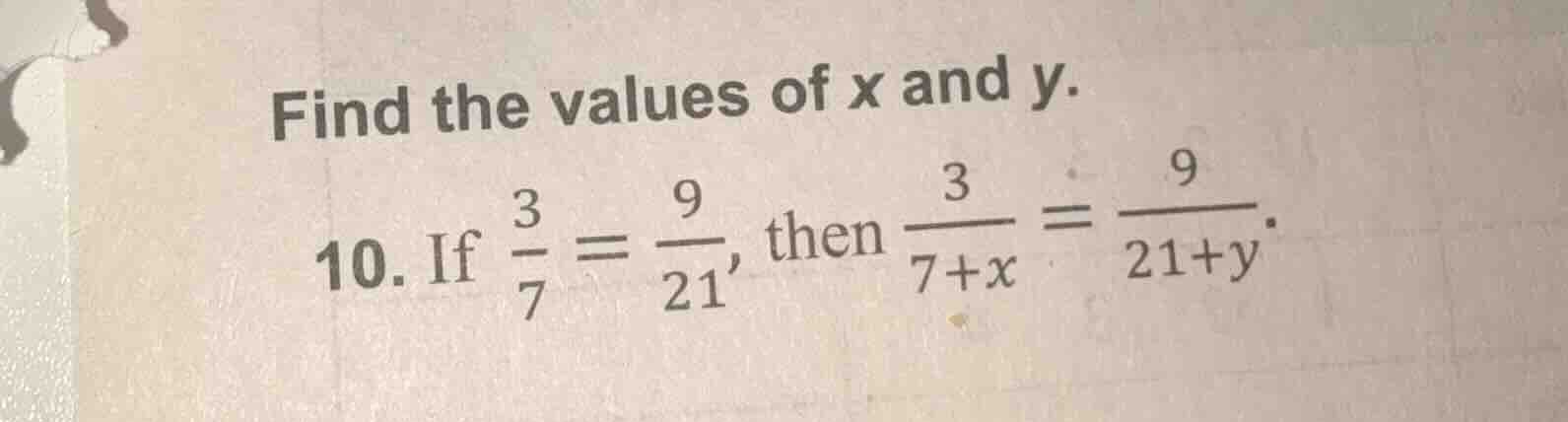
- if \\(\frac{3}{7} = \frac{9}{21}\\), then \\(\frac{3}{7+x} = \frac{9}{21+y}\\).
Step1: Cross - multiply the proportion
Given \(\frac{3}{7 + x}=\frac{9}{21 + y}\), cross - multiplying gives us \(3\times(21 + y)=9\times(7 + x)\).
Step2: Simplify both sides
First, expand the left - hand side: \(3\times21+3y = 63 + 3y\).
Expand the right - hand side: \(9\times7+9x=63 + 9x\).
So we have the equation \(63 + 3y=63 + 9x\).
Subtract 63 from both sides of the equation: \(3y=9x\), which simplifies to \(y = 3x\).
We also know that \(\frac{3}{7}=\frac{9}{21}\), and the proportion \(\frac{3}{7 + x}=\frac{9}{21 + y}\) should be equivalent. Let's consider the ratio of numerators: \(\frac{9}{3}=3\). So the ratio of denominators should also be 3.
For the denominators: \(\frac{21 + y}{7 + x}=3\), which is the same as \(21 + y=3\times(7 + x)=21 + 3x\). Subtract 21 from both sides, we get \(y = 3x\).
Now, let's use the fact that the original fraction \(\frac{3}{7}\) and \(\frac{3}{7 + x}\) should have a relationship based on the numerator multiple. Since the numerator of the second fraction is the same as the first, for the fractions to be equivalent (because \(\frac{3}{7}=\frac{9}{21}\) and \(\frac{3}{7 + x}=\frac{9}{21 + y}\) are in the same proportion), the denominators should be in the same ratio.
We know that \(\frac{3}{7}=\frac{9}{21}\) (because \(3\times3 = 9\) and \(7\times3=21\)). So for \(\frac{3}{7 + x}\) and \(\frac{9}{21 + y}\), since \(\frac{3}{7 + x}=\frac{9}{21 + y}\) and \(\frac{9}{3}=3\), then \(7 + x\) should be such that \(21 + y=3\times(7 + x)\). Also, since \(\frac{3}{7}=\frac{3}{7 + x}\) would imply \(7 + x = 7\) (if numerators are equal and fractions are equal), but here the second fraction's numerator is 3 times the first's numerator? Wait, no, \(\frac{3}{7 + x}=\frac{9}{21 + y}\), and \(\frac{3}{7}=\frac{9}{21}\). Let's solve the proportion directly.
From \(\frac{3}{7 + x}=\frac{9}{21 + y}\), cross - multiply:
\(3(21 + y)=9(7 + x)\)
\(63+3y = 63 + 9x\)
Subtract 63 from both sides:
\(3y=9x\)
\(y = 3x\)
Now, let's assume that the fractions \(\frac{3}{7}\) and \(\frac{3}{7 + x}\) have the same ratio as \(\frac{9}{21}\) and \(\frac{9}{21 + y}\). Since \(\frac{3}{7}=\frac{9}{21}\), the multiplier for numerator and denominator is 3. So for \(\frac{3}{7 + x}\) and \(\frac{9}{21 + y}\), the multiplier should also be 3. So \(7 + x\) should be equal to \(7\) (because the numerator of the first fraction in the second proportion is 3, same as the original first fraction) only if \(x = 0\)? Wait, no, let's do it step by step.
We know that \(\frac{3}{7}=\frac{9}{21}\), and \(\frac{3}{7 + x}=\frac{9}{21 + y}\). Let's set the two proportions equal in terms of the ratio.
Since \(\frac{3}{7 + x}=\frac{9}{21 + y}\), we can write \(\frac{3}{9}=\frac{7 + x}{21 + y}\), which simplifies to \(\frac{1}{3}=\frac{7 + x}{21 + y}\). Then \(21 + y=3\times(7 + x)=21 + 3x\). Subtract 21 from both sides: \(y = 3x\).
Now, let's find a particular solution. Let's assume that the fractions \(\frac{3}{7 + x}\) is equal to \(\frac{3}{7}\) (since \(\frac{3}{7}=\frac{9}{21}\)). If \(\frac{3}{7 + x}=\frac{3}{7}\), then \(7 + x=7\), so \(x = 0\). Then, since \(y = 3x\), \(y=0\). Let's check:
If \(x = 0\) and \(y = 0\), then \(\frac{3}{7+0}=\frac{3}{7}\) and \(\frac{9}{21 + 0}=\frac{9}{21}=\frac{3}{7}\), so \(\frac{3}{7}=\frac{9}{21}\) holds, and \(\frac{3}{7+0}=\frac{9}{21 + 0}\) also holds.

Snap & solve any problem in the app
Get step-by-step solutions on Sovi AI
Photo-based solutions with guided steps
Explore more problems and detailed explanations
\(x = 0\), \(y = 0\)