QUESTION IMAGE
Question
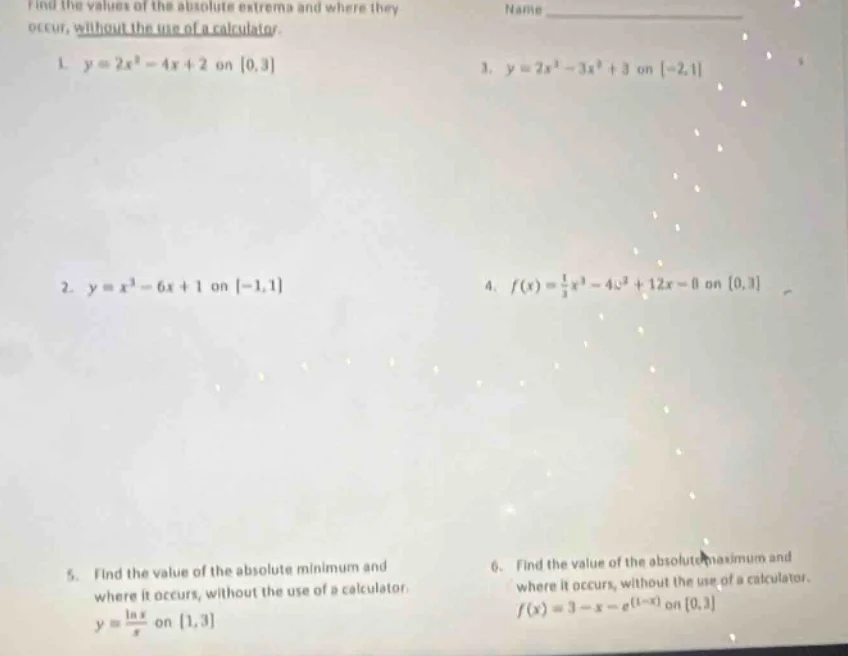
find the values of the absolute extrema and where they occur, without the use of a calculator.
- $y = 2x^2 - 4x + 2$ on $0, 3$
- $y = x^3 - 6x + 1$ on $-1, 1$
- $y = 2x^3 - 3x^2 + 3$ on $-2, 1$
- $f(x) = \frac{1}{3}x^3 - 4x^2 + 12x - 8$ on $0, 3$
- find the value of the absolute minimum and where it occurs, without the use of a calculator. $y = \frac{\ln x}{x}$ on $1, 3$
- find the value of the absolute maximum and where it occurs, without the use of a calculator. $f(x) = 3 - x - e^{-(1 - x)}$ on $0, 3$
Step1: Find critical points via derivative
For $y=2x^2-4x+2$:
Derivative: $y'=4x-4$
Set $y'=0$: $4x-4=0 \implies x=1$
Step2: Evaluate at critical/endpoints
At $x=0$: $y=2(0)^2-4(0)+2=2$
At $x=1$: $y=2(1)^2-4(1)+2=0$
At $x=3$: $y=2(3)^2-4(3)+2=8$
Step1: Find critical points via derivative
For $y=x^3-6x+1$:
Derivative: $y'=3x^2-6$
Set $y'=0$: $3x^2-6=0 \implies x=\pm\sqrt{2}$. Only $x=-\sqrt{2}\approx-1.414$ is outside $[-1,1]$, so no critical points in the interval.
Step2: Evaluate at endpoints
At $x=-1$: $y=(-1)^3-6(-1)+1=6$
At $x=1$: $y=(1)^3-6(1)+1=-4$
Step1: Find critical points via derivative
For $y=2x^3-3x^2+3$:
Derivative: $y'=6x^2-6x$
Set $y'=0$: $6x(x-1)=0 \implies x=0, x=1$ (both in $[-2,1]$)
Step2: Evaluate at critical/endpoints
At $x=-2$: $y=2(-2)^3-3(-2)^2+3=-25$
At $x=0$: $y=2(0)^3-3(0)^2+3=3$
At $x=1$: $y=2(1)^3-3(1)^2+3=2$
Step1: Find critical points via derivative
For $f(x)=\frac{1}{3}x^3-4x^2+12x-8$:
Derivative: $f'(x)=x^2-8x+12$
Set $f'(x)=0$: $(x-2)(x-6)=0 \implies x=2, x=6$. Only $x=2$ is in $[0,3]$.
Step2: Evaluate at critical/endpoints
At $x=0$: $f(0)=\frac{1}{3}(0)^3-4(0)^2+12(0)-8=-8$
At $x=2$: $f(2)=\frac{1}{3}(2)^3-4(2)^2+12(2)-8=\frac{8}{3}$
At $x=3$: $f(3)=\frac{1}{3}(3)^3-4(3)^2+12(3)-8=1$

Snap & solve any problem in the app
Get step-by-step solutions on Sovi AI
Photo-based solutions with guided steps
Explore more problems and detailed explanations
Absolute minimum: $0$ at $x=1$; Absolute maximum: $8$ at $x=3$
---