QUESTION IMAGE
Question
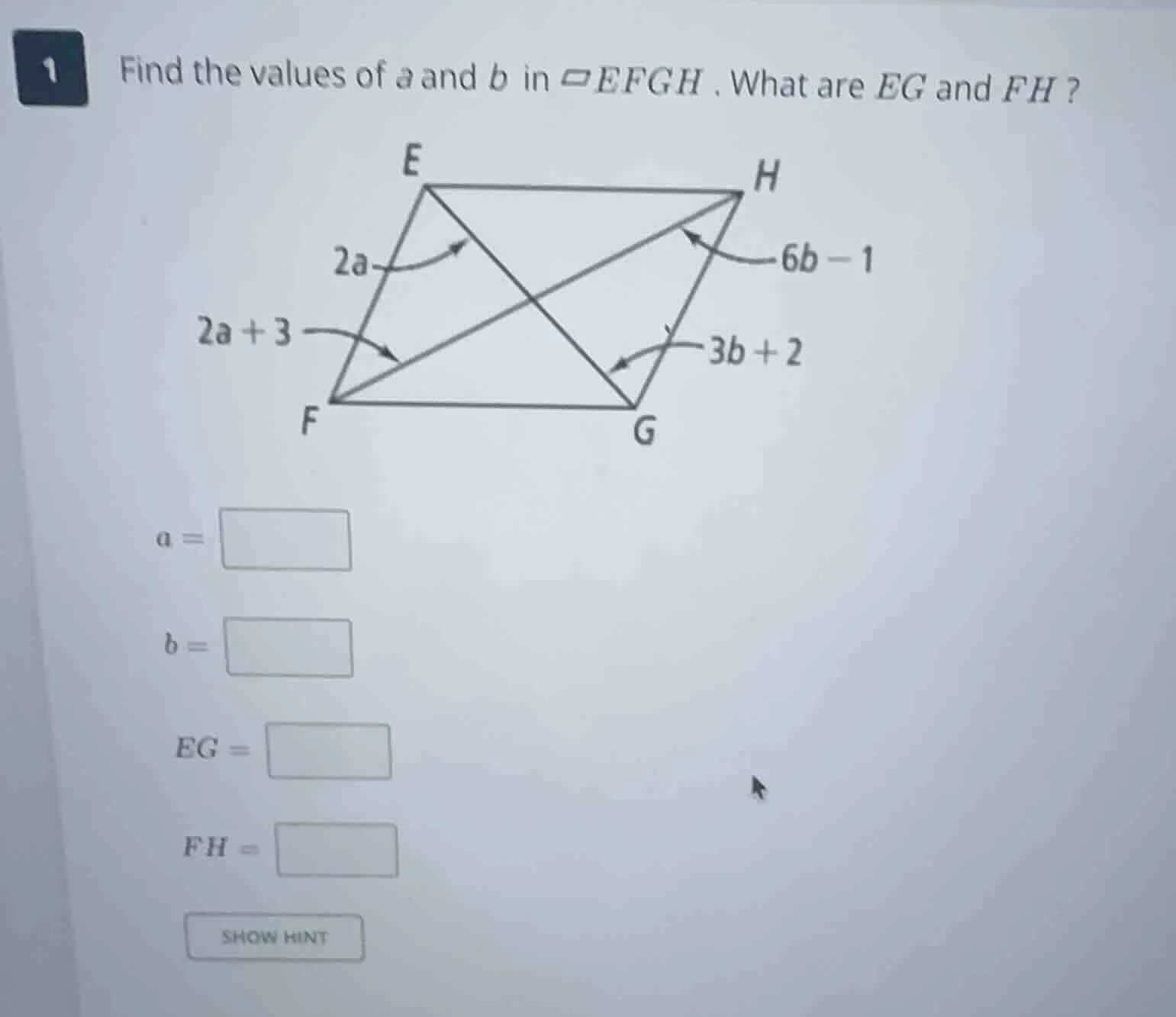
1 find the values of a and b in $square efgh$. what are $eg$ and $fh$?
$a = square$
$b = square$
$eg = square$
$fh = square$
show hint
Step1: Set equal segments for a
In a parallelogram, diagonals bisect each other, so $2a = 2a + 3$ is incorrect. Correct: the segments of diagonal $EG$ are equal: $2a = 2a + 3$ is wrong, actually, the two parts of diagonal $EG$ are $2a$ and $2a+3$? No, wait: diagonals of parallelogram bisect each other, so the two segments of one diagonal are equal. So for diagonal $EG$: $2a = 2a + 3$ is impossible, wait no, looking at the diagram: $E$ to intersection is $2a$, $F$ to intersection is $2a+3$? No, no: $EFGH$ is parallelogram, diagonals $EG$ and $FH$ intersect at midpoint. So the two parts of $EG$ are $2a$ and $2a+3$? No, no, the arrows: $2a$ is $E$ to midpoint, $2a+3$ is $F$ to midpoint? No, no, correct rule: In parallelogram, diagonals bisect each other, so the two segments of diagonal $EG$ are equal, so $2a = 2a + 3$ is wrong, I misread. Wait, no: $2a$ is $E$ to midpoint, $2a+3$ is $G$ to midpoint? No, no, the labels: $2a$ is on $EG$ (from $E$ to intersection), $2a+3$ is on $FH$ (from $F$ to intersection)? No, no, the diagram: $E$ connected to $G$ (diagonal), $F$ connected to $H$ (diagonal). The segments: $E$ to intersection is $2a$, $G$ to intersection is $2a+3$? No, that can't be, because diagonals bisect each other, so those two should be equal. Oh! I see, I misread: $2a$ is on $FH$ (from $E$ to intersection? No, $E$ to $F$ is side, no. Wait, no: the correct rule is that in parallelogram, the two segments of each diagonal are equal. So for diagonal $EG$, the two parts are $2a$ and $2a+3$? No, that would mean $2a = 2a+3$, which is impossible. Wait, no, the arrows: $2a$ is $E$ to $F$? No, no, the problem says $\square EFGH$, so vertices are $E, F, G, H$ in order. So diagonals are $EG$ and $FH$. The segments: $2a$ is part of $EG$, $2a+3$ is part of $FH$? No, no, the labels: $2a$ is on $EG$ (from $E$ to midpoint), $2a+3$ is on $FH$ (from $F$ to midpoint)? No, no, the other labels: $6b-1$ is on $FH$ (from $H$ to midpoint), $3b+2$ is on $EG$ (from $G$ to midpoint). Oh! Right! So diagonal $EG$ has segments $2a$ (E to midpoint) and $3b+2$ (G to midpoint), so they are equal. Diagonal $FH$ has segments $2a+3$ (F to midpoint) and $6b-1$ (H to midpoint), so they are equal. That makes sense.
Step1: Equate EG segments
$2a = 3b + 2$
Step2: Equate FH segments
$2a + 3 = 6b - 1$
Step3: Substitute 2a from Step1 into Step2
Substitute $2a = 3b + 2$ into $2a + 3 = 6b - 1$:
$(3b + 2) + 3 = 6b - 1$
Simplify: $3b + 5 = 6b - 1$
Step4: Solve for b
$5 + 1 = 6b - 3b$
$6 = 3b$
$b = \frac{6}{3} = 2$
Step5: Solve for a using b=2
Substitute $b=2$ into $2a = 3b + 2$:
$2a = 3(2) + 2 = 6 + 2 = 8$
$a = \frac{8}{2} = 4$
Step6: Calculate EG length
$EG = 2a + 3b + 2 = 2(4) + 3(2) + 2$? No, $EG$ is sum of its two segments: $2a + (3b+2) = 2(4) + (3(2)+2) = 8 + 8 = 16$
Or, since each segment is equal, $EG = 2 \times 2a = 2 \times 8 = 16$ (or $2 \times (3b+2) = 2 \times 8 = 16$)
Step7: Calculate FH length
$FH = (2a+3) + (6b-1) = (2(4)+3) + (6(2)-1) = 11 + 11 = 22$
Or, $FH = 2 \times (2a+3) = 2 \times 11 = 22$ (or $2 \times (6b-1) = 2 \times 11 = 22$)

Snap & solve any problem in the app
Get step-by-step solutions on Sovi AI
Photo-based solutions with guided steps
Explore more problems and detailed explanations
$a = 4$
$b = 2$
$EG = 16$
$FH = 22$