QUESTION IMAGE
Question
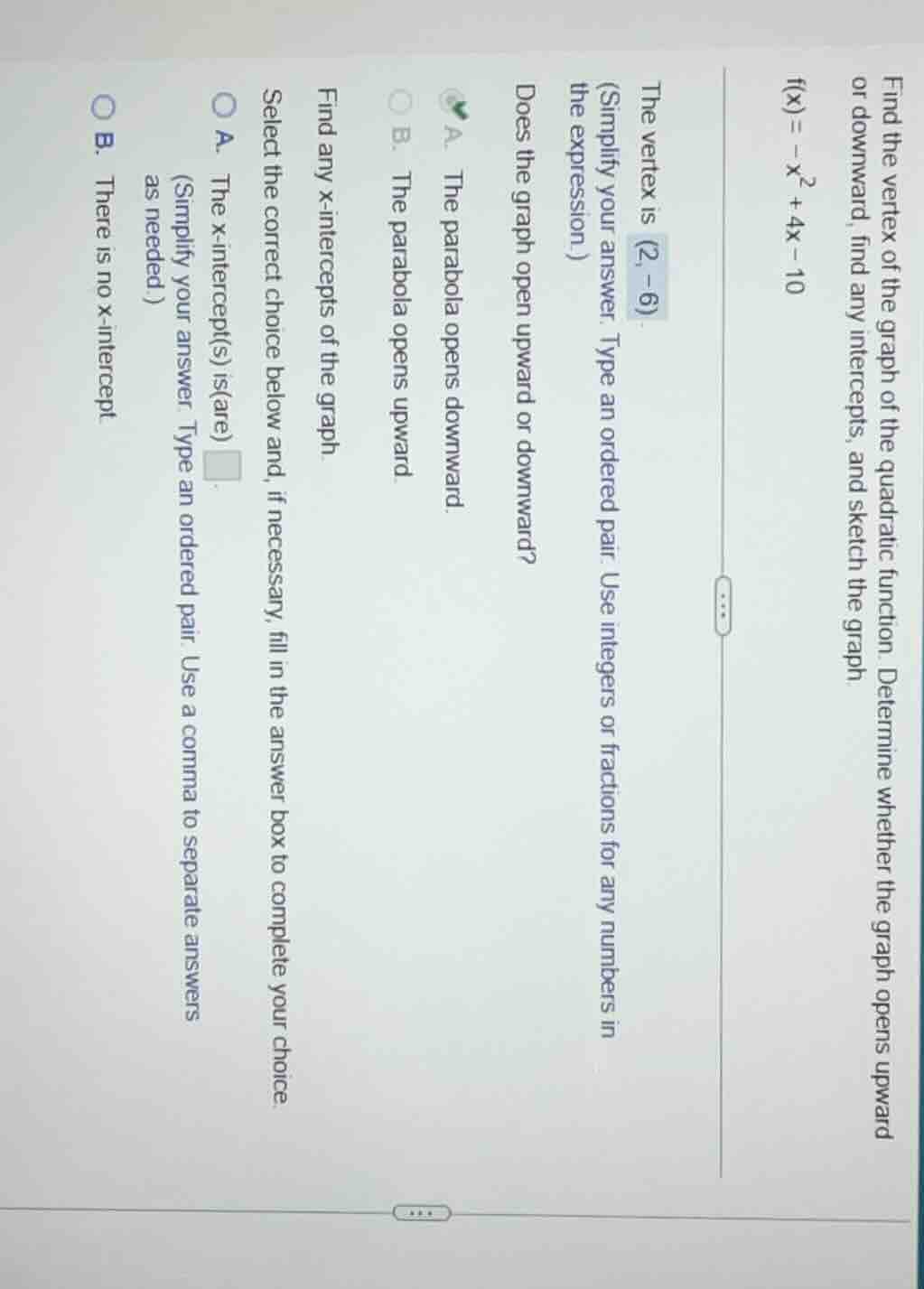
find the vertex of the graph of the quadratic function. determine whether the graph opens upward or downward, find any intercepts, and sketch the graph.
$f(x) = -x^2 + 4x - 10$
the vertex is \\((2, -6)\\) (simplify your answer. type an ordered pair. use integers or fractions for any numbers in the expression.)
does the graph open upward or downward?
a. the parabola opens downward.
b. the parabola opens upward.
find any x-intercepts of the graph.
select the correct choice below and, if necessary, fill in the answer box to complete your choice.
a. the x-intercept(s) is(are) \\(\square\\) (simplify your answer. type an ordered pair. use a comma to separate answers as needed.)
b. there is no x-intercept
For the x - intercepts part:
Step 1: Recall the formula for x - intercepts
To find the x - intercepts of the quadratic function \(y = f(x)=-x^{2}+4x - 10\), we set \(y = 0\), so we need to solve the quadratic equation \(-x^{2}+4x - 10=0\). Multiply both sides of the equation by - 1 to get \(x^{2}-4x + 10=0\).
Step 2: Use the quadratic formula
For a quadratic equation \(ax^{2}+bx + c = 0\) (\(a
eq0\)), the quadratic formula is \(x=\frac{-b\pm\sqrt{b^{2}-4ac}}{2a}\). In the equation \(x^{2}-4x + 10=0\), we have \(a = 1\), \(b=-4\), and \(c = 10\).
First, calculate the discriminant \(\Delta=b^{2}-4ac\). Substitute the values: \(\Delta=(-4)^{2}-4\times1\times10=16 - 40=- 24\).
Since the discriminant \(\Delta=-24<0\), the quadratic equation \(x^{2}-4x + 10=0\) has no real solutions.

Snap & solve any problem in the app
Get step-by-step solutions on Sovi AI
Photo-based solutions with guided steps
Explore more problems and detailed explanations
B. There is no x - intercept