QUESTION IMAGE
Question
finding angles (level 1)
question
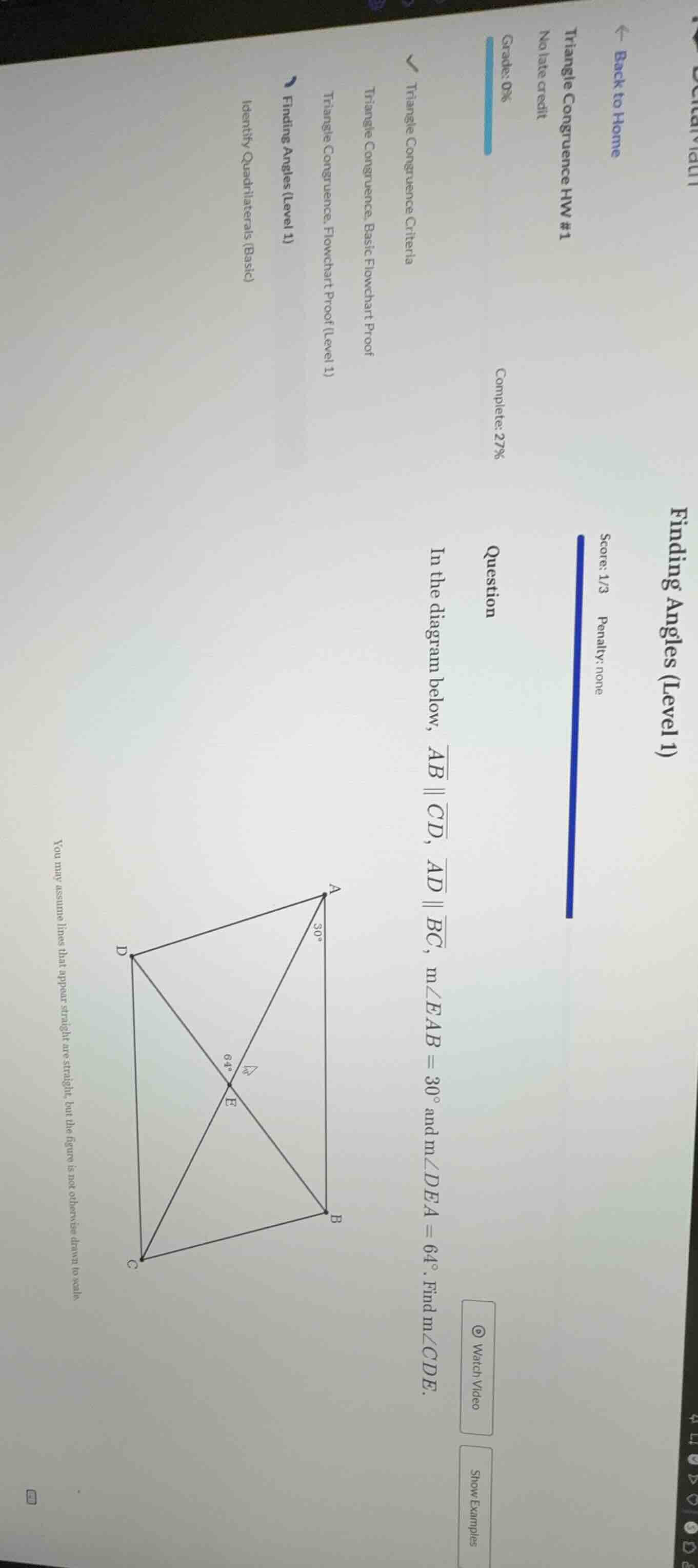
in the diagram below, \\(\overline{ab} \parallel \overline{cd}\\), \\(\overline{ad} \parallel \overline{bc}\\), \\(m\angle eab = 30^\circ\\) and \\(m\angle dea = 64^\circ\\). find \\(m\angle cde\\).
(diagram: a quadrilateral with vertices a, b, c, d, diagonals intersecting at e. angle eab is 30 degrees, angle dea is 64 degrees. you may assume lines that appear straight are straight, but the figure is not otherwise drawn to scale.)
Step1: Find $\angle ADE$ in $\triangle ADE$
Sum of angles in a triangle is $180^\circ$.
$$m\angle ADE = 180^\circ - m\angle EAB - m\angle DEA = 180^\circ - 30^\circ - 64^\circ = 86^\circ$$
Step2: Use parallel lines to find $\angle ADC$
Since $\overline{AB} \parallel \overline{CD}$, alternate interior angles are equal: $m\angle ADC = m\angle EAB = 30^\circ$
Step3: Calculate $\angle CDE$
Subtract $\angle ADC$ from $\angle ADE$.
$$m\angle CDE = m\angle ADE - m\angle ADC = 86^\circ - 30^\circ = 56^\circ$$

Snap & solve any problem in the app
Get step-by-step solutions on Sovi AI
Photo-based solutions with guided steps
Explore more problems and detailed explanations
$56^\circ$