QUESTION IMAGE
Question
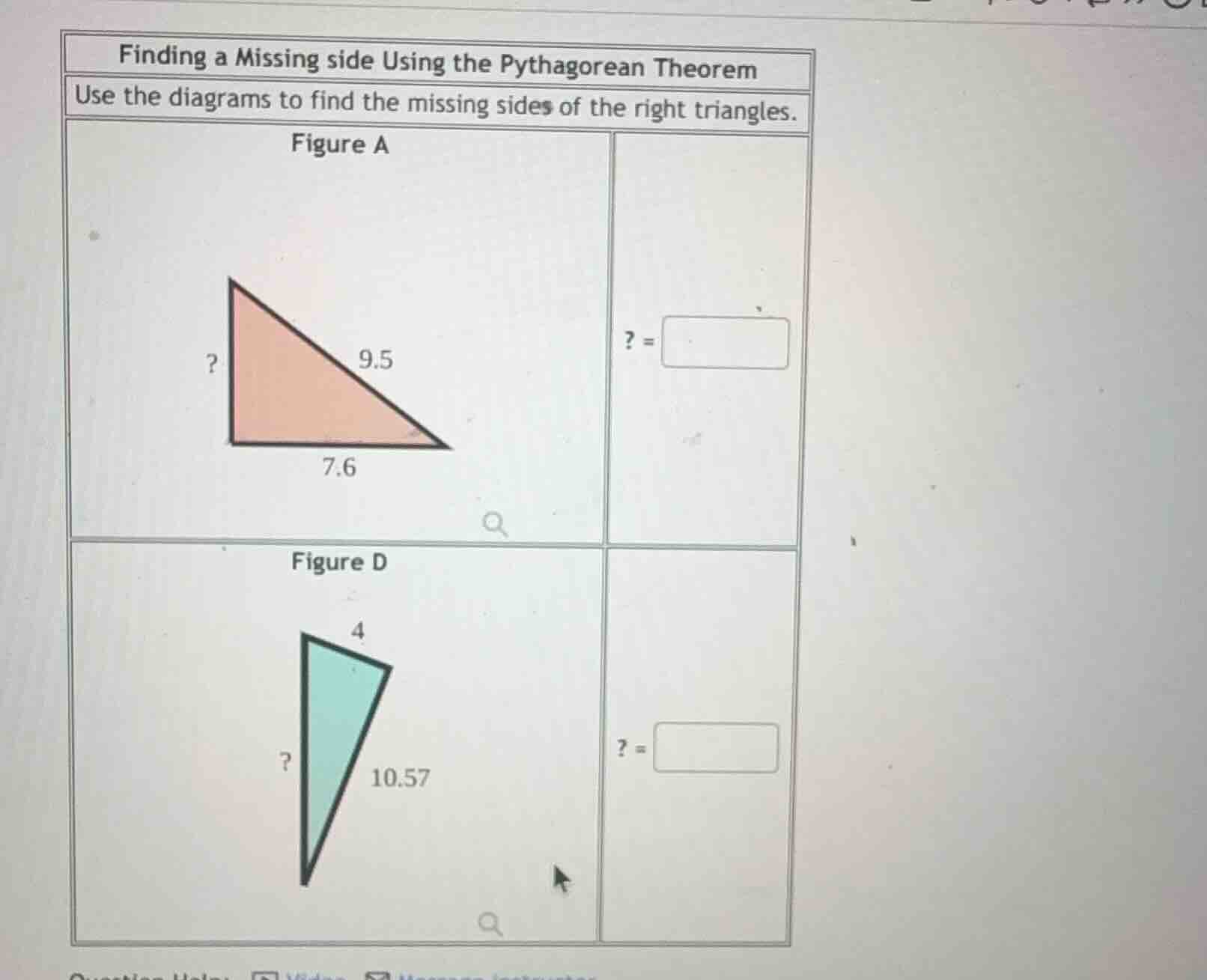
finding a missing side using the pythagorean theorem
use the diagrams to find the missing sides of the right triangles.
figure a
?
9.5
7.6
? =
figure d
?
4
10.57
? =
Step1: Define Pythagorean Theorem
For a right triangle with hypotenuse $c$, and legs $a,b$: $a^2 + b^2 = c^2$
---
For Figure A:
Step2: Assign values to variables
Let $c=9.5$, $b=7.6$, $a=?$
Step3: Rearrange to solve for $a$
$a = \sqrt{c^2 - b^2}$
Step4: Substitute values and calculate
$a = \sqrt{9.5^2 - 7.6^2} = \sqrt{90.25 - 57.76} = \sqrt{32.49}$
Step5: Compute final value for Figure A
$\sqrt{32.49} = 5.7$
---
For Figure D:
Step6: Assign values to variables
Let $c=10.57$, $a=4$, $b=?$
Step7: Rearrange to solve for $b$
$b = \sqrt{c^2 - a^2}$
Step8: Substitute values and calculate
$b = \sqrt{10.57^2 - 4^2} = \sqrt{111.7249 - 16} = \sqrt{95.7249}$
Step9: Compute final value for Figure D
$\sqrt{95.7249} = 9.784$ (rounded to 9.78, or exactly 9.784)

Snap & solve any problem in the app
Get step-by-step solutions on Sovi AI
Photo-based solutions with guided steps
Explore more problems and detailed explanations
Figure A: $5.7$
Figure D: $9.78$ (or $9.784$ for exact value)