QUESTION IMAGE
Question
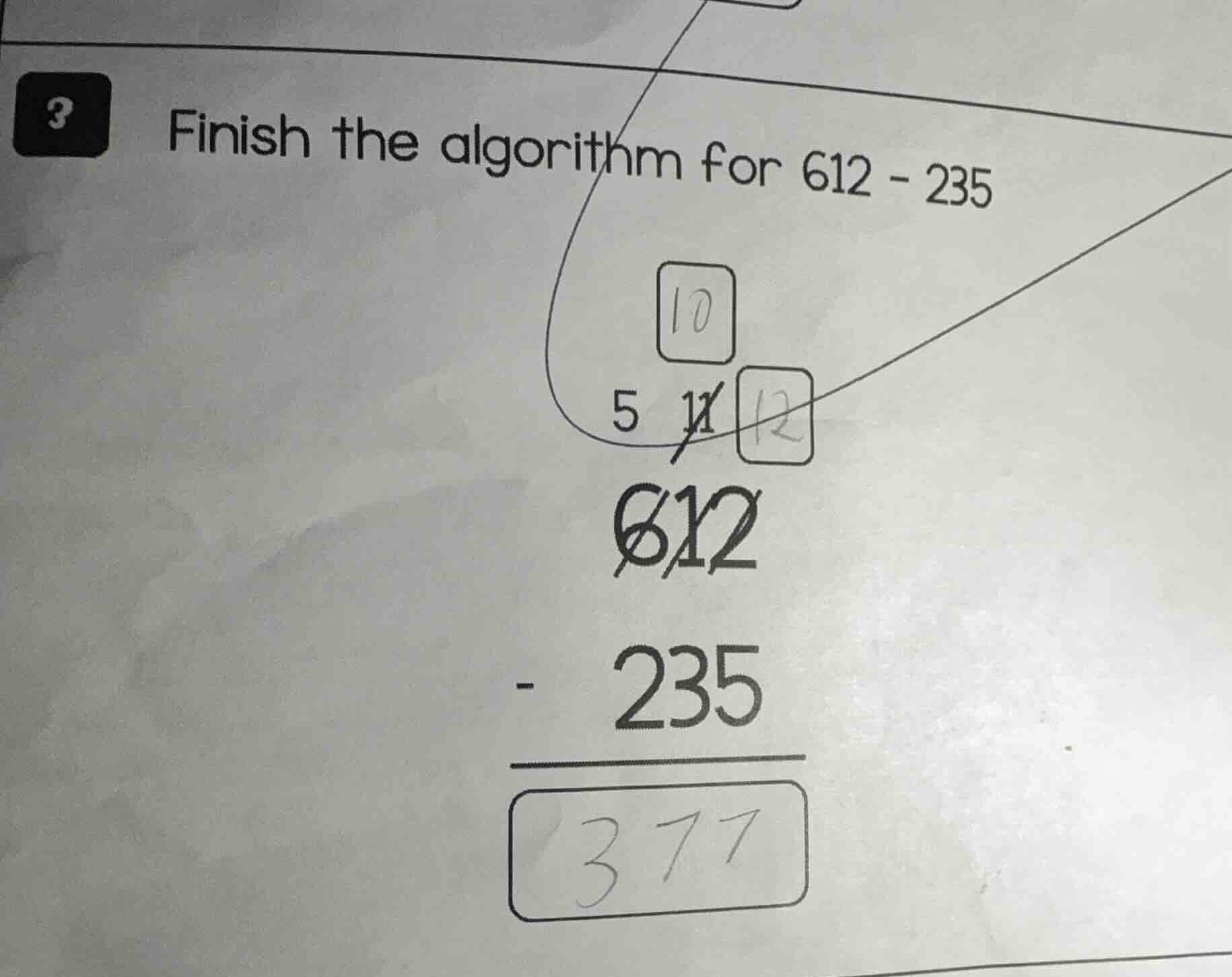
3 finish the algorithm for 612 - 235
Step1: Subtract units place
We can't subtract 5 from 2, so we borrow 1 ten (which is 10 units) from the tens place. Now the units place becomes \(12 - 5 = 7\).
Step2: Subtract tens place
After borrowing, the tens place was 1, but we gave 1 to the units place, so now it's 0. We can't subtract 3 from 0, so we borrow 1 hundred (which is 10 tens) from the hundreds place. Now the tens place becomes \(10 - 3 = 7\) (wait, no, wait: original tens place was 1, after borrowing 1 from hundreds, it becomes 11 tens? Wait, no, let's correct. The original number is 612. Hundreds: 6, Tens: 1, Units: 2. When subtracting 235, units: 2 - 5, can't do, so borrow 1 from tens: tens becomes 0, units becomes 12. Then tens: 0 - 3, can't do, so borrow 1 from hundreds: hundreds becomes 5, tens becomes 10. Wait, but in the diagram, it's shown as 5 (hundreds), 11 (tens), 12 (units). Oh, maybe the borrowing is from hundreds to tens first? Wait, maybe the algorithm is:
Hundreds: 6, we borrow 1 to make tens 11 (since 1 hundred = 10 tens, so 10 + 1 = 11 tens), then tens borrow 1 to units, making units 12. So:
Units: \(12 - 5 = 7\)
Tens: \(11 - 3 = 8\)? Wait, no, the diagram has 11 and 12. Wait, maybe the calculation is:
612 - 235:
- Units: 2 < 5, so borrow 1 from tens (but tens is 1, so we need to borrow from hundreds. So hundreds: 6 becomes 5, tens: 1 becomes 11 (because 1 hundred = 10 tens, so 10 + 1 = 11 tens), then units: 2 becomes 12 (because 1 ten = 10 units, so 10 + 2 = 12 units).
Now units: \(12 - 5 = 7\)
Tens: \(11 - 3 = 8\)
Hundreds: \(5 - 2 = 3\)
Wait, but the answer in the box is 377, which would be if tens was 7. Wait, maybe I made a mistake. Wait 612 - 235:
Let's do standard subtraction:
6 1 2
- 2 3 5
--------
Units: 2 - 5: can't, borrow from tens: tens 1 becomes 0, units 12. 12 - 5 = 7.
Tens: 0 - 3: can't, borrow from hundreds: hundreds 6 becomes 5, tens 0 becomes 10. 10 - 3 = 7.
Hundreds: 5 - 2 = 3.
Ah! There we go. So:
Units: \(12 - 5 = 7\)
Tens: \(10 - 3 = 7\) (wait, but after borrowing from hundreds, tens is 10, because we borrowed 1 hundred (10 tens) to tens place (which was 0 after borrowing to units). So:
Hundreds: 6 - 1 = 5
Tens: 0 + 10 = 10, then subtract 3: 10 - 3 = 7
Units: 2 + 10 = 12, subtract 5: 12 - 5 = 7
So 5 (hundreds) 100 + 7 (tens) 10 + 7 (units) = 500 + 70 + 7 = 577? Wait, no, 5100=500, 710=70, 7*1=7: 500+70+7=577? But 612 - 235 is 377. Oh! Wait, I messed up the hundreds place. 6 - 2 is 4, but with borrowing:
Wait, correct standard subtraction:
6 1 2
- 2 3 5
--------
Start from units: 2 - 5. Can't do. Borrow 1 from tens: tens becomes 0, units becomes 12. 12 - 5 = 7.
Tens: 0 - 3. Can't do. Borrow 1 from hundreds: hundreds becomes 5, tens becomes 10. 10 - 3 = 7.
Hundreds: 5 - 2 = 3.
So total: 3 (hundreds) 100 + 7 (tens) 10 + 7 (units) = 300 + 70 + 7 = 377.
Ah, there we go. So the steps are:
- Units: 12 - 5 = 7
- Tens: 10 - 3 = 7 (after borrowing from hundreds, tens is 10, because we borrowed 1 hundred (10 tens) to the tens place which was 0 after borrowing to units)
- Hundreds: 5 - 2 = 3
So putting it together: 3 (hundreds) + 7 (tens) + 7 (units) = 377.

Snap & solve any problem in the app
Get step-by-step solutions on Sovi AI
Photo-based solutions with guided steps
Explore more problems and detailed explanations
377