QUESTION IMAGE
Question
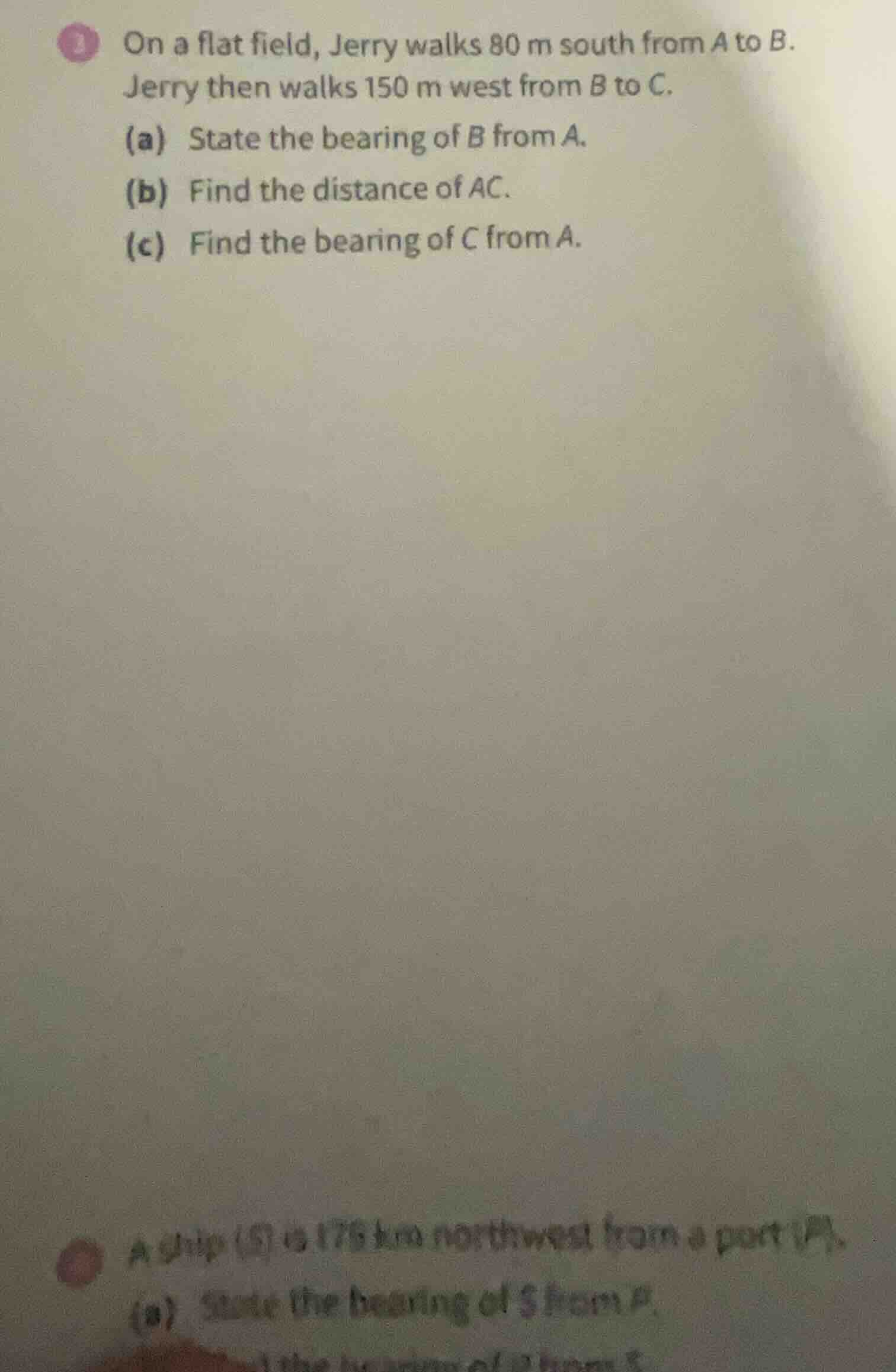
on a flat field, jerry walks 80 m south from a to b. jerry then walks 150 m west from b to c. (a) state the bearing of b from a. (b) find the distance of ac. (c) find the bearing of c from a.
Part (a)
Bearing is measured clockwise from north. Since Jerry walks south from A to B, the bearing of B from A is \(180^\circ\) (or S, but in standard bearing notation, it's \(180^\circ\)).
Step 1: Identify the triangle type
The path from A to B to C forms a right - angled triangle, with \(AB = 80\space m\) (vertical side, south direction) and \(BC=150\space m\) (horizontal side, west direction). We can use the Pythagorean theorem to find \(AC\). The Pythagorean theorem states that for a right - angled triangle with legs \(a\) and \(b\) and hypotenuse \(c\), \(c=\sqrt{a^{2}+b^{2}}\). Here, \(a = 80\) and \(b = 150\).
Step 2: Apply the Pythagorean theorem
First, calculate \(a^{2}+b^{2}\):
\(a^{2}=80^{2}=6400\)
\(b^{2}=150^{2}=22500\)
\(a^{2}+b^{2}=6400 + 22500=28900\)
Then, find the square root of \(28900\):
\(AC=\sqrt{28900}\)
Since \(170\times170 = 28900\), \(\sqrt{28900}=170\)
Step 1: Find the angle \(\theta\)
We know that in the right - angled triangle \(ABC\), \(\tan\theta=\frac{BC}{AB}\), where \(\theta\) is the angle between the south direction and the line \(AC\) (measured from A).
We have \(AB = 80\space m\) and \(BC = 150\space m\). So \(\tan\theta=\frac{150}{80}=\frac{15}{8}=1.875\)
Step 2: Calculate the angle \(\theta\)
Using the arctangent function, \(\theta=\arctan(1.875)\). We know that \(\arctan(1.875)\approx61.93^\circ\)
Step 3: Determine the bearing
The bearing of C from A is measured clockwise from north. The south direction is \(180^\circ\) from north. We need to find the bearing by adding the angle \(\theta\) to the south - west direction. The bearing is \(180^\circ+ (90^\circ - 61.93^\circ)\)? Wait, no. Let's re - think. The triangle is right - angled at B. So from point A, the line AC makes an angle \(\theta\) with the south direction towards the west. So the bearing is \(180^\circ+\theta\)? No, wait. The standard bearing is measured from north. So the angle between north and the line AC: the south direction is \(180^\circ\) from north. The angle between south and AC is \(\theta=\arctan(\frac{150}{80})\approx61.93^\circ\) west of south. So to get the bearing from north, we go \(180^\circ - 61.93^\circ\)? No, no. Let's use the correct method.
The bearing is calculated as follows: The angle between the south line (from A) and AC is \(\alpha=\arctan(\frac{BC}{AB})=\arctan(\frac{150}{80})\approx61.93^\circ\) (west of south). So the bearing from A to C is \(180^\circ+ (90^\circ - 61.93^\circ)\)? No, let's use the formula for bearing. The bearing is \(180^\circ+\theta\), where \(\theta\) is the angle between the south and AC towards west. Wait, actually, in terms of 3 - figure bearing:
We know that in triangle \(ABC\), \(\tan\theta=\frac{BC}{AB}=\frac{150}{80}=1.875\), so \(\theta=\arctan(1.875)\approx61.93^\circ\)
The bearing of C from A: we start at north, turn clockwise. The direction from A to C is south - west of some angle. The angle between the south direction and AC is \(\theta\approx61.93^\circ\) west of south. So the bearing is \(180^\circ+\theta\)? No, the correct way is:
The bearing is \(180^\circ+\ (90^\circ-\theta)\)? No, let's calculate the angle from north. The south is \(180^\circ\) from north. The angle between north and AC: the line AC is in the third quadrant (south - west). The angle between north and the negative y - axis (south) is \(180^\circ\). The angle between the negative y - axis (south) and AC is \(\theta=\arctan(\frac{150}{80})\approx61.93^\circ\) towards the negative x - axis (west). So the total bearing from north is \(180^\circ+\ (90^\circ - 61.93^\circ)\)? No, I think I made a mistake. Let's use the formula for bearing in a right - angled triangle.
The bearing of C from A is \(180^\circ+\arctan(\frac{AB}{BC})\)? No, \(AB = 80\), \(BC = 150\). \(\tan\theta=\frac{AB}{BC}=\frac{80}{150}=\frac{8}{15}\approx0.533\), so \(\theta=\arctan(\frac{8}{15})\approx28.07^\circ\). Wait, now I'm confused. Let's use the correct trigonometry.
In right - triangle \(ABC\), right - angled at B. So angle at A: \(\angle BAC\), \(\tan(\angle BAC)=\frac{BC}{AB}=\frac{150}{80}=\frac{15}{8}\), so \(\angle BAC=\arctan(\frac{15}{8})\approx61.93^\circ\)
The bearing of C from A: we measure clockwise from north. The line AB is south (180 degrees from north). The angle between AB and AC is \(\angle BAC\approx61.93^\circ\) towards the west. So the bearing is \(180^\circ - 61.93^\circ\)? No, that would be towards the east of south, which is wrong. Wait, no. The direction from A…

Snap & solve any problem in the app
Get step-by-step solutions on Sovi AI
Photo-based solutions with guided steps
Explore more problems and detailed explanations
The bearing of B from A is \(180^\circ\) (or "south" in non - standard bearing terms, but the standard 3 - figure bearing is \(180^\circ\)).