QUESTION IMAGE
Question
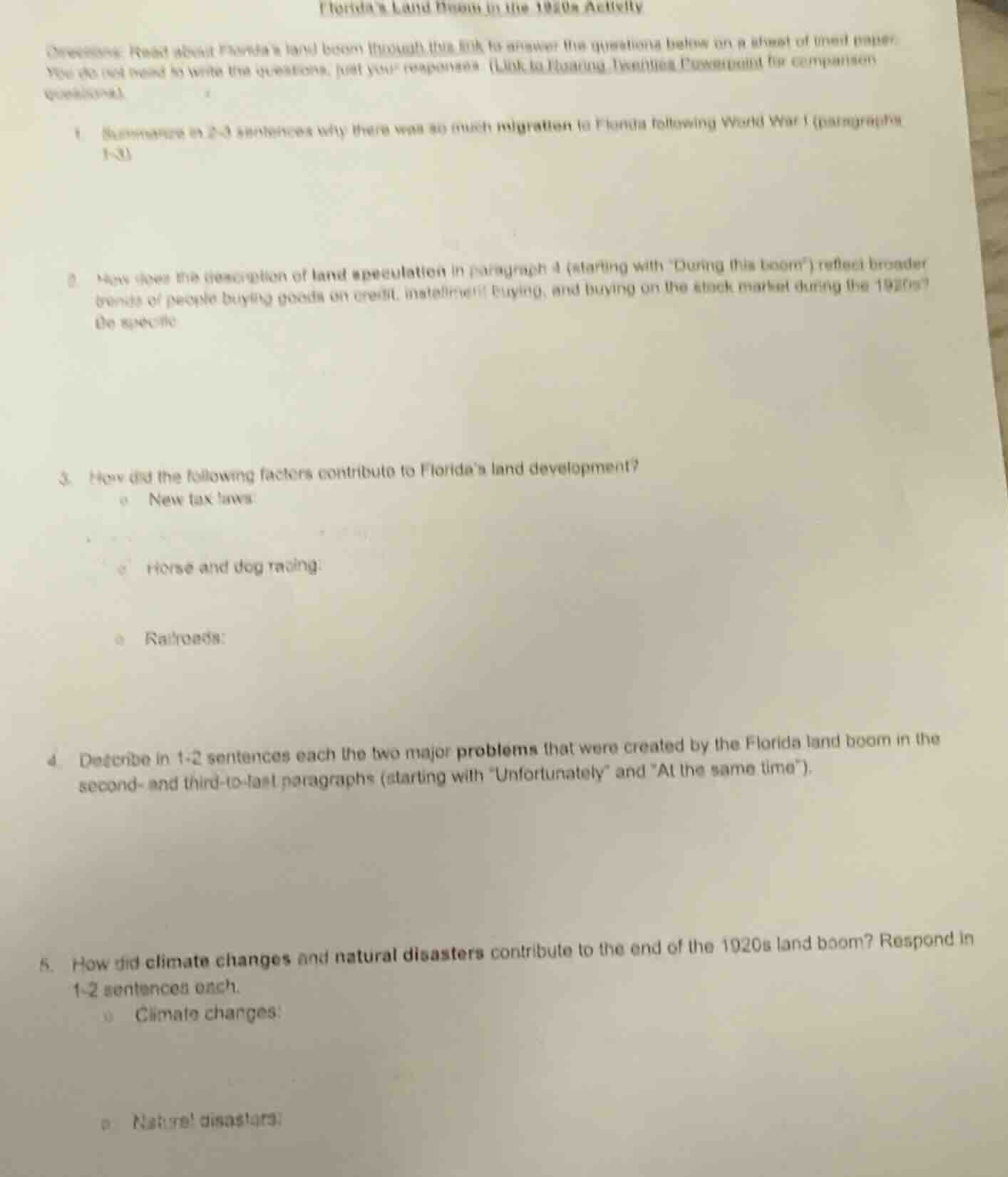
florida’s land boom in the 1920s activity
directions: read about florida’s land boom through the link to answer the questions below on a sheet of lined paper. you do not need to write the questions, just your responses. (link to florida’s land boom for companion questions!)
- summarize in 2 - 3 sentences why there was so much migration to florida following world war i (paragraphs 1 - 3)
- how does the description of land speculation in paragraph 4 (starting with “during this boom”) reflect broader trends of people buying goods on credit, installment buying, and buying on the stock market during the 1920s? be specific.
- how did the following factors contribute to florida’s land development?
- new tax laws:
- horse and dog racing:
- railroads:
- describe in 1 - 2 sentences each the two major problems that were created by the florida land boom in the second - and third - to - last paragraphs (starting with “unfortunately” and “at the same time”).
- how did climate changes and natural disasters contribute to the end of the 1920s land boom? respond in 1 - 2 sentences each.
- climate changes:
- natural disasters:
To answer these questions, we would need access to the linked resource (about Florida's land boom) to gather the necessary information. Since the link and its content are not provided here, I can offer general guidance on how to approach each question based on typical knowledge of Florida's 1920s land boom:
Question 1: Migration to Florida after WWI
After WWI, many Americans sought warmer climates, new economic opportunities (like land speculation), and a break from post - war hardships. Florida’s mild winters, growing tourism industry, and land development projects attracted people looking for a better quality of life or investment prospects.
Question 2: Land Speculation and 1920s Consumer Trends
In the 1920s, consumer culture emphasized buying on credit (including installment plans) and speculative investing (like in the stock market). Land speculation in Florida mirrored this: people bought land with little cash down, hoping to sell it at a profit later (similar to buying stocks on margin or goods on credit, as they relied on future gains rather than immediate ability to pay).
Question 3: Factors in Florida’s Land Development
- New tax laws: Likely reduced taxes on real estate or income, making Florida more attractive for investors and new residents (increasing demand for land).
- Horse and dog racing: These sports drew tourists and wealthy investors, boosting local economies and creating demand for land (for tracks, resorts, housing for visitors).
- Railroads: Expanded rail networks made Florida more accessible, reducing travel time/cost, which spurred migration and land development (especially in areas connected by rail).
Question 4: Problems from the Land Boom
- From the “Unfortunately” paragraph: Likely issues like fraudulent land sales (selling swampland as prime real estate) or overdevelopment (unplanned construction leading to infrastructure strain).
- From the “At the same time” paragraph: Possibly a housing bubble, where supply outpaced demand, or financial instability as speculation drove land prices to unsustainable levels.
Question 5: Climate and Disasters Ending the Boom
- Climate changes: A cooler, wetter climate might have reduced Florida’s appeal as a “tropical paradise,” lowering demand for vacation homes/land.
- Natural disasters: Hurricanes (like the 1926 Miami hurricane) damaged property, destroyed infrastructure, and scared away investors/tourists, collapsing land values.
To provide precise answers, you should analyze the specific paragraphs mentioned in the activity (e.g., paragraphs 1 - 3 for Question 1, the “During this boom” paragraph for Question 2, etc.) from the linked resource. If you can share key details from the link, I can help refine these responses further.

Snap & solve any problem in the app
Get step-by-step solutions on Sovi AI
Photo-based solutions with guided steps
Explore more problems and detailed explanations
To answer these questions, we would need access to the linked resource (about Florida's land boom) to gather the necessary information. Since the link and its content are not provided here, I can offer general guidance on how to approach each question based on typical knowledge of Florida's 1920s land boom:
Question 1: Migration to Florida after WWI
After WWI, many Americans sought warmer climates, new economic opportunities (like land speculation), and a break from post - war hardships. Florida’s mild winters, growing tourism industry, and land development projects attracted people looking for a better quality of life or investment prospects.
Question 2: Land Speculation and 1920s Consumer Trends
In the 1920s, consumer culture emphasized buying on credit (including installment plans) and speculative investing (like in the stock market). Land speculation in Florida mirrored this: people bought land with little cash down, hoping to sell it at a profit later (similar to buying stocks on margin or goods on credit, as they relied on future gains rather than immediate ability to pay).
Question 3: Factors in Florida’s Land Development
- New tax laws: Likely reduced taxes on real estate or income, making Florida more attractive for investors and new residents (increasing demand for land).
- Horse and dog racing: These sports drew tourists and wealthy investors, boosting local economies and creating demand for land (for tracks, resorts, housing for visitors).
- Railroads: Expanded rail networks made Florida more accessible, reducing travel time/cost, which spurred migration and land development (especially in areas connected by rail).
Question 4: Problems from the Land Boom
- From the “Unfortunately” paragraph: Likely issues like fraudulent land sales (selling swampland as prime real estate) or overdevelopment (unplanned construction leading to infrastructure strain).
- From the “At the same time” paragraph: Possibly a housing bubble, where supply outpaced demand, or financial instability as speculation drove land prices to unsustainable levels.
Question 5: Climate and Disasters Ending the Boom
- Climate changes: A cooler, wetter climate might have reduced Florida’s appeal as a “tropical paradise,” lowering demand for vacation homes/land.
- Natural disasters: Hurricanes (like the 1926 Miami hurricane) damaged property, destroyed infrastructure, and scared away investors/tourists, collapsing land values.
To provide precise answers, you should analyze the specific paragraphs mentioned in the activity (e.g., paragraphs 1 - 3 for Question 1, the “During this boom” paragraph for Question 2, etc.) from the linked resource. If you can share key details from the link, I can help refine these responses further.