QUESTION IMAGE
Question
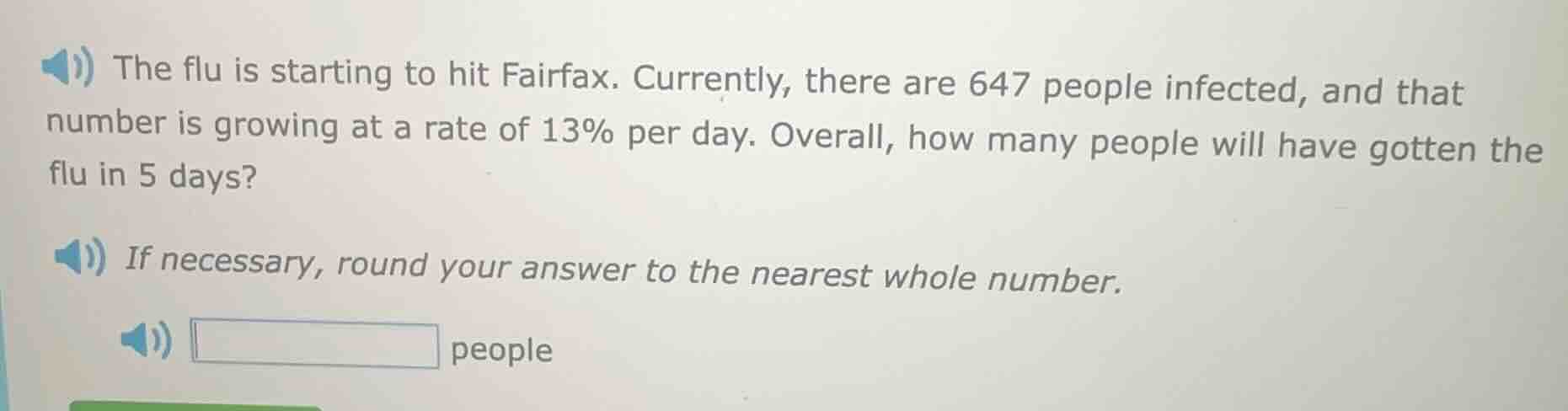
the flu is starting to hit fairfax. currently, there are 647 people infected, and that number is growing at a rate of 13% per day. overall, how many people will have gotten the flu in 5 days? if necessary, round your answer to the nearest whole number. people
Step1: Identify the formula for exponential growth
The formula for exponential growth is \( A = P(1 + r)^t \), where \( P \) is the initial amount, \( r \) is the growth rate (in decimal), \( t \) is the time, and \( A \) is the amount after time \( t \).
Here, \( P = 647 \), \( r = 0.13 \) (since 13% = 0.13), and \( t = 5 \).
Step2: Substitute the values into the formula
Substitute \( P = 647 \), \( r = 0.13 \), and \( t = 5 \) into the formula:
\( A = 647(1 + 0.13)^5 \)
First, calculate \( 1 + 0.13 = 1.13 \).
Then, calculate \( 1.13^5 \). Let's compute that:
\( 1.13^2 = 1.2769 \)
\( 1.13^3 = 1.2769 \times 1.13 = 1.442897 \)
\( 1.13^4 = 1.442897 \times 1.13 = 1.63047361 \)
\( 1.13^5 = 1.63047361 \times 1.13 \approx 1.8424351793 \)
Step3: Multiply by the initial amount
Now, multiply \( 647 \) by \( 1.8424351793 \):
\( 647 \times 1.8424351793 \approx 647 \times 1.8424 \)
Calculate \( 647 \times 1.8424 \):
\( 600 \times 1.8424 = 1105.44 \)
\( 47 \times 1.8424 = 86.5928 \)
Add them together: \( 1105.44 + 86.5928 = 1192.0328 \)
Rounding to the nearest whole number, we get \( 1192 \). Wait, but let's do the multiplication more accurately:
\( 647 \times 1.8424351793 = 647 \times 1.8424351793 \)
Calculate \( 1.8424351793 \times 647 \):
\( 1.8424351793 \times 600 = 1105.46110758 \)
\( 1.8424351793 \times 40 = 73.697407172 \)
\( 1.8424351793 \times 7 = 12.8970462551 \)
Add them: \( 1105.46110758 + 73.697407172 = 1179.15851475 + 12.8970462551 = 1192.05556101 \)
So, rounding to the nearest whole number, it's \( 1192 \)? Wait, no, wait, maybe I made a mistake in the exponent calculation. Wait, let's use a calculator for \( 1.13^5 \):
\( 1.13^5 = e^{5 \ln(1.13)} \approx e^{5 \times 0.122276394} \approx e^{0.61138197} \approx 1.842435 \)
Then \( 647 \times 1.842435 = 647 \times 1.842435 \)
Let's do \( 647 \times 1.842435 \):
\( 647 \times 1 = 647 \)
\( 647 \times 0.8 = 517.6 \)
\( 647 \times 0.04 = 25.88 \)
\( 647 \times 0.002435 = 647 \times 0.002 + 647 \times 0.000435 = 1.294 + 0.281445 = 1.575445 \)
Add them: \( 647 + 517.6 = 1164.6 + 25.88 = 1190.48 + 1.575445 = 1192.055445 \)
So, rounding to the nearest whole number, it's \( 1192 \). Wait, but let's check with a calculator:
\( 647*(1.13)^5 \)
First, \( 1.13^5 = 1.13*1.13=1.2769; 1.2769*1.13=1.442897; 1.442897*1.13=1.63047361; 1.63047361*1.13=1.8424351793 \)
Then \( 647*1.8424351793 = 647*1.8424351793 \approx 1192.055 \), so rounded to the nearest whole number is \( 1192 \). Wait, but maybe I miscalculated. Wait, let's do 647*1.842435:
647 * 1.842435:
1.842435 * 600 = 1105.461
1.842435 * 40 = 73.6974
1.842435 * 7 = 12.897045
Sum: 1105.461 + 73.6974 = 1179.1584 + 12.897045 = 1192.055445, so yes, 1192.
Wait, but let's check with another approach. Maybe the formula is correct. The initial number is 647, growing at 13% per day, so each day it's 1.13 times the previous day. So after 1 day: 647*1.13 = 731.11
After 2 days: 731.11*1.13 = 826.1543
After 3 days: 826.1543*1.13 = 933.554359
After 4 days: 933.554359*1.13 = 1054.91642567
After 5 days: 1054.91642567*1.13 = 1192.05556091
Ah, there we go. So after 5 days, it's approximately 1192.055, which rounds to 1192. Wait, but wait, the problem says "overall, how many people will have gotten the flu in 5 days". Wait, is it the total number, or the number on day 5? Wait, the problem says "currently, there are 647 people infected, and that number is growing at a rate of 13% per day. Overall, how many people will have gotten the flu in 5 days?" Wait, maybe it's the total number, but actually, in exponential growth, the formula \( A = P(…

Snap & solve any problem in the app
Get step-by-step solutions on Sovi AI
Photo-based solutions with guided steps
Explore more problems and detailed explanations
1192