QUESTION IMAGE
Question
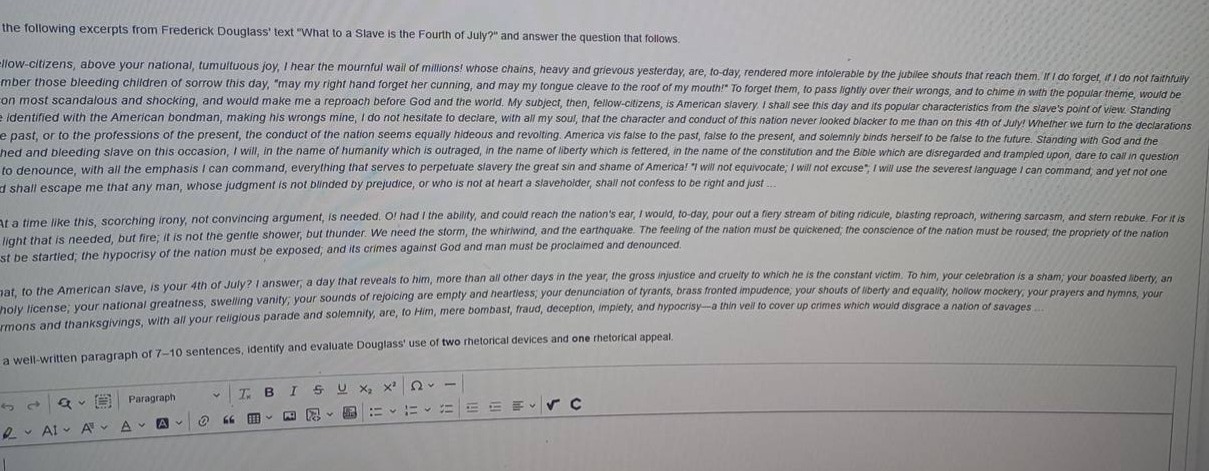
the following excerpts from frederick douglass text \what to a slave is the fourth of july?\ and answer the question that follows.
low - citizens, above your national, tumultuous joy, i hear the mournful wail of millions! whose chains, heavy and grievous yesterday, are, to - day, rendered more intolerable by the jubilee shouts that reach them. if i do forget, if i do not faithfully member those bleeding children of sorrow this day, \may my right hand forget her cunning, and my tongue cleave to the roof of my mouth!\ to forget them, to pass lightly over their wrongs, and to chime in with the popular theme, would be on most scandalous and shocking, and would make me a reproach before god and the world. my subject, then, fellow - citizens, is american slavery. i shall see this day and its popular characteristics from the slaves point of view. standing, identified with the american bondman, making his wrongs mine, i do not hesitate to declare, with all my soul, that the character and conduct of this nation never looked blacker to me than on this 4th of july! whether we turn to the declarations past, or to the professions of the present, the conduct of the nation seems equally hideous and revolting. america is false to the past, false to the present, and solemnly binds herself to be false to the future. standing with god and the hed and bleeding slave on this occasion, i will, in the name of humanity which is outraged, in the name of liberty which is fettered, in the name of the constitution and the bible which are disregarded and trampled upon, dare to call in question and to denounce, with all the emphasis i can command, everything that serves to perpetuate slavery—the great sin and shame of america! \i will not equivocate, i will not excuse\; i will use the severest language i can command, and yet not one shall escape me all that any man, whose judgment is not blinded by prejudice, or who is not at heart a slaveholder, shall not confess to be right and just...
at a time like this, scorching irony, not convincing argument, is needed. oh! had i the ability, and could reach the nations ear, i would, to - day, pour out a fiery stream of biting ridicule, blasting reproach, withering sarcasm, and stern rebuke. for it is light that is needed, but fire; it is not the gentle shower, but thunder. we need the storm, the whirlwind, and the earthquake. the feeling of the nation must be quickened; the conscience of the nation must be roused; the property of the nation st be startled; the hypocrisy of the nation must be exposed; and its crimes against god and man must be proclaimed and denounced.
hat, to the american slave, is your 4th of july? i answer, a day that reveals to him, more than all other days in the year, the gross injustice and cruelty to which he is the constant victim. to him, your celebration is a sham; your boasted liberty, an holy license; your national greatness, your sounds of rejoicing are empty and heartless; your denunciation of tyrants, brass - fronted impudence; your shouts of liberty and equality, hollow mockery; your prayers and hymns, your mons and thanksgivings, with all your religious parade and solemnity, are, to him, mere bombast, fraud, deception, impiety, and hypocrisy—a thin veil to cover up crimes which would disgrace a nation of savages...
in a well - written paragraph of 7–10 sentences, identify and evaluate douglass use of two rhetorical devices and one rhetorical appeal.
Para evaluar el uso de dos dispositivos retóricos y un recurso retórico en el texto de Frederick Douglass, primero identificamos: 1) Ironía (ejemplo: "To him, your celebration is a sham; your boasted liberty, an unholy license..."): la celebración del 4 de julio para los esclavos es farsa, ya que su "libertad" es hipócrita. 2) Sarcasmo (ejemplo: "your shouts of liberty and equality, hollow mockery"): usa lenguaje mordaz para mostrar la hipocresía de la nación. 3) Recurso Ético (Ethos): Al invocar "humanity", "liberty", "constitution" y "Bible", Douglass establece credibilidad, asociándose con valores morales y legales para denunciar la esclavitud. La ironía destaca la incongruencia entre la retórica de libertad y la realidad esclavista; el sarcasmo intensifica la crítica, despertando conciencia. El ethos legitima su argumento, uniendo justicia moral y legal.

Snap & solve any problem in the app
Get step-by-step solutions on Sovi AI
Photo-based solutions with guided steps
Explore more problems and detailed explanations
Frederick Douglass utiliza ironía (ejemplo: "To him, your celebration is a sham; your boasted liberty, an unholy license..."), mostrando la farsa de la celebración del 4 de julio para los esclavos, ya que la "libertad" nacional niega su humanidad. También usa sarcasmo (ejemplo: "your shouts of liberty and equality, hollow mockery"), con lenguaje mordaz para exponer la hipocresía de una nación que proclama libertad pero mantiene la esclavitud. Como recurso retórico, el ethos (invocación de "humanity", "liberty", "constitution" y "Bible") otorga credibilidad, asociándose con valores morales/legales para denunciar la injusticia. La ironía destaca la incongruencia entre retórica y realidad; el sarcasmo intensifica la crítica, despertando conciencia. El ethos legitima su argumento, uniendo justicia moral y legal para exigir cambio.