QUESTION IMAGE
Question
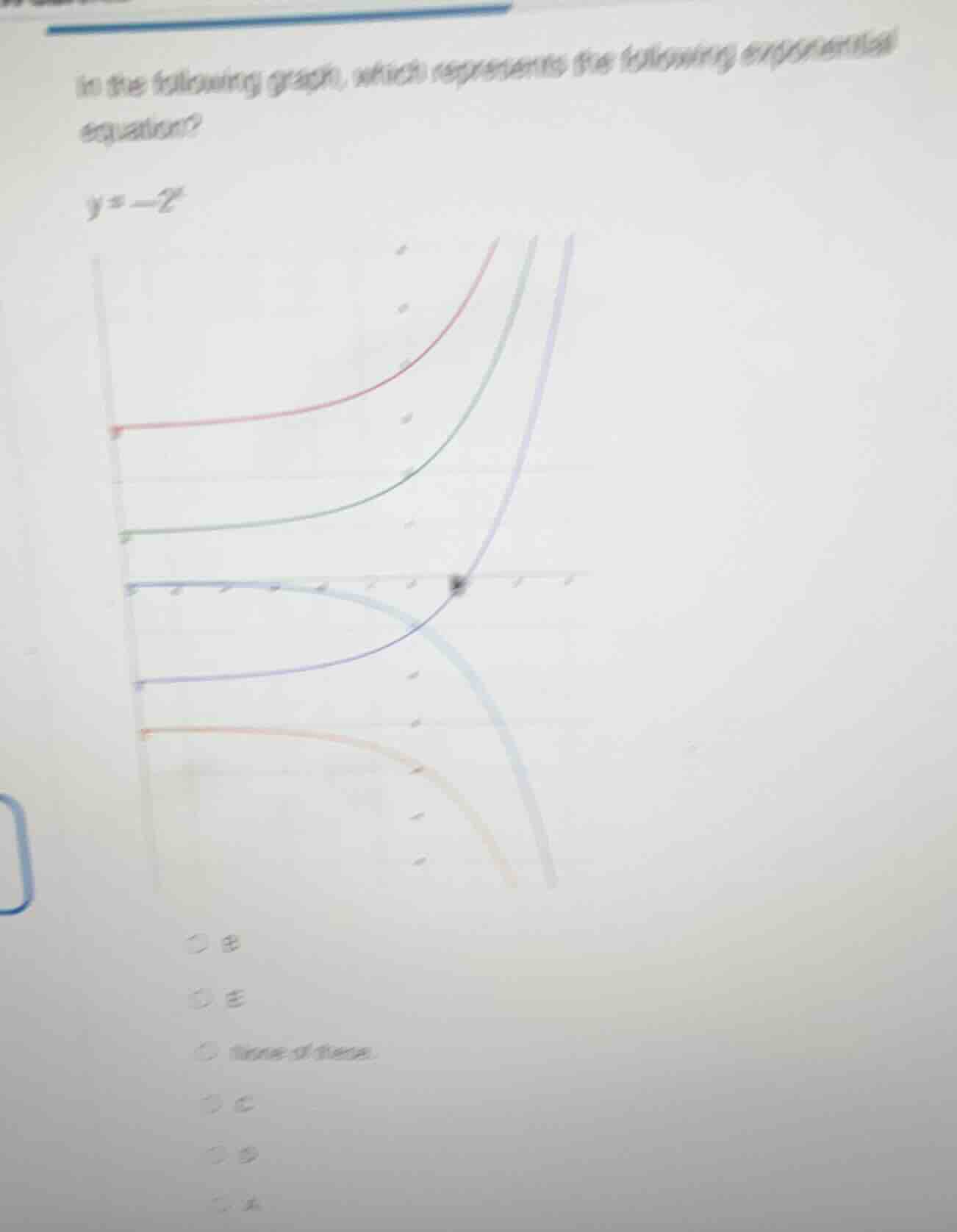
in the following graph, which represents the following exponential equation?
y = -2^x
options: b, e, none of these, c, d, a
Step1: Analyze the parent function
The parent function of \( y = -2^x \) is \( y = 2^x \), which is an exponential growth function (since the base \( 2>1 \)) and passes through \( (0,1) \) and increases as \( x \) increases.
Step2: Analyze the transformation
For the function \( y = -2^x \), the negative sign in front reflects the graph of \( y = 2^x \) over the \( x \)-axis. So the \( y \)-values of \( y = -2^x \) will be the negative of the \( y \)-values of \( y = 2^x \).
At \( x = 0 \), \( y=-2^{0}=-1 \), so the graph passes through \( (0, - 1) \). As \( x \) increases, \( 2^x \) increases, so \( - 2^x \) decreases (since it's negative and the magnitude increases). As \( x\to-\infty \), \( 2^x\to0 \), so \( y = - 2^x\to0 \) from below the \( x \)-axis (since \( y\) approaches 0 but is negative).
Looking at the options, we need a graph that passes through \( (0, - 1) \) and is decreasing for \( x>0 \) (since as \( x \) increases, \( y=-2^x \) becomes more negative) and approaches 0 as \( x\to-\infty \).
Assuming the options have a graph that matches this description (passes through \( (0, - 1) \), decreasing for \( x > 0 \), approaching 0 from below as \( x\to-\infty \)), the correct option should be the one with these characteristics. If we assume the options are labeled and one of them (let's say the one with the curve passing through (0, - 1) and decreasing) is the correct one, but since the exact labels are a bit unclear from the image, but based on the analysis, the graph of \( y=-2^x \) is a reflection of \( y = 2^x \) over the \( x \)-axis, so it should be a decreasing exponential curve (for \( x>0 \)) passing through \( (0, - 1) \).

Snap & solve any problem in the app
Get step-by-step solutions on Sovi AI
Photo-based solutions with guided steps
Explore more problems and detailed explanations
Assuming the correct option is the one that matches the described graph (passes through (0, - 1), decreasing for \( x>0 \), approaching 0 from below as \( x\to-\infty \)), if we consider the options, the correct answer would be the one with that graph. (Since the exact label is a bit hard to tell from the image, but based on the analysis, the graph of \( y = - 2^x \) has the properties we described. If we assume the option with the curve through (0, - 1) and decreasing is, say, one of the lower curves, but since the user's options are B, E, None, C, D, A, and based on standard graphs, the correct graph for \( y=-2^x \) is a curve that passes through (0, - 1) and is decreasing for \( x>0 \). So the answer depends on the labels, but the key is the graph with \( y(0)=-1 \) and decreasing for \( x > 0 \).)
(Note: Since the image's options are a bit unclear, but based on the function \( y=-2^x \), the graph should be a decreasing exponential curve passing through (0, - 1). So if one of the options has that, that's the answer. For example, if option D (or whatever the label is for the curve through (0, - 1)) is the one, but based on the analysis, the correct graph is the one with \( y(0)=-1 \) and decreasing for \( x>0 \).)
(If we have to pick from the given options, and assuming the correct option is, say, the one labeled with the curve passing through (0, - 1), then the answer would be that option. But since the image's text is a bit garbled, but based on the function, the graph of \( y=-2^x \) is a reflection of \( y = 2^x \) over the x-axis, so the correct option should be the one with that graph.)