QUESTION IMAGE
Question
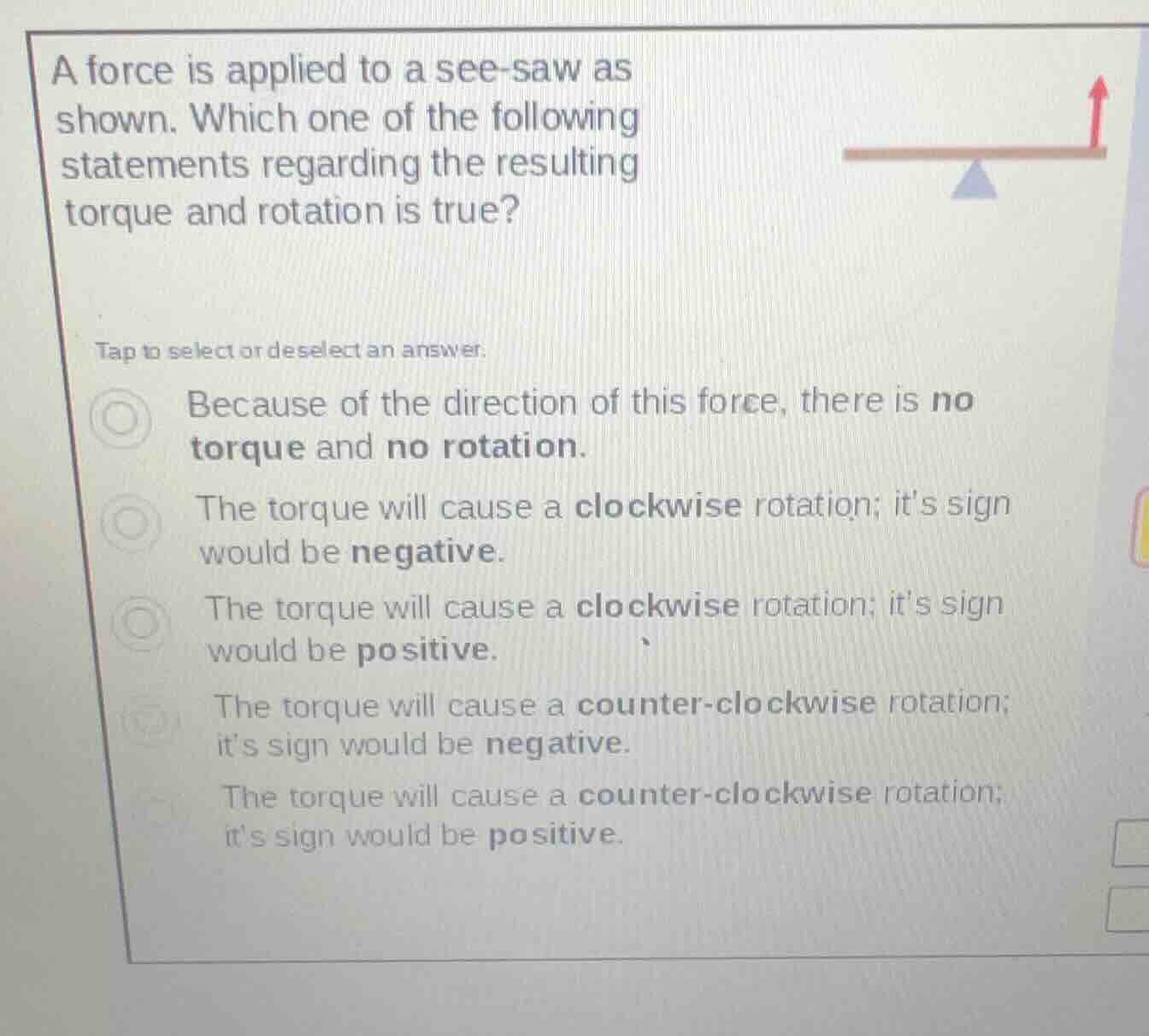
a force is applied to a see - saw as shown. which one of the following statements regarding the resulting torque and rotation is true? tap to select or deselect an answer. because of the direction of this force, there is no torque and no rotation. the torque will cause a clockwise rotation; its sign would be negative. the torque will cause a clockwise rotation; its sign would be positive. the torque will cause a counter - clockwise rotation; its sign would be negative. the torque will cause a counter - clockwise rotation; its sign would be positive.
To determine the torque and rotation, we analyze the force direction relative to the pivot. The force is applied upward at the right end of the see - saw. The lever arm (distance from pivot to force application point) and the force direction: when a force is applied along the line of the lever arm (radial direction), the perpendicular component of the force relative to the lever arm is zero. Torque \(\tau=r\times F = rF\sin\theta\), where \(\theta\) is the angle between \(r\) (position vector from pivot) and \(F\). Here, \(\theta = 0^{\circ}\) (since force is along the lever arm), so \(\sin\theta=0\), meaning torque \(\tau = 0\). If there is no torque, there will be no rotational motion.

Snap & solve any problem in the app
Get step-by-step solutions on Sovi AI
Photo-based solutions with guided steps
Explore more problems and detailed explanations
A. Because of the direction of this force, there is no torque and no rotation.