QUESTION IMAGE
Question
free-response questions
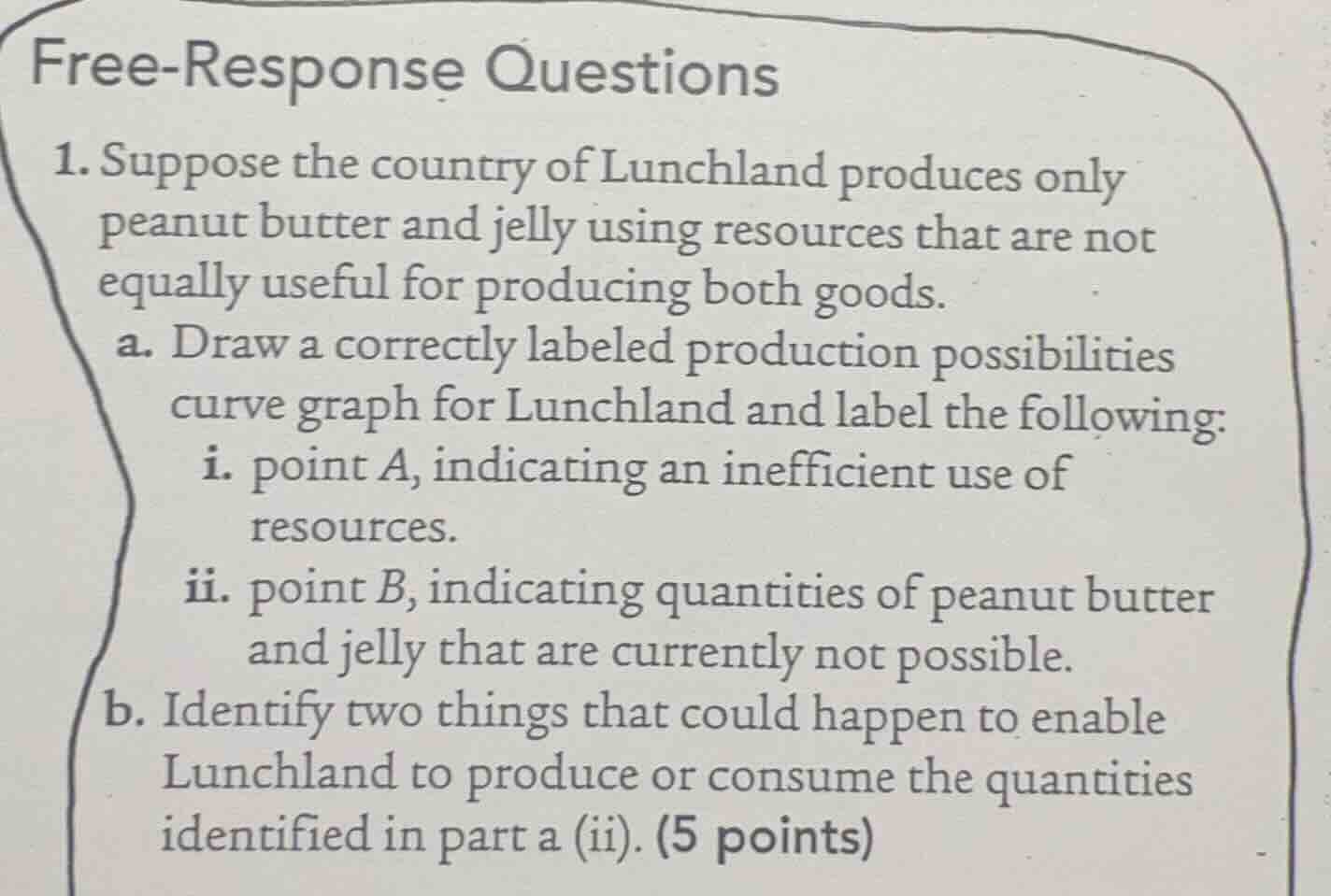
- suppose the country of lunchland produces only peanut butter and jelly using resources that are not equally useful for producing both goods.
a. draw a correctly labeled production possibilities curve graph for lunchland and label the following:
i. point a, indicating an inefficient use of resources.
ii. point b, indicating quantities of peanut butter and jelly that are currently not possible.
b. identify two things that could happen to enable lunchland to produce or consume the quantities identified in part a (ii). (5 points)
Brief Explanations
For part a:
- A production possibilities curve (PPC) for two goods is a downward-sloping, bowed-out curve (bowed out because resources are not equally useful for both goods). The x-axis is labeled "Peanut Butter" and y-axis is labeled "Jelly".
- Point A is located inside the PPC, as points inside represent inefficient resource use where not all resources are fully employed or used optimally.
- Point B is located outside the PPC, as points beyond the curve represent output combinations that are unattainable with current resources and technology.
For part b:
- Technological advancement: Improvements in production technology for either peanut butter, jelly, or both can shift the entire PPC outward, making previously unattainable points (like B) reachable.
- Increase in resources: Adding more resources (such as more labor, land, or capital dedicated to producing these two goods) expands the economy's productive capacity, shifting the PPC outward to cover the once-unattainable output levels.

Snap & solve any problem in the app
Get step-by-step solutions on Sovi AI
Photo-based solutions with guided steps
Explore more problems and detailed explanations
a.
i. (On a bowed-out PPC with x-axis = Peanut Butter, y-axis = Jelly) Point A is inside the PPC curve.
ii. (On the same PPC) Point B is outside the PPC curve.
b.
- Technological advancements in peanut butter/jelly production
- An increase in available production resources (labor, capital, land)