QUESTION IMAGE
Question
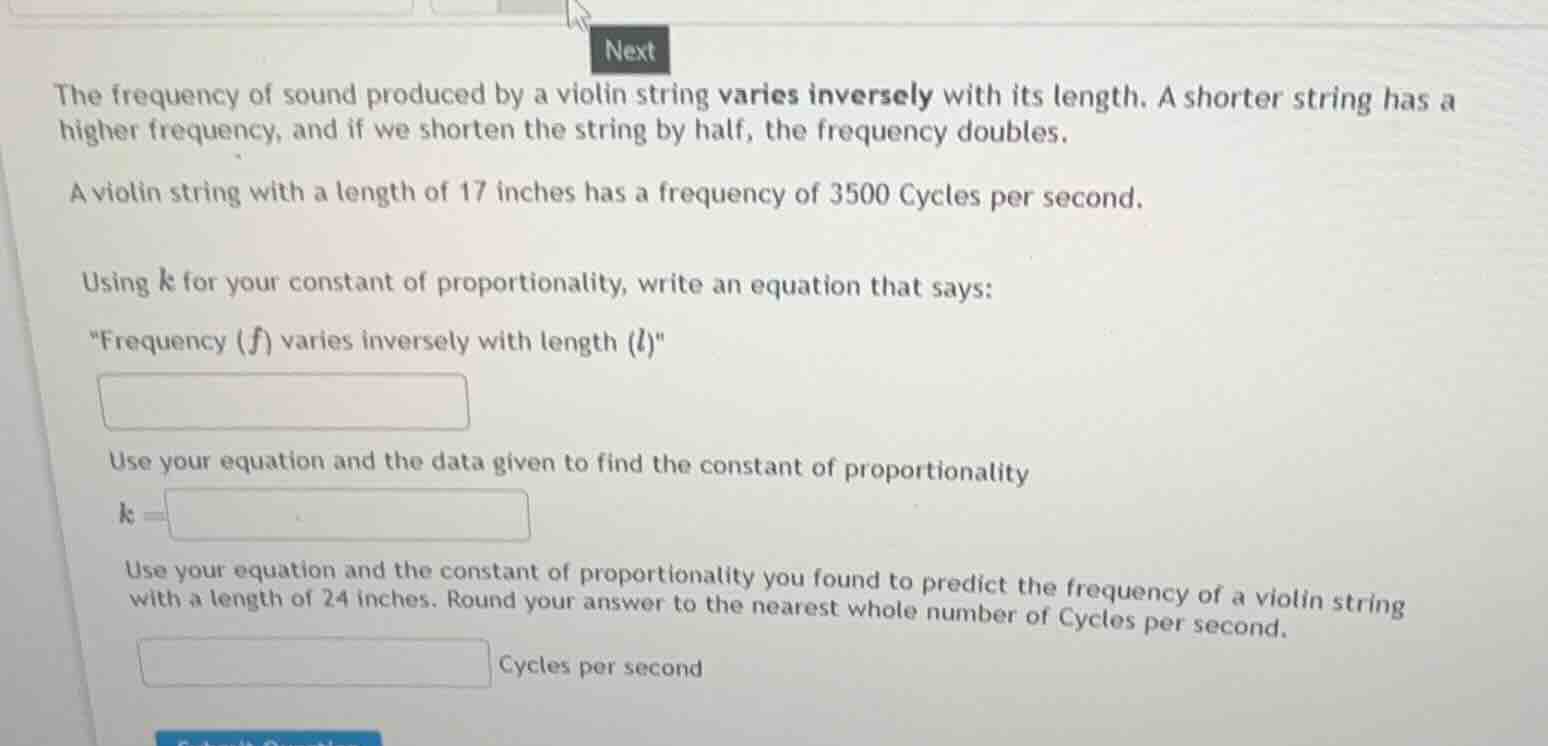
the frequency of sound produced by a violin string varies inversely with its length. a shorter string has a higher frequency, and if we shorten the string by half, the frequency doubles.
a violin string with a length of 17 inches has a frequency of 3500 cycles per second.
using ( k ) for your constant of proportionality, write an equation that says:
\frequency (( f )) varies inversely with length (( l ))\
use your equation and the data given to find the constant of proportionality
( k = )
use your equation and the constant of proportionality you found to predict the frequency of a violin string with a length of 24 inches. round your answer to the nearest whole number of cycles per second.
cycles per second
Step1: Define inverse variation equation
When two quantities vary inversely, their relationship is given by $f = \frac{k}{l}$, where $f$ is frequency, $l$ is length, and $k$ is the constant of proportionality.
Step2: Solve for constant $k$
Substitute $f=3500$ and $l=17$ into the inverse variation equation to solve for $k$.
$k = f \times l = 3500 \times 17$
$k = 59500$
Step3: Calculate frequency for $l=24$
Use the found $k$ and $l=24$ in the inverse variation formula to find $f$.
$f = \frac{k}{l} = \frac{59500}{24} \approx 2479.17$
Round to the nearest whole number: $f \approx 2479$

Snap & solve any problem in the app
Get step-by-step solutions on Sovi AI
Photo-based solutions with guided steps
Explore more problems and detailed explanations
- $f = \frac{k}{l}$
- $k = 59500$
- 2479 Cycles per second