QUESTION IMAGE
Question
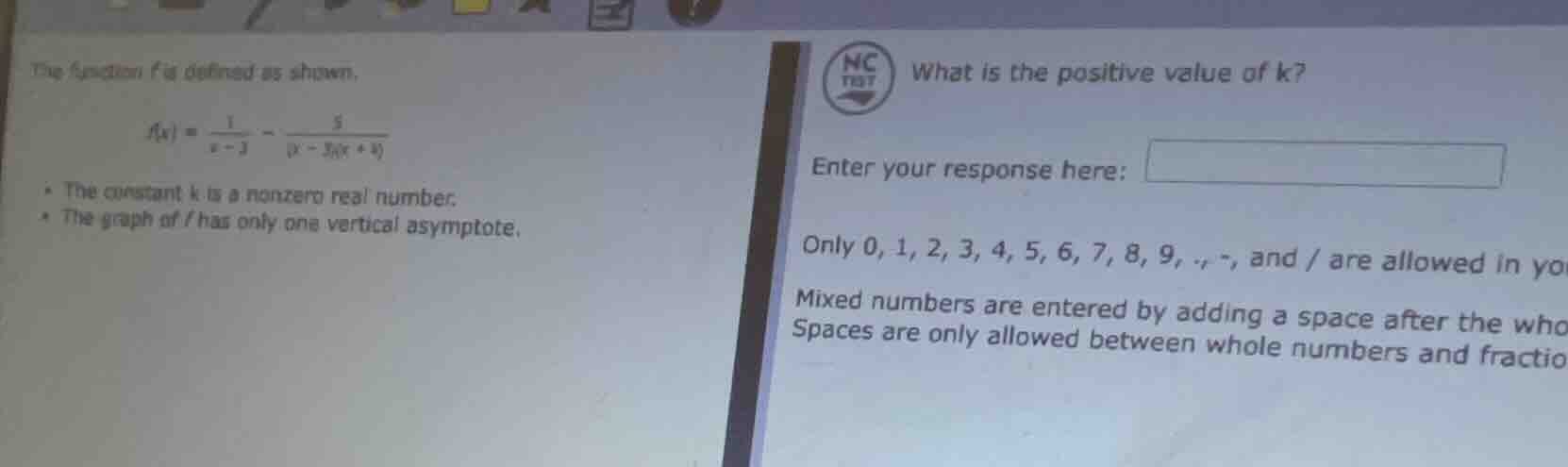
the function f is defined as shown.
$f(x) = \frac{1}{x - 3} - \frac{5}{(x - 3)(x + k)}$
- the constant k is a nonzero real number.
- the graph of f has only one vertical asymptote.
what is the positive value of k?
enter your response here:
only 0, 1, 2, 3, 4, 5, 6, 7, 8, 9, ..., and / are allowed in your response.
mixed numbers are entered by adding a space after the whole number.
spaces are only allowed between whole numbers and fractions.
Step1: Simplify the function
First, we find a common denominator for the two fractions in \( f(x)=\frac{1}{x - 3}-\frac{5}{(x - 3)(x + k)} \). The common denominator is \( (x - 3)(x + k) \). So we rewrite the first fraction:
\( \frac{1}{x - 3}=\frac{x + k}{(x - 3)(x + k)} \)
Then \( f(x)=\frac{x + k-5}{(x - 3)(x + k)} \)
Step2: Analyze vertical asymptotes
A vertical asymptote occurs where the denominator is zero (and the numerator is not zero at that point). The original denominators are \( x - 3 \) and \( (x - 3)(x + k) \). After simplifying, the denominator of the combined fraction is \( (x - 3)(x + k) \) and the numerator is \( x + k - 5 \).
For the graph to have only one vertical asymptote, the two factors in the denominator must be the same (or one of them makes the numerator zero at the same time, but since \( k
eq0 \), we consider the case where the two linear factors are equal or one of them is canceled out by the numerator's root coinciding with a denominator's root, but we want only one vertical asymptote, so we need \( x + k \) to be such that when \( x=-k \), the numerator is also zero (so that the factor \( x + k \) is canceled out, leaving only \( x - 3 \) as the vertical asymptote) or \( x + k=x - 3 \) (but \( k=- 3 \) would make \( x + k=x - 3 \), but let's check the first case).
Set the numerator equal to zero when \( x=-k \):
Substitute \( x=-k \) into the numerator \( x + k-5 \):
\( -k + k-5=-5
eq0 \), so that case doesn't work.
Now, we want the two factors \( x - 3 \) and \( x + k \) to be the same, so \( x + k=x - 3 \) is not possible (since \( k=-3 \), but let's check the simplified function. Wait, maybe we made a mistake. Wait, the original function is \( f(x)=\frac{1}{x - 3}-\frac{5}{(x - 3)(x + k)}=\frac{x + k-5}{(x - 3)(x + k)} \). For there to be only one vertical asymptote, either \( x - 3 \) and \( x + k \) are the same (so \( k=-3 \), but \( k \) is nonzero, but let's check the numerator when \( x + k=x - 3 \), i.e., \( k = - 3 \), then the numerator is \( x-3 - 5=x - 8 \), and the denominator is \( (x - 3)(x - 3)=(x - 3)^2 \). But then the vertical asymptote is at \( x = 3 \), but wait, maybe another approach: if \( x + k \) is such that \( x + k=x - 3 \) is not, but we want only one vertical asymptote, so the root of \( x + k \) must be the same as the root of \( x - 3 \) or the numerator cancels \( x + k \). Wait, no, let's think again. The original function before simplifying has denominators \( x - 3 \) and \( (x - 3)(x + k) \). So the potential vertical asymptotes are at \( x = 3 \) and \( x=-k \). For there to be only one vertical asymptote, either \( x=-k \) is the same as \( x = 3 \) (so \( -k=3\Rightarrow k=-3 \), but \( k \) is nonzero, but let's check the simplified function) or the numerator is zero at \( x=-k \) (so that the factor \( x + k \) is canceled). Wait, when \( x=-k \), numerator is \( -k + k-5=-5
eq0 \), so that can't be. Wait, maybe we made a mistake in simplification. Wait, the first term is \( \frac{1}{x - 3}=\frac{x + k}{(x - 3)(x + k)} \), then subtract \( \frac{5}{(x - 3)(x + k)} \), so \( f(x)=\frac{x + k-5}{(x - 3)(x + k)} \). Now, if \( x + k=x - 3 \), then \( k=-3 \), but then the denominator is \( (x - 3)^2 \) and the numerator is \( x-3 - 5=x - 8 \). Then the vertical asymptote is at \( x = 3 \) (since the numerator is not zero at \( x = 3 \): \( 3-8=-5
eq0 \)). But we need the positive value of \( k \). Wait, maybe we messed up the sign. Wait, maybe the problem is that we want \( x + k \) to be equal to \( x - 3 \) but with a positive \( k \)? No, that wou…

Snap & solve any problem in the app
Get step-by-step solutions on Sovi AI
Photo-based solutions with guided steps
Explore more problems and detailed explanations
2