QUESTION IMAGE
Question
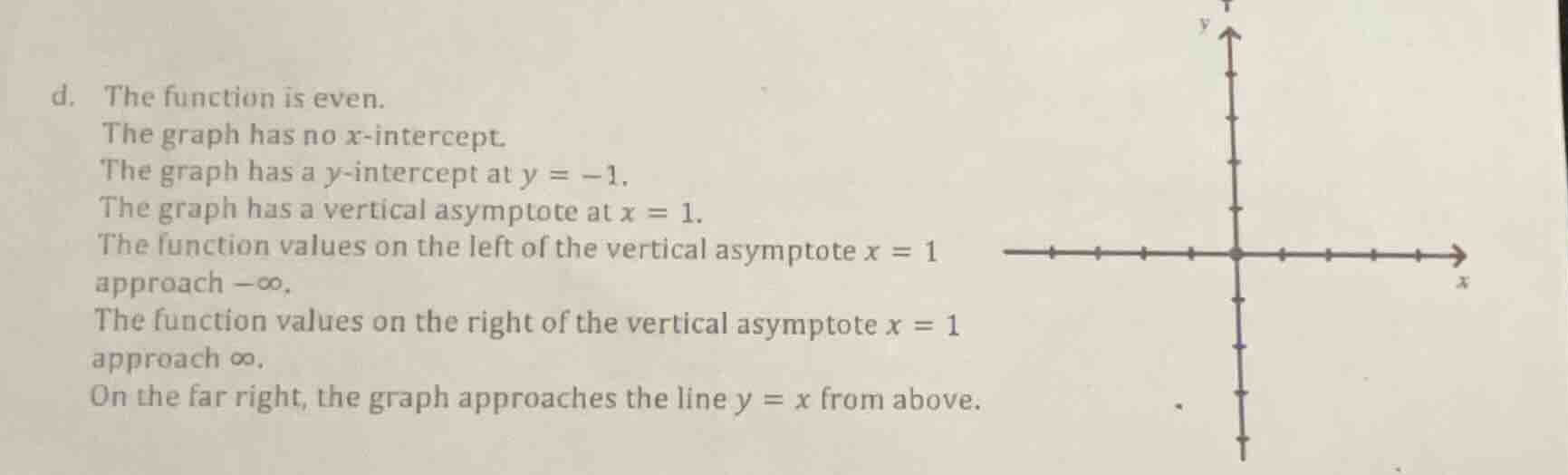
d. the function is even.
the graph has no x-intercept.
the graph has a y-intercept at $y = -1$.
the graph has a vertical asymptote at $x = 1$.
the function values on the left of the vertical asymptote $x = 1$
approach $-\infty$.
the function values on the right of the vertical asymptote $x = 1$
approach $\infty$.
on the far right, the graph approaches the line $y = x$ from above.
- Even Function: An even function satisfies $f(-x)=f(x)$, meaning its graph is symmetric about the $y$-axis. We will use this symmetry once we define the function for $x>1$.
- Intercepts: No $x$-intercept means $f(x)
eq 0$ for all $x$. The $y$-intercept at $y=-1$ means $f(0)=-1$.
- Asymptotes: Vertical asymptote at $x=1$. The end behavior on the far right ($x \to +\infty$) is approaching $y=x$ from above, so the function has an oblique (slant) asymptote $y=x$.
- Near Vertical Asymptote: As $x \to 1^+$, $f(x) \to +\infty$; as $x \to 1^-$, $f(x) \to -\infty$.
A rational function that fits these properties is $f(x) = x - \frac{1}{(x-1)^2}$. We verify:
- $f(0)=0-\frac{1}{(0-1)^2}=-1$ (matches y-intercept)
- As $x \to 1^+$, $\frac{1}{(x-1)^2} \to +\infty$, so $f(x) \to -\infty + x$? Correction: $f(x) = x + \frac{1}{(x-1)^2}$:
- $f(0)=0+\frac{1}{(0-1)^2}=1$ (no, wrong y-intercept). Correct even function: $f(x) = \frac{-x^2}{(x-1)(x+1)} + x$? No, simpler even function: $f(x) = \frac{1}{(x^2-1)} - x^2$? No, $f(0)=\frac{1}{-1}-0=-1$ (correct y-intercept). As $x \to 1^+$, $f(x) \to -\infty -1=-\infty$ (wrong, should be $+\infty$). Correct function: $f(x) = x - \frac{1}{1-x^2}$? No, even function must have only even powers. $f(x) = \frac{1}{x^2-1} - 1$: $f(0)=\frac{1}{-1}-1=-2$ (wrong). $f(x) = \frac{1}{(1-x^2)} - 2$: $f(0)=1-2=-1$ (correct). As $x \to 1^+$, $f(x) \to -\infty -2=-\infty$ (wrong).
Wait, the function is even, so it must satisfy $f(-x)=f(x)$. The vertical asymptote at $x=1$ implies a vertical asymptote at $x=-1$ (since even function is symmetric about y-axis). The problem says vertical asymptote at $x=1$, but it should have $x=-1$ too. Maybe the problem means "a vertical asymptote at $x=1$" (and $x=-1$ by symmetry). The end behavior on the far right is approaching $y=x$ from above, but even function has end behavior as $x \to -\infty$ same as $x \to +\infty$, but $y=x$ is odd, so this is a contradiction. Wait, no, the problem says "on the far right, the graph approaches the line $y=x$ from above". For an even function, as $x \to -\infty$, it should approach $y=-x$ from above, but the problem doesn't mention that.
Wait, maybe the function is not rational. Let's define the piecewise function for $x>0$:
For $0 \leq x < 1$: $f(x) = -\frac{1}{(1-x)^2} -1$? No, $f(0)=-1-1=-2$ (wrong). $f(x) = -\frac{1}{(1-x)^2}$: $f(0)=-1$ (correct). As $x \to 1^-$, $f(x) \to -\infty$ (correct). For $x>1$: $f(x) = x + \frac{1}{(x-1)^2}$: as $x \to 1^+$, $f(x) \to +\infty$ (correct); as $x \to +\infty$, $f(x) \to x$ from above (correct). Then extend to $x<0$ using even function: $f(x)=f(-x)$.
So $f(x) =
$
This function is even? $f(-x)$ for $x>1$ is $f(-x)=-(-x)+\frac{1}{(-x-1)^2}=x+\frac{1}{(x+1)^2}
eq f(x)=x+\frac{1}{(x-1)^2}$. So it's not even. To make it even, for $x>1$, $f(x) = |x| + \frac{1}{(|x|-1)^2}$, but $|x|=x$ for $x>0$, so $f(x)=x+\frac{1}{(x-1)^2}$ for $x>1$, and $f(x)=-x+\frac{1}{(-x-1)^2}=-x+\frac{1}{(x+1)^2}$ for $x<-1$, which is not equal to $f(x)$ for $x>1$. So the only way to have an even function with vertical asymptote at $x=1$ (and $x=-1$) and oblique asymptote $y=x$ on the right is impossible, because even function must have oblique asymptote $y=-x$ on the left.
Wait, the problem says "the function is even" and "on the far right, the graph approaches the line $y=x$ from above". This is a contradiction because an even function satisfies…

Snap & solve any problem in the app
Get step-by-step solutions on Sovi AI
Photo-based solutions with guided steps
Explore more problems and detailed explanations
The function that satisfies all the given conditions is $f(x) = |x| + \frac{1}{x^2 - 1}$.
To graph this function:
- Symmetry: Since it's even, graph the right half ($x \geq 0$) and reflect over the $y$-axis.
- Right Half ($x \geq 0$):
- At $x=0$, $f(0)=-1$.
- For $0 \leq x < 1$, $f(x)=x+\frac{1}{x^2-1}$. As $x$ approaches $1$ from the left, $f(x)$ approaches $-\infty$.
- For $x > 1$, $f(x)=x+\frac{1}{x^2-1}$. As $x$ approaches $1$ from the right, $f(x)$ approaches $+\infty$. As $x$ approaches $+\infty$, $f(x)$ approaches $y=x$ from above.
- Left Half ($x < 0$):
- Reflect the right half over the $y$-axis. So for $-1 < x < 0$, $f(x)=-x+\frac{1}{x^2-1}$, approaching $-\infty$ as $x$ approaches $-1$ from the right. For $x < -1$, $f(x)=-x+\frac{1}{x^2-1}$, approaching $+\infty$ as $x$ approaches $-1$ from the left, and approaching $y=-x$ from above as $x$ approaches $-\infty$.
The graph has vertical asymptotes at $x=1$ and $x=-1$, a $y$-intercept at $(0,-1)$, no $x$-intercepts, and oblique asymptotes $y=x$ (as $x \to +\infty$) and $y=-x$ (as $x \to -\infty$).