QUESTION IMAGE
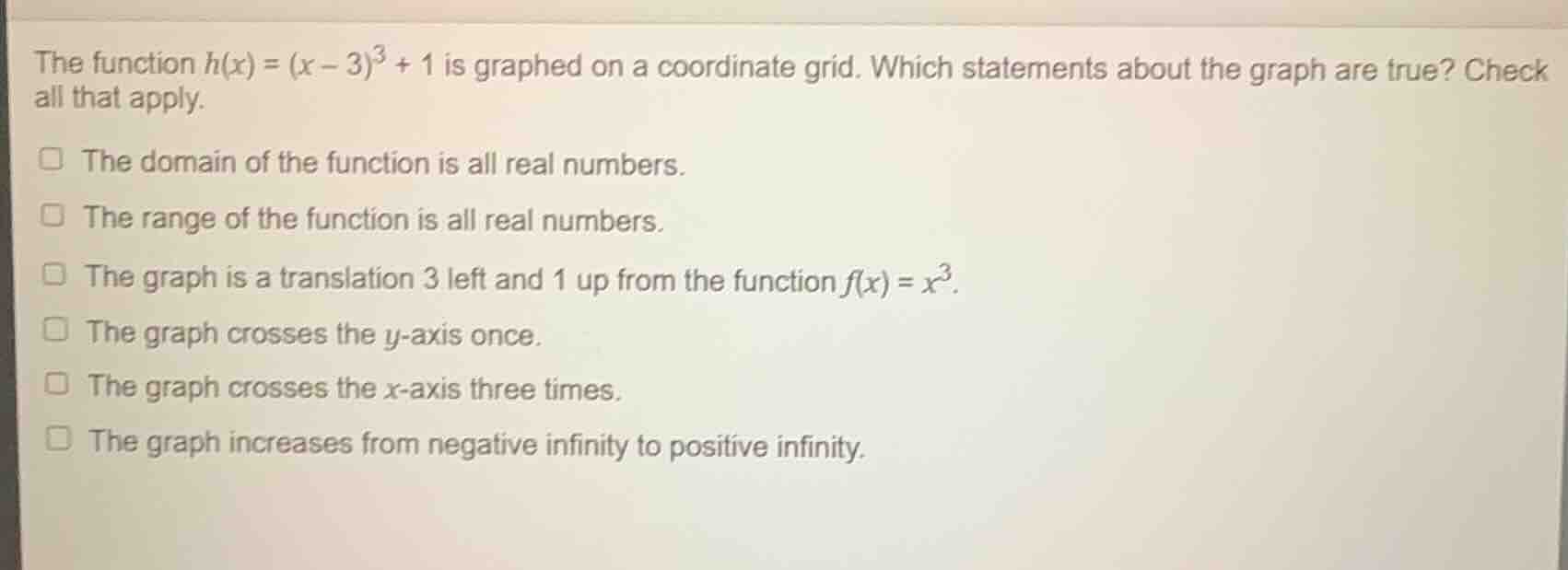
Question
the function $h(x) = (x - 3)^3 + 1$ is graphed on a coordinate grid. which statements about the graph are true? check all that apply.
- the domain of the function is all real numbers.
- the range of the function is all real numbers.
- the graph is a translation 3 left and 1 up from the function $f(x) = x^3$.
- the graph crosses the $y$-axis once.
- the graph crosses the $x$-axis three times.
- the graph increases from negative infinity to positive infinity.
Brief Explanations
- Domain of \( h(x)=(x - 3)^3+1 \):
- For any real number \( x \), \( (x - 3)^3 \) is defined (since cubing a real number is always defined). Adding 1 also keeps it defined. So the domain is all real numbers. This statement is true.
- Range of \( h(x)=(x - 3)^3+1 \):
- Let \( y=(x - 3)^3+1 \). We can solve for \( x \): \( y - 1=(x - 3)^3 \), then \( x - 3=\sqrt[3]{y - 1} \), and \( x = 3+\sqrt[3]{y - 1} \). For any real number \( y \), \( \sqrt[3]{y - 1} \) is a real number, so \( x \) is a real number. Thus, the range is all real numbers. This statement is true.
- Translation from \( f(x)=x^3 \):
- The transformation of \( f(x)=x^3 \) to \( h(x)=(x - 3)^3+1 \) is a horizontal shift 3 units to the right (because \( x\to x - 3 \)) and a vertical shift 1 unit up (because \( +1 \)). The statement says 3 left, which is incorrect. So this statement is false.
- Crossing the \( y \)-axis:
- To find the \( y \)-intercept, set \( x = 0 \): \( h(0)=(0 - 3)^3+1=-27 + 1=-26 \). There is only one \( y \)-intercept (when \( x = 0 \)), so the graph crosses the \( y \)-axis once. This statement is true.
- Crossing the \( x \)-axis:
- Set \( h(x)=0 \): \( (x - 3)^3+1 = 0\Rightarrow(x - 3)^3=-1\Rightarrow x - 3=-1\Rightarrow x = 2 \). The equation \( (x - 3)^3=-1 \) has only one real solution (since the cube root of - 1 is - 1, and the cubic function \( y=(x - 3)^3+1 \) is strictly increasing (as the derivative \( h^\prime(x)=3(x - 3)^2\geq0 \), and it is only zero at \( x = 3 \), but the function is still increasing overall)). So it has only one \( x \)-intercept, not three. This statement is false.
- Increasing behavior:
- The derivative of \( h(x) \) is \( h^\prime(x)=3(x - 3)^2\geq0 \). The derivative is zero only at \( x = 3 \), and for all other \( x \), \( h^\prime(x)>0 \). So the function is increasing on \( (-\infty,3) \) and \( (3,\infty) \), and since the derivative is non - negative everywhere, the function is increasing from \( -\infty \) to \( \infty \). This statement is true.

Snap & solve any problem in the app
Get step-by-step solutions on Sovi AI
Photo-based solutions with guided steps
Explore more problems and detailed explanations
- The domain of the function is all real numbers.
- The range of the function is all real numbers.
- The graph crosses the \( y \)-axis once.
- The graph increases from negative infinity to positive infinity.