QUESTION IMAGE
Question
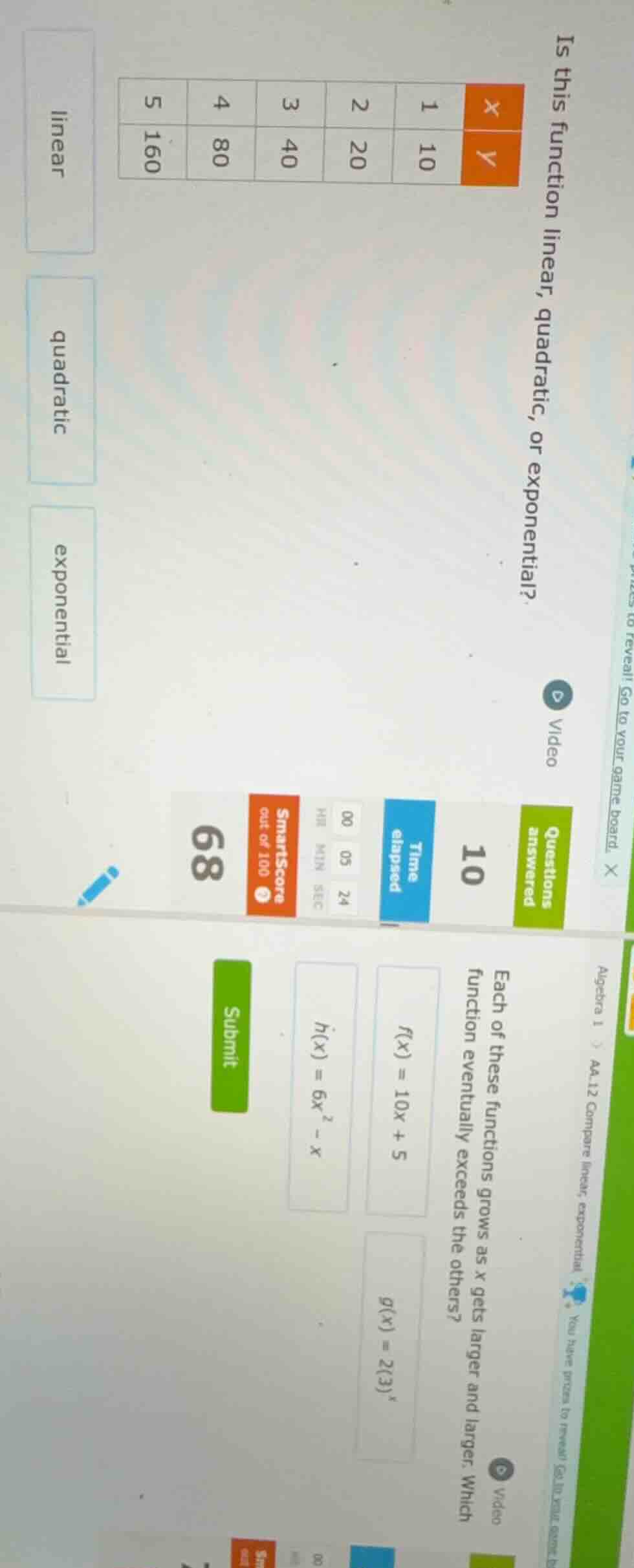
- is this function linear, quadratic, or exponential?
| x | y |
|---|---|
| 2 | 20 |
| 3 | 40 |
| 4 | 80 |
| 5 | 160 |
options: linear, quadratic, exponential
- each of these functions grows as x gets larger and larger. which function eventually exceeds the others?
$f(x)=10x + 5$
$g(x)=2(3)^x$
$h(x)=6x^2 - x$
Response
First Problem: Classify the table function
Step1: Check linear (constant Δy)
Calculate differences in y-values:
$20-10=10$, $40-20=20$, $80-40=40$, $160-80=80$
Differences are not constant, so not linear.
Step2: Check exponential (constant ratio)
Calculate ratios of consecutive y-values:
$\frac{20}{10}=2$, $\frac{40}{20}=2$, $\frac{80}{40}=2$, $\frac{160}{80}=2$
Ratios are constant (2).
Step1: Recall growth rate hierarchy
Exponential functions ($b^x, b>1$) grow faster than quadratic ($x^2$) and linear ($x$) functions as $x\to\infty$.
Step2: Match functions to types
- $f(x)=10x+5$: linear
- $h(x)=6x^2-x$: quadratic
- $g(x)=2(3)^x$: exponential
Exponential outpaces the others long-term.

Snap & solve any problem in the app
Get step-by-step solutions on Sovi AI
Photo-based solutions with guided steps
Explore more problems and detailed explanations
exponential
---