QUESTION IMAGE
Question
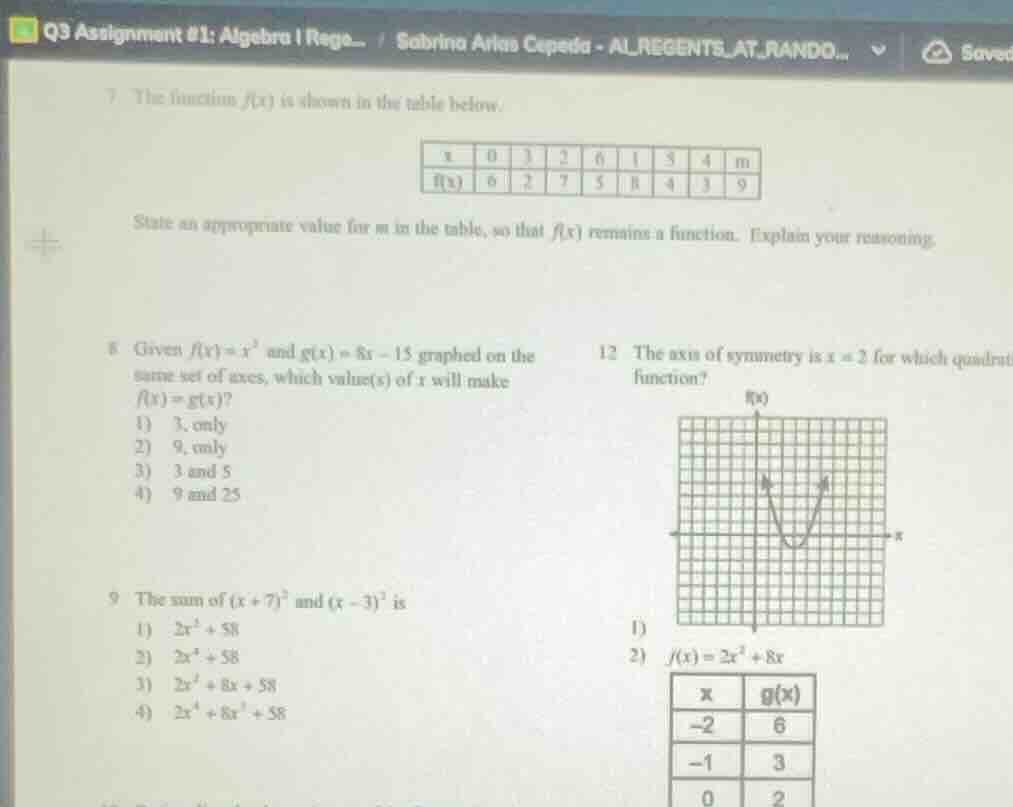
7 the function ( f(x) ) is shown in the table below.
\begin{array}{|c|c|c|c|c|c|c|c|}hlinex & 0 & 3 & 2 & 6 & 1 & 5 & 4 & m \hlinef(x) & 6 & 2 & 7 & 5 & 8 & 4 & 3 & 9 \hlineend{array}
state an appropriate value for ( m ) in the table, so that ( f(x) ) remains a function. explain your reasoning.
8 given ( f(x) = x^2 ) and ( g(x) = 8x - 15 ) graphed on the same set of axes, which value(s) of ( x ) will make ( f(x) = g(x) )?
- 3, only
- 9, only
- 3 and 5
- 9 and 25
9 the sum of ( (x + 7)^2 ) and ( (x - 3)^2 ) is
- ( 2x^2 + 58 )
- ( 2x^2 + 58 )
- ( 2x^2 + 8x + 58 )
- ( 2x^4 + 8x^2 + 58 )
12 the axis of symmetry is ( x = 2 ) for which quadratic function?
(there is a graph of a quadratic function and a table for ( g(x) ) with ( x = -2, -1, 0 ) and ( g(x) = 6, 3, 2 ))
Question 7
Step1: Recall function definition
A function is a relation where each input \( x \) has exactly one output \( f(x) \). So, for \( f(x) \) to be a function, the new \( x \)-value \( m \) must not be equal to any existing \( x \)-values in the table.
Step2: Identify existing \( x \)-values
The existing \( x \)-values in the table are \( 0, 3, 2, 6, 1, 5, 4 \).
Step3: Choose a valid \( m \)
We can choose any value for \( m \) that is not in \( \{0, 3, 2, 6, 1, 5, 4\} \). For example, let's choose \( m = 7 \) (any number not in the existing set works, like 8, 9, -1, etc.).
Step1: Set \( f(x) = g(x) \)
Given \( f(x)=x^{2} \) and \( g(x)=8x - 15 \), set \( x^{2}=8x - 15 \).
Step2: Rearrange to quadratic equation
\( x^{2}-8x + 15 = 0 \).
Step3: Factor the quadratic
\( (x - 3)(x - 5)=0 \).
Step4: Solve for \( x \)
Set each factor to zero: \( x - 3 = 0 \) gives \( x = 3 \); \( x - 5 = 0 \) gives \( x = 5 \).
Step1: Expand \( (x + 7)^{2} \)
Using the formula \( (a + b)^{2}=a^{2}+2ab + b^{2} \), we get \( (x + 7)^{2}=x^{2}+14x + 49 \).
Step2: Expand \( (x - 3)^{2} \)
Using the formula \( (a - b)^{2}=a^{2}-2ab + b^{2} \), we get \( (x - 3)^{2}=x^{2}-6x + 9 \).
Step3: Sum the two expanded forms
\( (x^{2}+14x + 49)+(x^{2}-6x + 9)=x^{2}+14x + 49 + x^{2}-6x + 9 \).
Step4: Combine like terms
Combine \( x^{2} \) terms: \( x^{2}+x^{2}=2x^{2} \); combine \( x \) terms: \( 14x-6x = 8x \); combine constant terms: \( 49 + 9 = 58 \). So the sum is \( 2x^{2}+8x + 58 \).

Snap & solve any problem in the app
Get step-by-step solutions on Sovi AI
Photo-based solutions with guided steps
Explore more problems and detailed explanations
An appropriate value for \( m \) is \( 7 \) (or any number not in \( \{0, 3, 2, 6, 1, 5, 4\} \)). Reason: A function requires each \( x \)-value to have exactly one \( f(x) \)-value, so \( m \) must not duplicate any existing \( x \)-value.