QUESTION IMAGE
Question
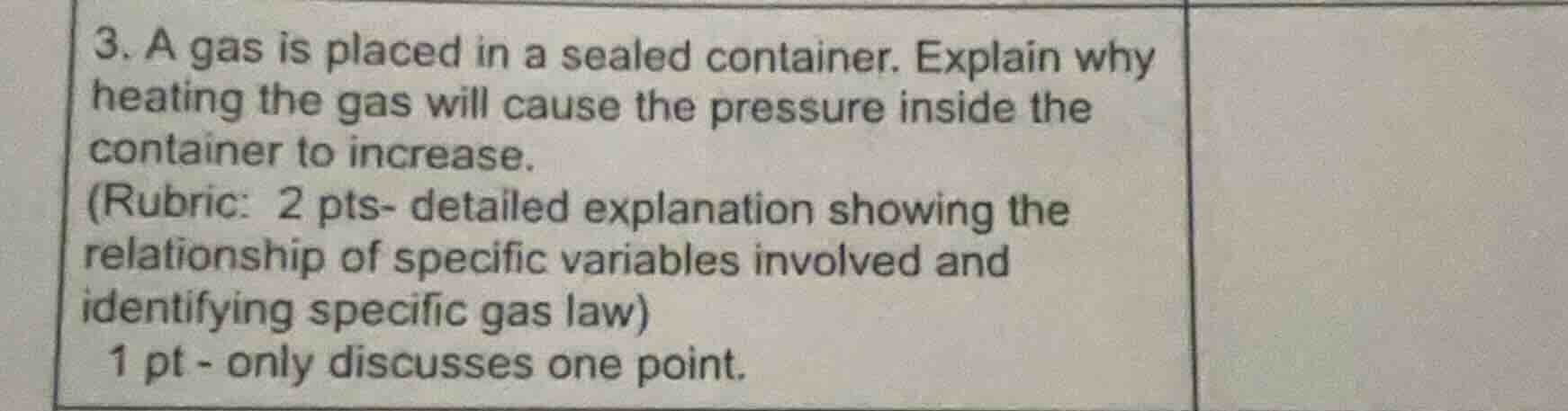
- a gas is placed in a sealed container. explain why heating the gas will cause the pressure inside the container to increase. (rubric: 2 pts - detailed explanation showing the relationship of specific variables involved and identifying specific gas law) 1 pt - only discusses one point.
Brief Explanations
Heating the gas increases the average kinetic energy of its particles, so they move faster and collide with the container walls more frequently and with greater force. This scenario follows Gay-Lussac's Law, which states for a fixed volume (sealed container), gas pressure is directly proportional to its absolute temperature ($P \propto T$ when $V$ and $n$ are constant). The increased collisions result in higher pressure inside the container.

Snap & solve any problem in the app
Get step-by-step solutions on Sovi AI
Photo-based solutions with guided steps
Explore more problems and detailed explanations
When a gas in a sealed (fixed-volume) container is heated:
- The gas particles gain kinetic energy, moving faster and with more force.
- These particles collide with the container walls more frequently and with greater impact.
- This follows Gay-Lussac's Law ($\frac{P_1}{T_1} = \frac{P_2}{T_2}$ for constant $V$ and $n$), which defines the direct proportionality between gas pressure and absolute temperature at fixed volume. The increased collision force/frequency leads to a rise in internal pressure.