QUESTION IMAGE
Question
geography of china
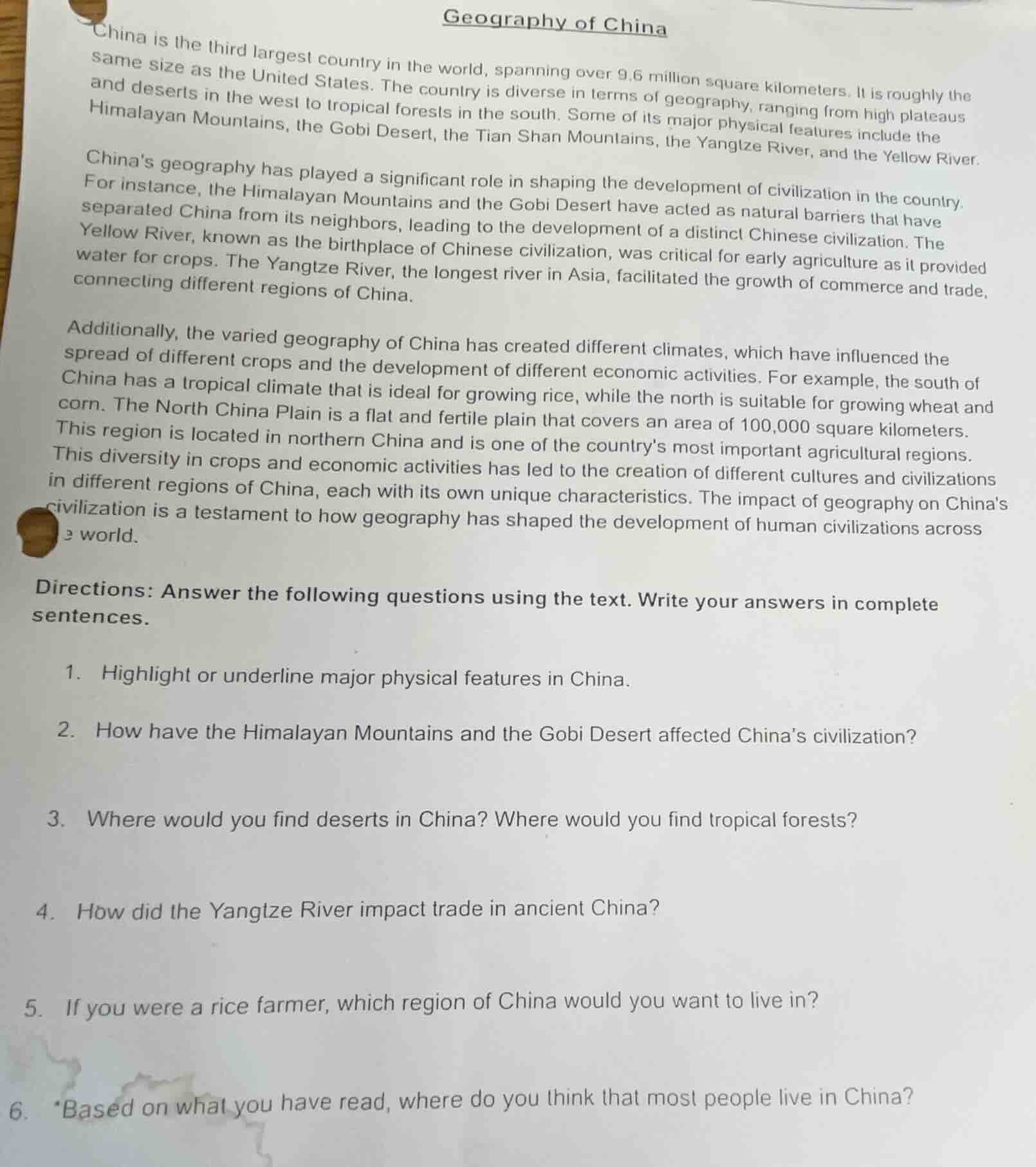
china is the third largest country in the world, spanning over 9.6 million square kilometers. it is roughly the same size as the united states. the country is diverse in terms of geography, ranging from high plateaus and deserts in the west to tropical forests in the south. some of its major physical features include the himalayan mountains, the gobi desert, the tian shan mountains, the yangtze river, and the yellow river.
chinas geography has played a significant role in shaping the development of civilization in the country. for instance, the himalayan mountains and the gobi desert have acted as natural barriers that have separated china from its neighbors, leading to the development of a distinct chinese civilization. the yellow river, known as the birthplace of chinese civilization, was critical for early agriculture as it provided water for crops. the yangtze river, the longest river in asia, facilitated the growth of commerce and trade, connecting different regions of china.
additionally, the varied geography of china has created different climates, which have influenced the spread of different crops and the development of different economic activities. for example, the south of china has a tropical climate that is ideal for growing rice, while the north is suitable for growing wheat and corn. the north china plain is a flat and fertile plain that covers an area of 100,000 square kilometers. this region is located in northern china and is one of the countrys most important agricultural regions. this diversity in crops and economic activities has led to the creation of different cultures and civilizations in different regions of china, each with its own unique characteristics. the impact of geography on chinas civilization is a testament to how geography has shaped the development of human civilizations across the world.
directions: answer the following questions using the text. write your answers in complete sentences.
- highlight or underline major physical features in china.
- how have the himalayan mountains and the gobi desert affected china’s civilization?
- where would you find deserts in china? where would you find tropical forests?
- how did the yangtze river impact trade in ancient china?
- if you were a rice farmer, which region of china would you want to live in?
- *based on what you have read, where do you think that most people live in china?
Question 1
To find the major physical features, we refer to the text: "Some of its major physical features include the Himalayan Mountains, the Gobi Desert, the Tian Shan Mountains, the Yangtze River, and the Yellow River." We can highlight or underline these features.
From the text: "the Himalayan Mountains and the Gobi Desert have acted as natural barriers that have separated China from its neighbors, leading to the development of a distinct Chinese civilization." We use this information to form the answer.
For deserts: The text says "deserts in the west". For tropical forests: "tropical forests in the south". We extract these details.

Snap & solve any problem in the app
Get step-by-step solutions on Sovi AI
Photo-based solutions with guided steps
Explore more problems and detailed explanations
The major physical features in China (to be highlighted/underlined) are: the Himalayan Mountains, the Gobi Desert, the Tian Shan Mountains, the Yangtze River, and the Yellow River.