QUESTION IMAGE
Question
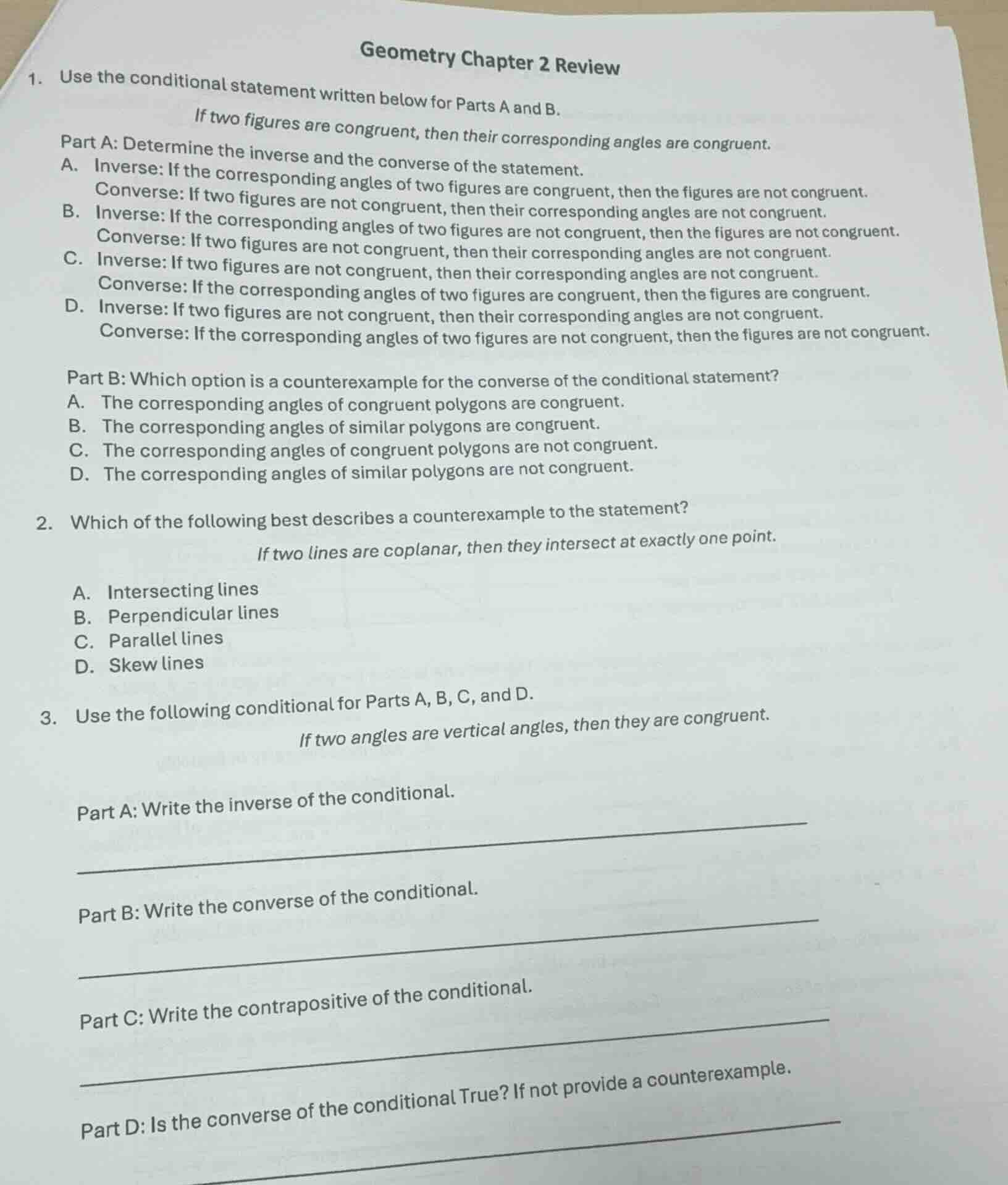
geometry chapter 2 review
- use the conditional statement written below for parts a and b.
if two figures are congruent, then their corresponding angles are congruent.
part a: determine the inverse and the converse of the statement.
a. inverse: if the corresponding angles of two figures are congruent, then the figures are not congruent.
converse: if two figures are not congruent, then their corresponding angles are not congruent.
b. inverse: if the corresponding angles of two figures are not congruent, then the figures are not congruent.
converse: if two figures are not congruent, then their corresponding angles are not congruent.
c. inverse: if two figures are not congruent, then their corresponding angles are not congruent.
converse: if the corresponding angles of two figures are congruent, then the figures are congruent.
d. inverse: if two figures are not congruent, then their corresponding angles are not congruent.
converse: if the corresponding angles of two figures are not congruent, then the figures are not congruent.
part b: which option is a counterexample for the converse of the conditional statement?
a. the corresponding angles of congruent polygons are congruent.
b. the corresponding angles of similar polygons are congruent.
c. the corresponding angles of congruent polygons are not congruent.
d. the corresponding angles of similar polygons are not congruent.
- which of the following best describes a counterexample to the statement?
if two lines are coplanar, then they intersect at exactly one point.
a. intersecting lines
b. perpendicular lines
c. parallel lines
d. skew lines
- use the following conditional for parts a, b, c, and d.
if two angles are vertical angles, then they are congruent.
part a: write the inverse of the conditional.
____________________
part b: write the converse of the conditional.
____________________
part c: write the contrapositive of the conditional.
____________________
part d: is the converse of the conditional true? if not provide a counterexample.
____________________
Question 1 Part A
To determine the inverse and converse of a conditional statement "If \( p \), then \( q \)":
- Inverse: "If not \( p \), then not \( q \)"
- Converse: "If \( q \), then \( p \)"
The given conditional statement is: "If two figures are congruent (\( p \)), then their corresponding angles are congruent (\( q \))".
- Inverse: "If two figures are not congruent (not \( p \)), then their corresponding angles are not congruent (not \( q \))"
- Converse: "If the corresponding angles of two figures are congruent (\( q \)), then the figures are congruent (\( p \))"
Now let's check the options:
- Option A: Inverse is incorrect (it has "If \( q \), then not \( p \)"), Converse is incorrect (it has "If not \( p \), then not \( q \)")
- Option B: Inverse is incorrect (it has "If not \( q \), then not \( p \)"), Converse is incorrect (it has "If not \( q \), then not \( p \)")
- Option C: Inverse is correct ("If not \( p \), then not \( q \)"), Converse is correct ("If \( q \), then \( p \)")
- Option D: Inverse is correct, but Converse is incorrect (it has "If not \( q \), then not \( p \)")
So the correct option is C.
First, find the converse of the conditional statement "If two figures are congruent, then their corresponding angles are congruent". The converse is "If the corresponding angles of two figures are congruent, then the figures are congruent".
A counterexample to a statement is an example that shows the statement is false. So we need an example where corresponding angles are congruent, but the figures are not congruent.
- Similar polygons have congruent corresponding angles but are not necessarily congruent (they have the same shape but different sizes).
- Option A: This is an example that supports the converse, not a counterexample.
- Option B: Similar polygons have congruent corresponding angles but are not congruent, so this is a counterexample.
- Option C: Congruent polygons should have congruent corresponding angles, so this is false and not a counterexample.
- Option D: Similar polygons have congruent corresponding angles, so this is false and not a counterexample.
So the correct option is B.
The statement is "If two lines are coplanar, then they intersect at exactly one point". We need a counterexample, i.e., an example of two coplanar lines that do not intersect at exactly one point.
- Intersecting lines: Intersect at exactly one point, so this supports the statement, not a counterexample.
- Perpendicular lines: A type of intersecting lines, intersect at exactly one point, supports the statement.
- Parallel lines: Coplanar lines that never intersect (so they don't intersect at exactly one point), this is a counterexample.
- Skew lines: Not coplanar, so they don't satisfy the hypothesis of the statement, so they can't be a counterexample.
So the correct option is C.

Snap & solve any problem in the app
Get step-by-step solutions on Sovi AI
Photo-based solutions with guided steps
Explore more problems and detailed explanations
C. Inverse: If two figures are not congruent, then their corresponding angles are not congruent.
Converse: If the corresponding angles of two figures are congruent, then the figures are congruent.