QUESTION IMAGE
Question
geometry
mock ia exam
directions: show all of your work for each question, making sure to draw and annotate all diagrams, and select the
best matching answer. grade your work against the answer key to see how you did. once you see your score and
the correct answers, begin completing corrections for the ones you got incorrect and redo them until they’re
correct. this will be counted as a quiz grade. good luck!
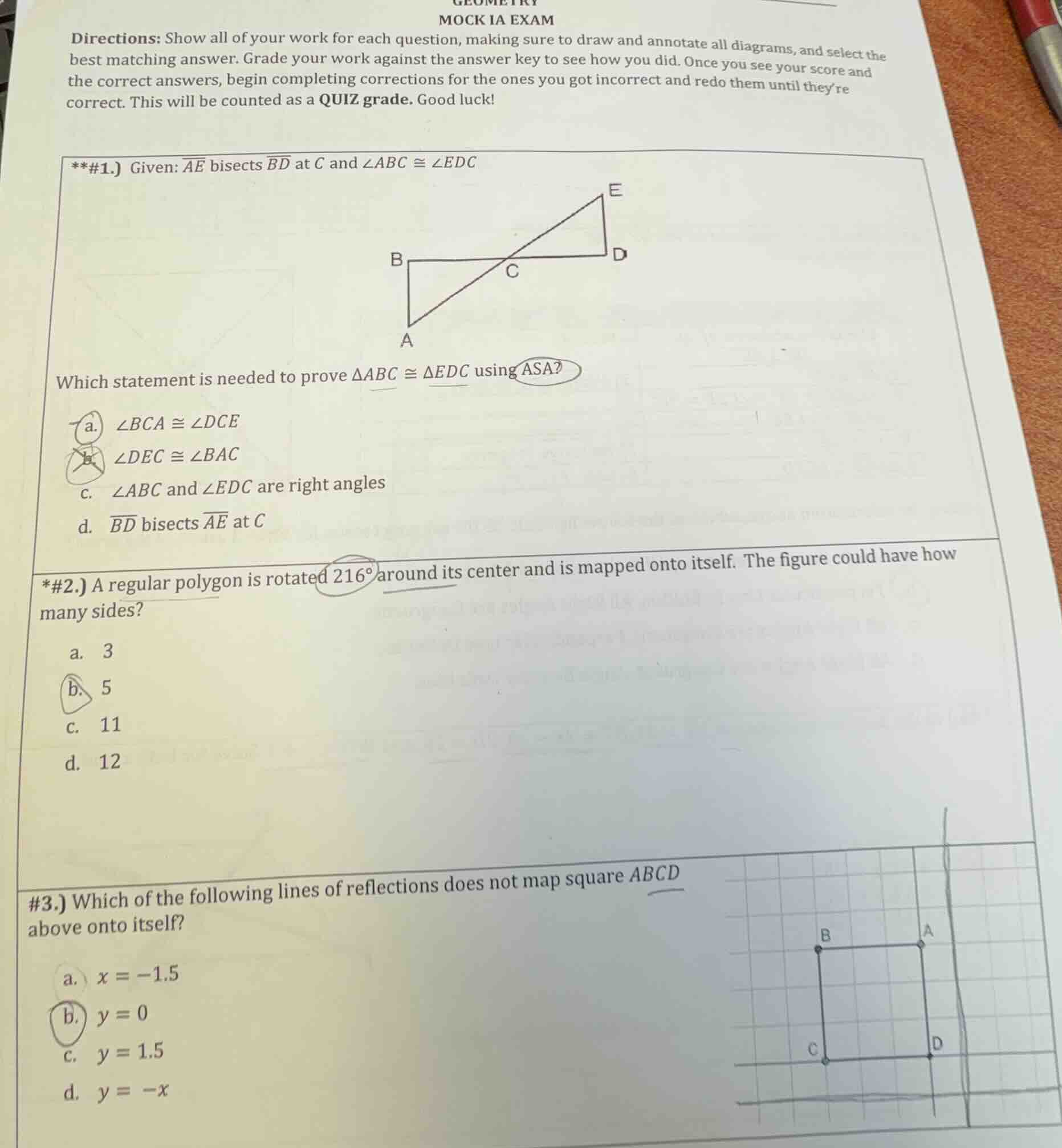
**#1.) given: \\(\overline{ae}\\) bisects \\(\overline{bd}\\) at \\(c\\) and \\(\angle abc \cong \angle edc\\)
diagram of triangles abc and edc with c on bd and ae
which statement is needed to prove \\(\triangle abc \cong \triangle edc\\) using asa?
a. \\(\angle bca \cong \angle dce\\)
b. \\(\angle dec \cong \angle bac\\)
c. \\(\angle abc\\) and \\(\angle edc\\) are right angles
d. \\(\overline{bd}\\) bisects \\(\overline{ae}\\) at \\(c\\)
*#2.) a regular polygon is rotated \\(216^\circ\\) around its center and is mapped onto itself. the figure could have how
many sides?
a. 3
b. 5
c. 11
d. 12
#3.) which of the following lines of reflections does not map square \\(abcd\\)
above onto itself?
a. \\(x = -1.5\\)
b. \\(y = 0\\)
c. \\(y = 1.5\\)
d. \\(y = -x\\)
diagram of square abcd on a grid
Question 1
To prove \(\triangle ABC \cong \triangle EDC\) using ASA (Angle - Side - Angle), we need two angles and the included side to be congruent. We know that \(\overline{AE}\) bisects \(\overline{BD}\) at \(C\), so \(BC = DC\) (by the definition of a bisector). We are also given that \(\angle ABC\cong\angle EDC\). For ASA, we need the included angle between the side \(BC = DC\) and the given angle. \(\angle BCA\) and \(\angle DCE\) are vertical angles, and vertical angles are congruent. So \(\angle BCA\cong\angle DCE\) gives us the second angle needed for ASA (along with \(BC = DC\) and \(\angle ABC\cong\angle EDC\)). Option b is for AAS or other congruence criteria, option c is not necessary as we don't know they are right angles, and option d is not related to ASA for these triangles.
Step 1: Recall the formula for rotational symmetry of a regular polygon
For a regular polygon with \(n\) sides, the minimum angle of rotation that maps the polygon onto itself is given by \(\theta=\frac{360^{\circ}}{n}\), where \(n\) is a positive integer greater than or equal to 3. If a regular polygon can be mapped onto itself by a rotation of \(216^{\circ}\), then \(216^{\circ}\) must be a multiple of \(\frac{360^{\circ}}{n}\). In other words, \(\frac{360^{\circ}}{n}\) must divide \(216^{\circ}\), or \(n=\frac{360^{\circ}}{k}\), where \(k\) is the number of times the minimum rotation fits into \(216^{\circ}\), and \(k\) must be a positive integer such that \(n\) is an integer. We can also think that \(216^{\circ}=\frac{360^{\circ}}{n}\times m\), where \(m\) is a positive integer. Rearranging for \(n\), we get \(n = \frac{360^{\circ}\times m}{216^{\circ}}=\frac{5m}{3}\). Since \(n\) must be an integer, \(m\) must be a multiple of 3. Let \(m = 3\), then \(n=\frac{5\times3}{3}=5\). Let's check: for a regular pentagon (\(n = 5\)), the minimum rotation angle is \(\frac{360^{\circ}}{5}=72^{\circ}\). And \(216^{\circ}\div72^{\circ}=3\), so a rotation of \(3\times72^{\circ}=216^{\circ}\) will map the regular pentagon onto itself. For \(n = 3\), the minimum rotation angle is \(120^{\circ}\), \(216\div120 = 1.8\) (not an integer). For \(n=11\), the minimum rotation angle is \(\frac{360}{11}\approx32.7^{\circ}\), \(216\div\frac{360}{11}=216\times\frac{11}{360}=6.6\) (not an integer). For \(n = 12\), the minimum rotation angle is \(30^{\circ}\), \(216\div30 = 7.2\) (not an integer).
Step 2: Calculate \(n\)
We know that the angle of rotation \(\alpha\) for a regular polygon with \(n\) sides satisfies \(\alpha=\frac{360k}{n}\), where \(k\) is a positive integer. We are given \(\alpha = 216^{\circ}\). So \(216=\frac{360k}{n}\), which can be rewritten as \(n=\frac{360k}{216}=\frac{5k}{3}\). We need \(n\) to be a positive integer, so \(k\) must be a multiple of 3. Let \(k = 3\), then \(n=\frac{5\times3}{3}=5\).
A square has reflection symmetry over vertical lines through its center, horizontal lines through its center, and the lines \(y = x\) and \(y=-x\) (depending on the square's position and orientation). If the square is not symmetric about the x - axis (\(y = 0\)), reflecting over \(y = 0\) will not map the square onto itself. The other lines (\(x=-1.5\) is a vertical line through the square's mid - x, \(y = 1.5\) is a horizontal line through the square's mid - y, and \(y=-x\) can be a line of symmetry for some square orientations) are more likely to be lines of symmetry, while \(y = 0\) is not.

Snap & solve any problem in the app
Get step-by-step solutions on Sovi AI
Photo-based solutions with guided steps
Explore more problems and detailed explanations
a. \(\angle BCA \cong \angle DCE\)