QUESTION IMAGE
Question
geometry
properties of the rectangle, rhombus, and square
rectangle
all properties of parallelograms
plus
---all diagonals are congruent
---all angles measure 90°
rhombus
all properties of parallelograms
plus
---all sides are congruent
---all diagonals are perpendicular
---all diagonals bisect opposite angles
square
all properties of
---parallelogram
---rectangle
---rhombus
use the properties to solve for the missing measures in the diagrams.
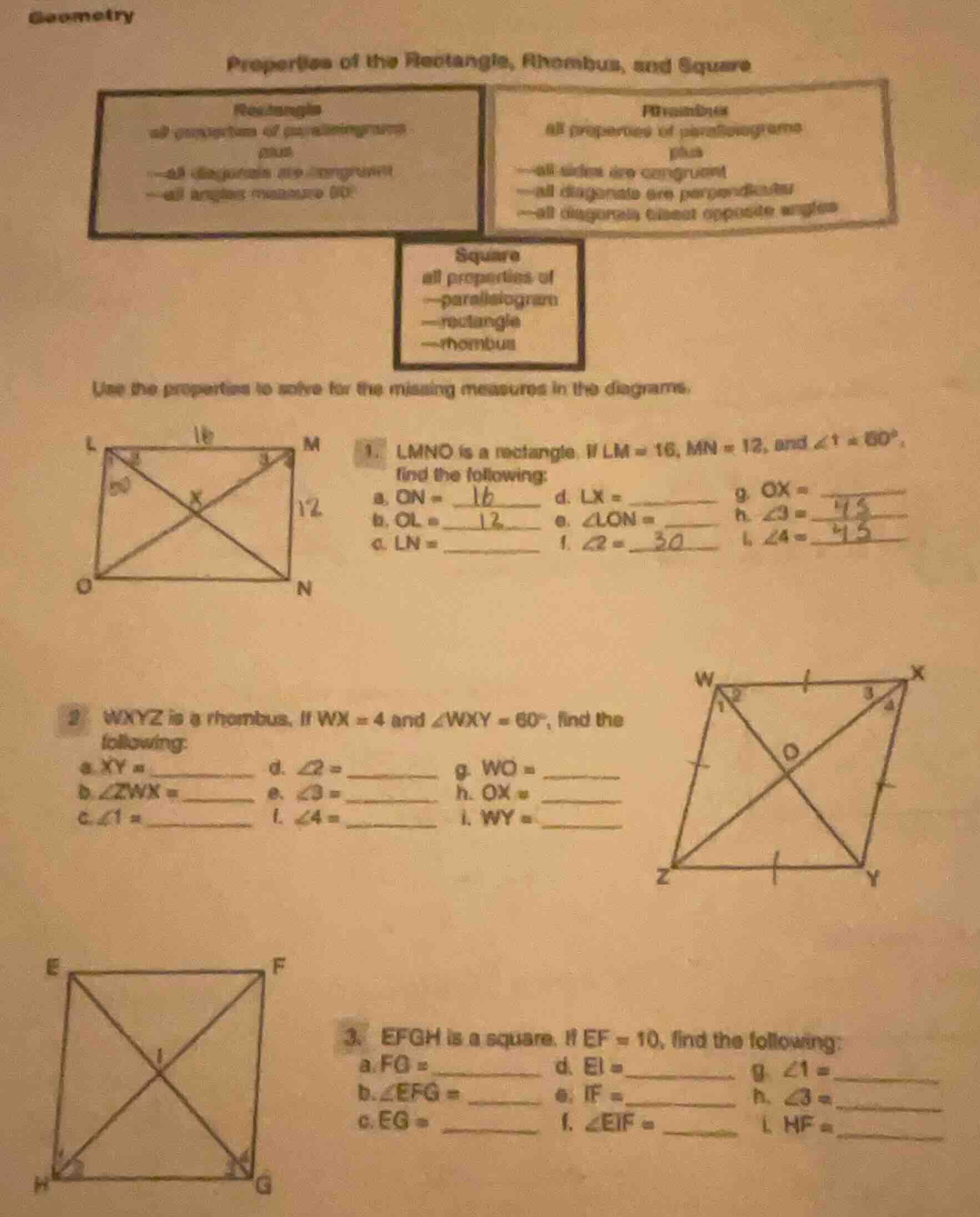
- lmno is a rectangle. if lm = 16, mn = 12, and $\angle1 = 60^\circ$, find the following:
a. on = ____ d. lx = __ g. ox = ____
b. ol = ____ e. $\angle lon$ = __ h. $\angle3$ = ____
c. ln = ____ f. $\angle2$ = __ i. $\angle4$ = ____
- wxyz is a rhombus, if wx = 4 and $\angle wxy = 60^\circ$, find the following:
a. xy = ____ d. $\angle2$ = __ g. wo = ____
b. $\angle zwx$ = ____ e. $\angle3$ = __ h. ox = ____
c. $\angle1$ = ____ f. $\angle4$ = __ i. wy = ____
- efgh is a square. if ef = 10, find the following:
a. fg = ____ d. ei = __ g. $\angle1$ = ____
b. $\angle efg$ = ____ e. if = __ h. $\angle3$ = ____
c. eg = ____ f. $\angle eif$ = __ i. hf = ____
For Problem 1 (Rectangle LMNO)
Step1: Find ON (opposite sides congruent)
In rectangles, opposite sides are equal. $ON = LM = 16$
Step2: Find OL (opposite sides congruent)
In rectangles, opposite sides are equal. $OL = MN = 12$
Step3: Calculate LN (Pythagorean theorem)
LN is the diagonal of the rectangle.
$$LN = \sqrt{LM^2 + MN^2} = \sqrt{16^2 + 12^2} = \sqrt{256+144} = \sqrt{400} = 20$$
Step4: Find LX (diagonals bisect each other)
Rectangle diagonals are congruent and bisect each other. $LX = \frac{LN}{2} = \frac{20}{2} = 10$
Step5: Find $\angle LON$ (rectangle angle property)
All rectangle angles are $90^\circ$. $\angle LON = 90^\circ$
Step6: Find $\angle 2$ (complementary to $\angle 1$)
$\angle 1 + \angle 2 = 90^\circ$, so $\angle 2 = 90^\circ - 60^\circ = 30^\circ$
Step7: Find OX (diagonals bisect each other)
Rectangle diagonals are congruent and bisect each other. $OX = \frac{LN}{2} = 10$
Step8: Find $\angle 3$ (alternate interior angles)
$\angle 3 = \angle 1 = 60^\circ$ (alternate interior angles for parallel sides)
Step9: Find $\angle 4$ (complementary to $\angle 3$)
$\angle 3 + \angle 4 = 90^\circ$, so $\angle 4 = 90^\circ - 60^\circ = 30^\circ$
Step1: Find XY (rhombus side property)
All rhombus sides are congruent. $XY = WX = 4$
Step2: Find $\angle ZWX$ (supplementary to $\angle WXY$)
Consecutive rhombus angles are supplementary. $\angle ZWX = 180^\circ - 60^\circ = 120^\circ$
Step3: Find $\angle 1$ (diagonal bisects angle)
Rhombus diagonals bisect angles. $\angle 1 = \frac{\angle WXY}{2} = \frac{60^\circ}{2} = 30^\circ$
Step4: Find $\angle 2$ (diagonal bisects angle)
Rhombus diagonals bisect angles. $\angle 2 = \frac{\angle ZWX}{2} = \frac{120^\circ}{2} = 60^\circ$
Step5: Find $\angle 3$ (alternate interior angles)
$\angle 3 = \angle 1 = 30^\circ$ (alternate interior angles for parallel sides)
Step6: Find $\angle 4$ (diagonal bisects angle)
Rhombus diagonals bisect angles. $\angle 4 = \frac{\angle WXY}{2} = 30^\circ$
Step7: Find WO (30-60-90 triangle side)
$\triangle WOX$ is a 30-60-90 triangle, $WX=4$. $WO = WX \cdot \sin(30^\circ) = 4 \cdot \frac{1}{2} = 2$
Step8: Find OX (30-60-90 triangle side)
$\triangle WOX$ is a 30-60-90 triangle. $OX = WX \cdot \cos(30^\circ) = 4 \cdot \frac{\sqrt{3}}{2} = 2\sqrt{3}$
Step9: Find WY (diagonal length)
Rhombus diagonals bisect each other. $WY = 2 \cdot WO = 2 \cdot 2 = 4$
Step1: Find FG (square side property)
All square sides are congruent. $FG = EF = 10$
Step2: Find $\angle EFG$ (square angle property)
All square angles are $90^\circ$. $\angle EFG = 90^\circ$
Step3: Calculate EG (Pythagorean theorem)
EG is the square's diagonal.
$$EG = \sqrt{EF^2 + FG^2} = \sqrt{10^2 + 10^2} = \sqrt{200} = 10\sqrt{2}$$
Step4: Find EI (diagonals bisect each other)
Square diagonals are congruent and bisect each other. $EI = \frac{EG}{2} = \frac{10\sqrt{2}}{2} = 5\sqrt{2}$
Step5: Find IF (diagonals bisect each other)
Square diagonals are congruent and bisect each other. $IF = \frac{EG}{2} = 5\sqrt{2}$
Step6: Find $\angle EIF$ (square diagonal property)
Square diagonals are perpendicular. $\angle EIF = 90^\circ$
Step7: Find $\angle 1$ (diagonal bisects angle)
Square diagonals bisect right angles. $\angle 1 = \frac{90^\circ}{2} = 45^\circ$
Step8: Find $\angle 3$ (diagonal bisects angle)
Square diagonals bisect right angles. $\angle 3 = 45^\circ$
Step9: Find HF (square diagonal property)
Square diagonals are congruent. $HF = EG = 10\sqrt{2}$

Snap & solve any problem in the app
Get step-by-step solutions on Sovi AI
Photo-based solutions with guided steps
Explore more problems and detailed explanations
a. $ON = 16$
b. $OL = 12$
c. $LN = 20$
d. $LX = 10$
e. $\angle LON = 90^\circ$
f. $\angle 2 = 30^\circ$
g. $OX = 10$
h. $\angle 3 = 60^\circ$
i. $\angle 4 = 30^\circ$
---