QUESTION IMAGE
Question
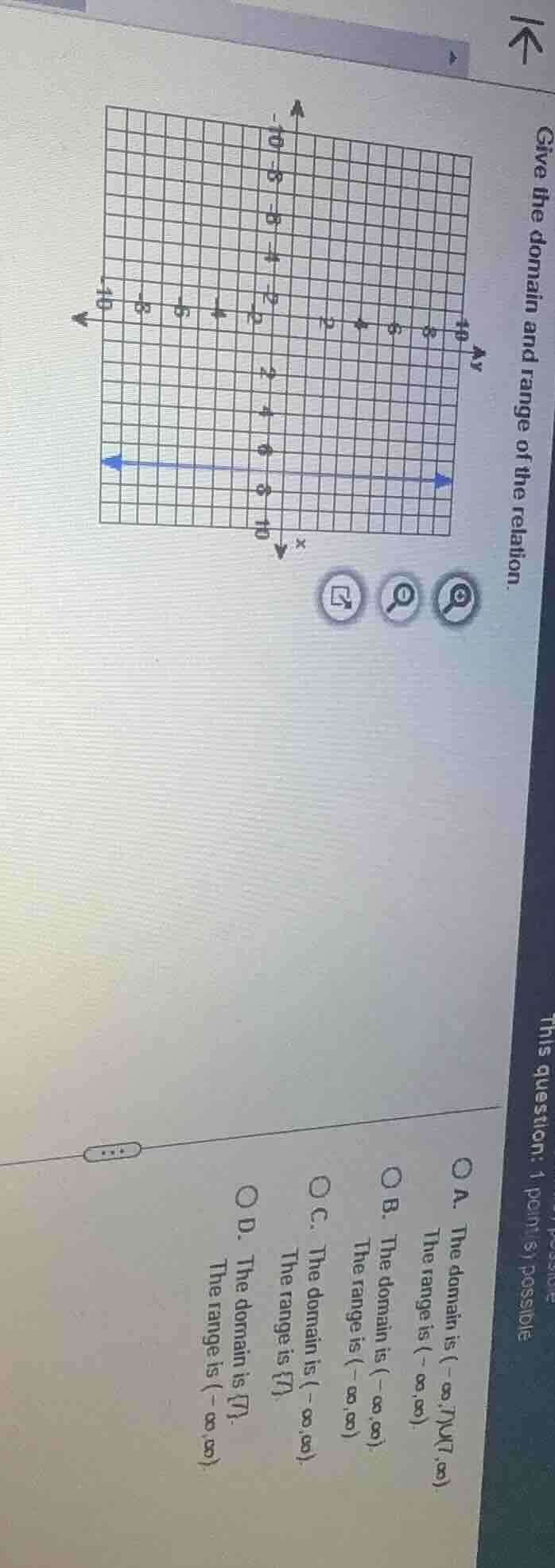
give the domain and range of the relation. a. the domain is $(-infty,7)cup(7,infty)$ the range is $(-infty,infty)$ b. the domain is $(-infty,infty)$ the range is $(-infty,infty)$ c. the domain is $(-infty,infty)$ the range is ${7}$ d. the domain is ${7}$ the range is $(-infty,infty)$
Step1: Analyze the graph (horizontal line)
The graph is a horizontal line, which means for all real - valued x (input values), the y - value (output value) is constant. From the graph, we can see that the y - coordinate of the line is 7? Wait, no, looking at the grid, the horizontal line seems to be at y = 7? Wait, no, the grid has x and y axes. Wait, the horizontal line: for a horizontal line, the domain is all real numbers because x can take any value from negative infinity to positive infinity. The range is the set of all y - values that the relation takes. Since it's a horizontal line, the y - value is constant. Wait, looking at the options, let's re - examine.
Wait, the horizontal line: domain is all real numbers (because x can be any real number, as the line extends infinitely left and right), so the domain is $(-\infty,\infty)$. The range: since it's a horizontal line, the y - value is fixed. Wait, looking at the options, option B: "The domain is $(-\infty,\infty)$ The range is $(-\infty,\infty)$" no, that's for a vertical line? Wait, no, a horizontal line has domain $(-\infty,\infty)$ and range a single value. Wait, maybe I misread the graph. Wait, the graph: the blue line is horizontal, so x can be any real number (domain $(-\infty,\infty)$), and y is a constant. But looking at the options, option B says domain $(-\infty,\infty)$ and range $(-\infty,\infty)$? No, that's wrong. Wait, maybe the line is y = 7? Wait, no, the options:
Option B: "The domain is $(-\infty,\infty)$ The range is $(-\infty,\infty)$" – no, for a horizontal line, range is a single value. Wait, maybe the graph is a horizontal line at y = 7? No, maybe I made a mistake. Wait, the options:
Wait, let's check the options again:
A. The domain is $(-\infty,7)\cup(7,\infty)$ The range is $(-\infty,\infty)$ – no, that's for a vertical line at x = 7.
B. The domain is $(-\infty,\infty)$ The range is $(-\infty,\infty)$ – no, horizontal line has range as a single value.
C. The domain is $(-\infty,\infty)$ The range is $\{7\}$ – wait, maybe the horizontal line is at y = 7. So domain is all real numbers (x can be any real number), range is just 7. But the options:
Wait, the user's options:
Option B: "The domain is $(-\infty,\infty)$ The range is $(-\infty,\infty)$" – no.
Wait, maybe the graph is a horizontal line, so domain is $(-\infty,\infty)$ (since x can be any real number) and range is a single value. But looking at the options, maybe I misread. Wait, the correct approach:
For a horizontal line (y = k, where k is a constant), the domain is all real numbers (because x can take any value from $-\infty$ to $\infty$), and the range is $\{k\}$ (only the constant y - value). But among the given options, let's check:
Wait, maybe the line is y = 7, so domain is $(-\infty,\infty)$ and range is $\{7\}$. But the options:
Option C: "The domain is $(-\infty,\infty)$ The range is $\{7\}$" – but in the options provided, let's re - check the original problem's options:
Wait, the user's options:
O A. The domain is $(-\infty,7)\cup(7,\infty)$ The range is $(-\infty,\infty)$
O B. The domain is $(-\infty,\infty)$ The range is $(-\infty,\infty)$
O C. The domain is $(-\infty,\infty)$ The range is $\{7\}$
O D. The domain is $\{7\}$ The range is $(-\infty,\infty)$
Ah! I see, I misread earlier. So for a horizontal line, the domain is all real numbers (x can be any real number, so domain $(-\infty,\infty)$) and the range is the set containing the single y - value (since the line is horizontal, y is constant). So if the horizontal line is at y = 7, then range is $\{7\}$…

Snap & solve any problem in the app
Get step-by-step solutions on Sovi AI
Photo-based solutions with guided steps
Explore more problems and detailed explanations
C. The domain is \((-\infty,\infty)\). The range is \(\{7\}\)