QUESTION IMAGE
Question
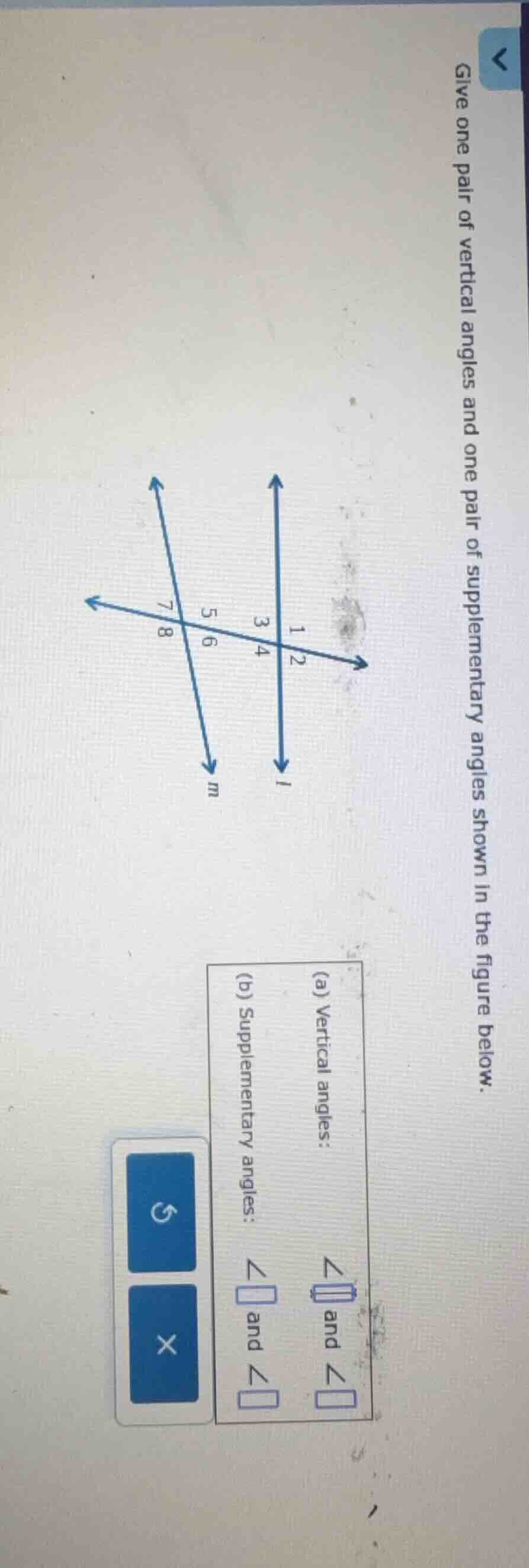
give one pair of vertical angles and one pair of supplementary angles shown in the figure below.
(a) vertical angles:
$\angle \square$ and $\angle \square$
(b) supplementary angles:
$\angle \square$ and $\angle \square$
Part (a): Vertical Angles
Vertical angles are formed when two lines intersect, and they are opposite each other. They are equal in measure. Looking at the diagram, when lines intersect, pairs like ∠1 and ∠4 (or ∠2 and ∠3, ∠5 and ∠8, ∠6 and ∠7) are vertical angles. Let's take ∠1 and ∠4 as an example.
Step1: Identify vertical angles
Vertical angles are opposite angles formed by intersecting lines. For the intersecting lines forming ∠1, ∠2, ∠3, ∠4, ∠1 and ∠4 are opposite. Similarly, for the other intersection (with angles 5,6,7,8), ∠5 and ∠8 are vertical.
Supplementary angles are two angles whose sum is 180 degrees. Adjacent angles formed by a straight line are supplementary. For example, ∠1 and ∠2 are adjacent and form a straight line, so they are supplementary. Also, ∠1 and ∠3 (since ∠2 and ∠3 are vertical, and ∠1 + ∠2 = 180, so ∠1 + ∠3 = 180 as well), or ∠5 and ∠6, etc. Let's take ∠1 and ∠2.
Step1: Identify supplementary angles
Supplementary angles sum to 180°. Angles on a straight line are supplementary. ∠1 and ∠2 are on a straight line, so their sum is 180°.

Snap & solve any problem in the app
Get step-by-step solutions on Sovi AI
Photo-based solutions with guided steps
Explore more problems and detailed explanations
(a): ∠1 and ∠4 (or other valid pairs like ∠2 and ∠3, ∠5 and ∠8, ∠6 and ∠7)