QUESTION IMAGE
Question
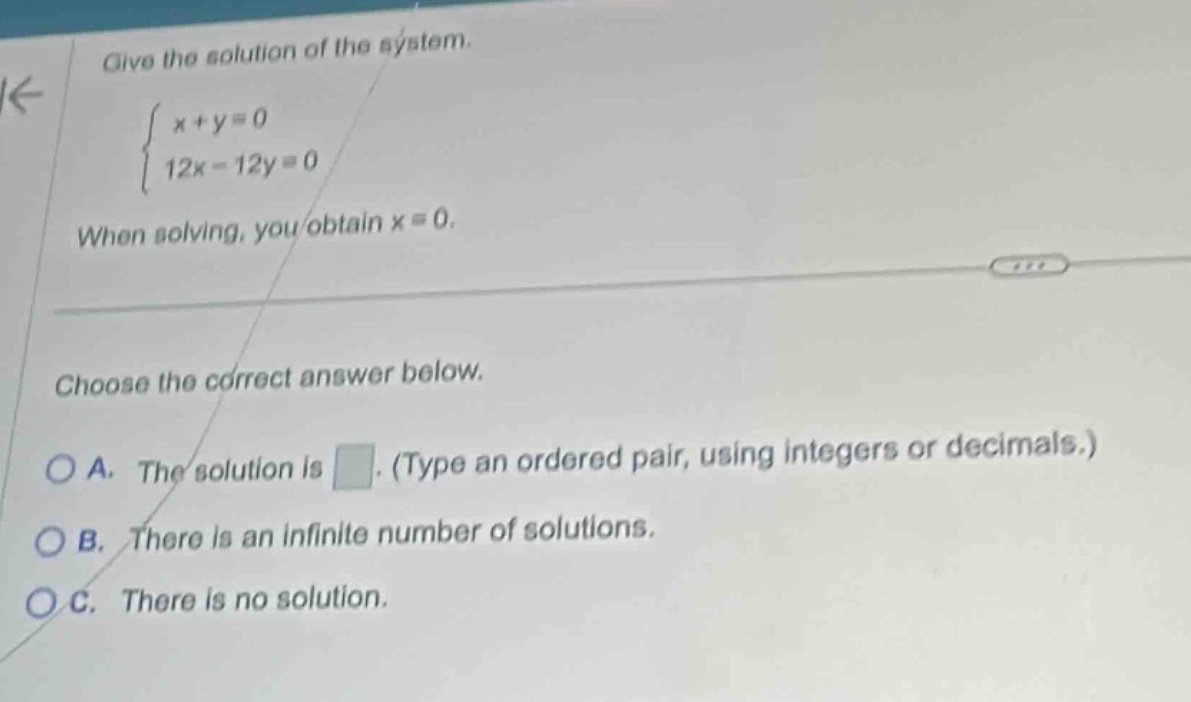
give the solution of the system.
\
when solving, you obtain x = 0.
choose the correct answer below.
\bigcirc a. the solution is \square. (type an ordered pair, using integers or decimals.)
\bigcirc b. there is an infinite number of solutions.
\bigcirc c. there is no solution.
Step1: Substitute \( x = 0 \) into the first equation
The first equation is \( x + y = 0 \). Substitute \( x = 0 \) into it: \( 0 + y = 0 \), so \( y = 0 \).
Step2: Check the second equation
The second equation is \( 12x - 12y = 0 \). Substitute \( x = 0 \) and \( y = 0 \) into it: \( 12(0) - 12(0) = 0 - 0 = 0 \), which satisfies the equation. But let's also analyze the system's nature. Simplify the second equation: divide \( 12x - 12y = 0 \) by 12, we get \( x - y = 0 \), or \( x = y \). The first equation is \( x + y = 0 \). Substitute \( x = y \) into \( x + y = 0 \), we get \( 2x = 0 \), so \( x = 0 \), then \( y = 0 \). Wait, but actually, if we rewrite the two equations: Equation 1: \( x + y = 0 \), Equation 2: \( x - y = 0 \) (after dividing by 12). Solving these two, we can add them: \( (x + y) + (x - y) = 0 + 0 \), \( 2x = 0 \), \( x = 0 \), then \( y = 0 \). But wait, is there a mistake? Wait, no—wait, the second equation was \( 12x - 12y = 0 \), which is equivalent to \( x = y \). The first equation is \( x + y = 0 \). So substituting \( y = x \) into \( x + y = 0 \) gives \( 2x = 0 \), so \( x = 0 \), \( y = 0 \). But wait, actually, let's check the system again. Wait, maybe I made a mistake. Wait, the two equations: \( x + y = 0 \) and \( 12x - 12y = 0 \). Let's solve them using elimination. Multiply the first equation by 12: \( 12x + 12y = 0 \). Then the second equation is \( 12x - 12y = 0 \). Now subtract the second equation from the first: \( (12x + 12y) - (12x - 12y) = 0 - 0 \), \( 24y = 0 \), so \( y = 0 \), then \( x = 0 \). So there is a unique solution? Wait, but the options have A as a unique solution, B as infinite, C as no solution. Wait, but according to the calculation, the solution is (0,0). But wait, let's check again. Wait, no—wait, the second equation is \( 12x - 12y = 0 \), which is the same as \( x = y \). The first equation is \( x + y = 0 \). So the only solution is \( x = 0 \), \( y = 0 \). So the solution is the ordered pair (0,0). Wait, but let's check the options. Option A says "The solution is [ ] (ordered pair)". So we need to find the ordered pair.
Wait, but wait—maybe I messed up the second equation. Let's re-express the second equation: \( 12x - 12y = 0 \) can be simplified to \( x - y = 0 \) (divide both sides by 12). So the system is:
\( x + y = 0 \)
\( x - y = 0 \)
Adding these two equations: \( 2x = 0 \implies x = 0 \). Then substituting \( x = 0 \) into \( x + y = 0 \), we get \( y = 0 \). So the solution is (0,0), which is an ordered pair. So option A is correct, and the ordered pair is (0,0).

Snap & solve any problem in the app
Get step-by-step solutions on Sovi AI
Photo-based solutions with guided steps
Explore more problems and detailed explanations
A. The solution is \((0, 0)\). (Type an ordered pair, using integers or decimals.)