QUESTION IMAGE
Question
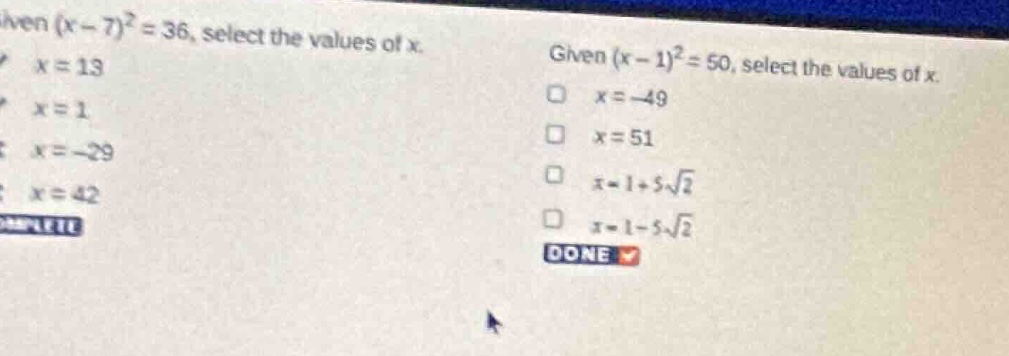
given ((x - 7)^2 = 36), select the values of (x).
(x = 13)
(x = 1)
(x = -29)
(x = 42)
complete
given ((x - 1)^2 = 50), select the values of (x).
(x = -49)
(x = 51)
(x = 1 + 5sqrt{2})
(x = 1 - 5sqrt{2})
done
First Problem: Solve \((x - 7)^2 = 36\)
Step 1: Take square root of both sides
To solve for \(x\), we start by taking the square root of both sides of the equation \((x - 7)^2 = 36\). Remember that when we take the square root of a square, we get both a positive and a negative solution. So we have:
\[
x - 7=\pm\sqrt{36}
\]
Since \(\sqrt{36} = 6\), this simplifies to:
\[
x - 7=\pm6
\]
Step 2: Solve for \(x\) in both cases
We now have two separate equations to solve:
- Case 1: \(x - 7 = 6\)
To solve for \(x\), we add 7 to both sides of the equation:
\[
x=6 + 7
\]
\[
x = 13
\]
- Case 2: \(x - 7=-6\)
Again, we add 7 to both sides of the equation:
\[
x=-6 + 7
\]
\[
x = 1
\]
Second Problem: Solve \((x - 1)^2 = 50\)
Step 1: Take square root of both sides
We start by taking the square root of both sides of the equation \((x - 1)^2 = 50\). As before, we will have a positive and a negative solution:
\[
x - 1=\pm\sqrt{50}
\]
Simplify \(\sqrt{50}\). We know that \(50 = 25\times2\), so \(\sqrt{50}=\sqrt{25\times2}=5\sqrt{2}\). So the equation becomes:
\[
x - 1=\pm5\sqrt{2}
\]
Step 2: Solve for \(x\) in both cases
We now have two separate equations to solve:
- Case 1: \(x - 1 = 5\sqrt{2}\)
To solve for \(x\), we add 1 to both sides of the equation:
\[
x=1 + 5\sqrt{2}
\]
- Case 2: \(x - 1=-5\sqrt{2}\)
Again, we add 1 to both sides of the equation:
\[
x=1-5\sqrt{2}
\]
Final Answers:
- For \((x - 7)^2 = 36\), the values of \(x\) are \(x = 13\) and \(x = 1\).
- For \((x - 1)^2 = 50\), the values of \(x\) are \(x = 1 + 5\sqrt{2}\) and \(x = 1-5\sqrt{2}\).

Snap & solve any problem in the app
Get step-by-step solutions on Sovi AI
Photo-based solutions with guided steps
Explore more problems and detailed explanations
Step 1: Take square root of both sides
We start by taking the square root of both sides of the equation \((x - 1)^2 = 50\). As before, we will have a positive and a negative solution:
\[
x - 1=\pm\sqrt{50}
\]
Simplify \(\sqrt{50}\). We know that \(50 = 25\times2\), so \(\sqrt{50}=\sqrt{25\times2}=5\sqrt{2}\). So the equation becomes:
\[
x - 1=\pm5\sqrt{2}
\]
Step 2: Solve for \(x\) in both cases
We now have two separate equations to solve:
- Case 1: \(x - 1 = 5\sqrt{2}\)
To solve for \(x\), we add 1 to both sides of the equation:
\[
x=1 + 5\sqrt{2}
\]
- Case 2: \(x - 1=-5\sqrt{2}\)
Again, we add 1 to both sides of the equation:
\[
x=1-5\sqrt{2}
\]
Final Answers:
- For \((x - 7)^2 = 36\), the values of \(x\) are \(x = 13\) and \(x = 1\).
- For \((x - 1)^2 = 50\), the values of \(x\) are \(x = 1 + 5\sqrt{2}\) and \(x = 1-5\sqrt{2}\).