QUESTION IMAGE
Question
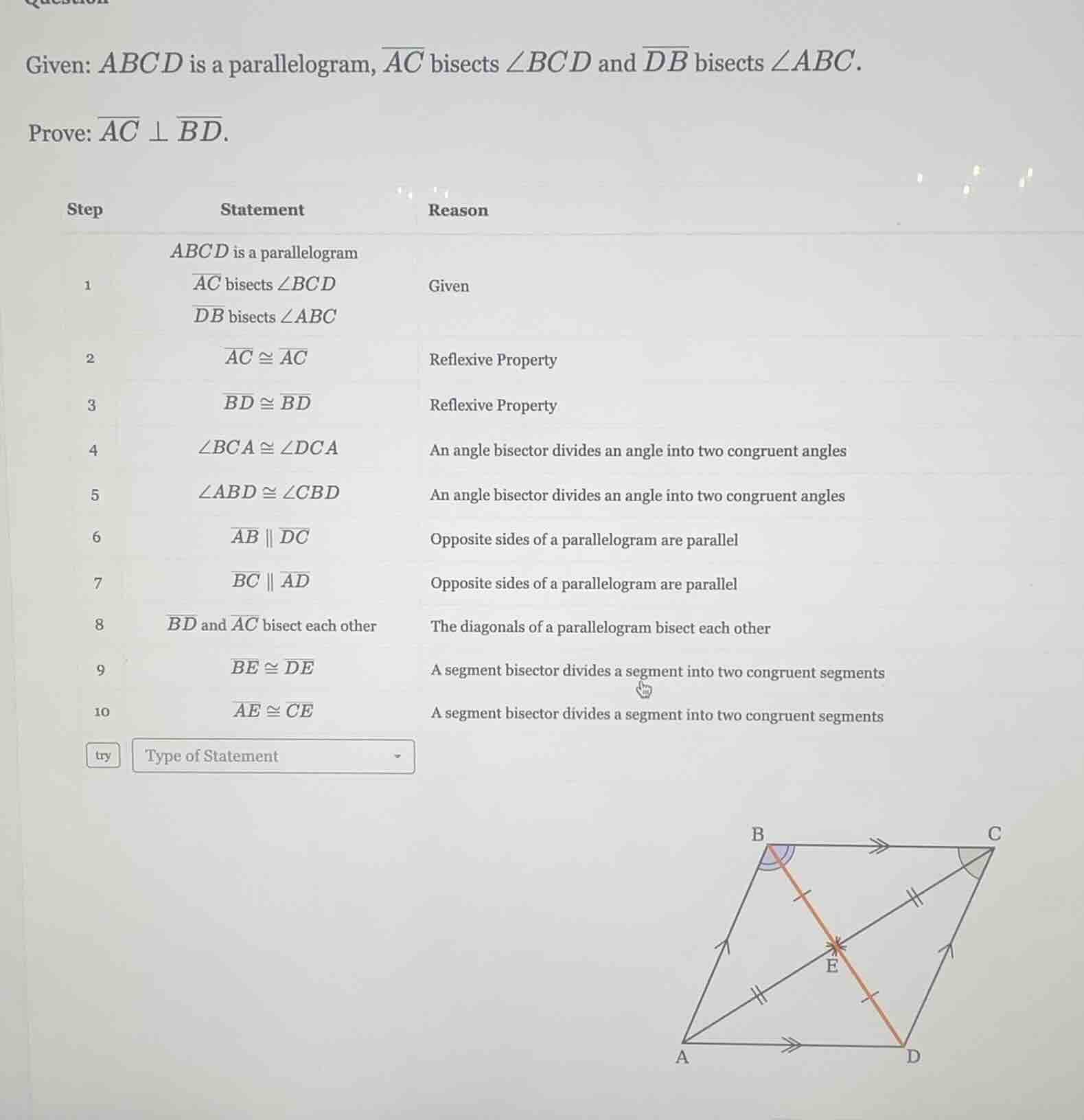
given: abcd is a parallelogram, \\(\overline{ac}\\) bisects \\(\angle bcd\\) and \\(\overline{db}\\) bisects \\(\angle abc\\). prove: \\(\overline{ac} \perp \overline{bd}\\). step statement reason 1 abcd is a parallelogram \\(\overline{ac}\\) bisects \\(\angle bcd\\) \\(\overline{db}\\) bisects \\(\angle abc\\) given 2 \\(\overline{ac} \cong \overline{ac}\\) reflexive property 3 \\(\overline{bd} \cong \overline{bd}\\) reflexive property 4 \\(\angle bca \cong \angle dca\\) an angle bisector divides an angle into two congruent angles 5 \\(\angle abd \cong \angle cbd\\) an angle bisector divides an angle into two congruent angles 6 \\(\overline{ab} \parallel \overline{dc}\\) opposite sides of a parallelogram are parallel 7 \\(\overline{bc} \parallel \overline{ad}\\) opposite sides of a parallelogram are parallel 8 \\(\overline{bd}\\) and \\(\overline{ac}\\) bisect each other the diagonals of a parallelogram bisect each other 9 \\(\overline{be} \cong \overline{de}\\) a segment bisector divides a segment into two congruent segments 10 \\(\overline{ae} \cong \overline{ce}\\) a segment bisector divides a segment into two congruent segments try type of statement image of parallelogram abcd with diagonals ac and bd intersecting at e, angle at b marked, ac with two marks, bd with two marks, sides with arrows
Step1: Use alternate interior angles
Since $\overline{AB} \parallel \overline{DC}$, $\angle BAC \cong \angle DCA$
Step2: Substitute congruent angles
From Step4, $\angle BCA \cong \angle DCA$, so $\angle BAC \cong \angle BCA$
Step3: Conclude isosceles triangle
$\triangle ABC$ is isosceles, so $\overline{AB} \cong \overline{BC}$
Step4: Identify rhombus
$ABCD$ is a parallelogram with adjacent sides congruent, so it is a rhombus
Step5: Use rhombus diagonal property
Diagonals of a rhombus are perpendicular, so $\overline{AC} \perp \overline{BD}$

Snap & solve any problem in the app
Get step-by-step solutions on Sovi AI
Photo-based solutions with guided steps
Explore more problems and detailed explanations
$\overline{AC} \perp \overline{BD}$ is proven.