QUESTION IMAGE
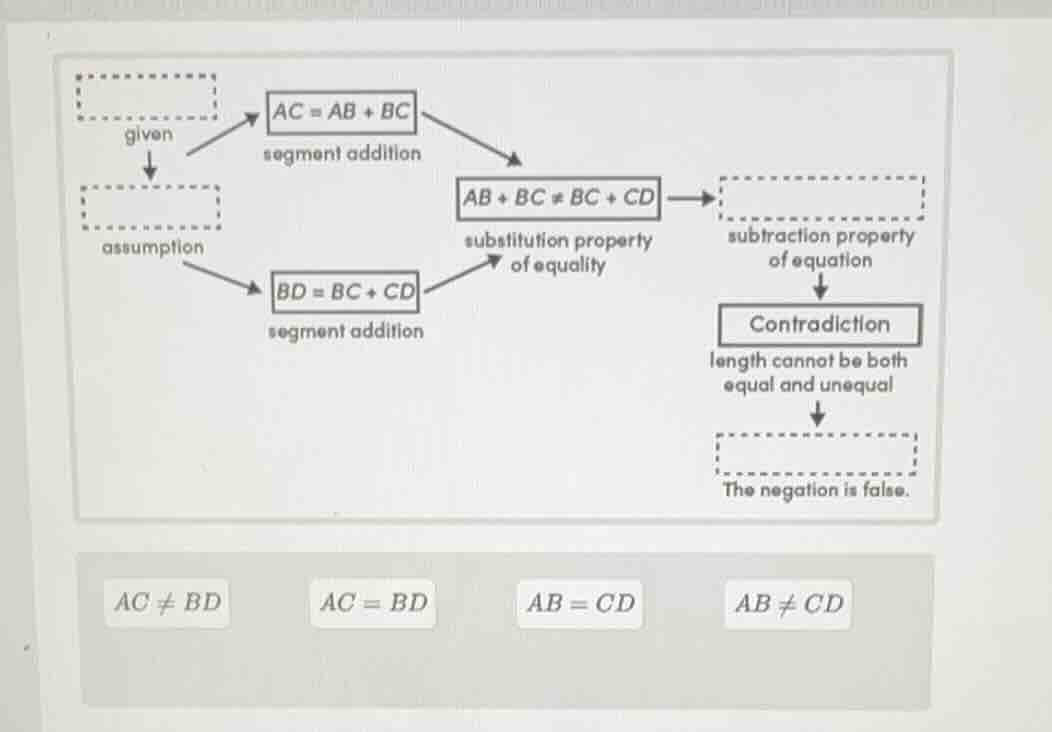
Question
given
ac = ab + bc
segment addition
assumption
bd = bc + cd
segment addition
ab + bc ≠ bc + cd
substitution property
of equality
subtraction property
of equation
contradiction
length cannot be both
equal and unequal
the negation is false.
ac ≠ bd
ac = bd
ab = cd
ab ≠ cd
Step1: Identify proof structure
This is a proof by contradiction, so we first assume the negation of the statement we want to prove.
Step2: Match given and assumption
The proof uses segment addition for $AC=AB+BC$ (given) and $BD=BC+CD$ (from assumption). We substitute into $AB+BC
eq BC+CD$, then use subtraction property to get a contradiction. The negation (assumption) must be the opposite of the conclusion. If the contradiction shows the negation is false, the conclusion is $AB=CD$, so the assumption (negation) is $AB
eq CD$, and the given is $AC=BD$.
- First dashed box (given): $AC=BD$
- Second dashed box (assumption): $AB
eq CD$
- Third dashed box (subtraction step): Subtract $BC$ from both sides of $AB+BC
eq BC+CD$, so $AB
eq CD$ (this is the step leading to contradiction)
- Final dashed box: Since negation ($AB
eq CD$) is false, the true statement is $AB=CD$.

Snap & solve any problem in the app
Get step-by-step solutions on Sovi AI
Photo-based solutions with guided steps
Explore more problems and detailed explanations
- Given (first dashed box): $\boldsymbol{AC=BD}$
- Assumption (second dashed box): $\boldsymbol{AB
eq CD}$
- Subtraction property step (third dashed box): $\boldsymbol{AB
eq CD}$
- Final conclusion (fourth dashed box leads to): $\boldsymbol{AB=CD}$
Filling the boxes in order of the flow:
- Given: $AC=BD$
- Assumption: $AB
eq CD$
- Subtraction property result: $AB
eq CD$
- Final verified statement: $AB=CD$