QUESTION IMAGE
Question
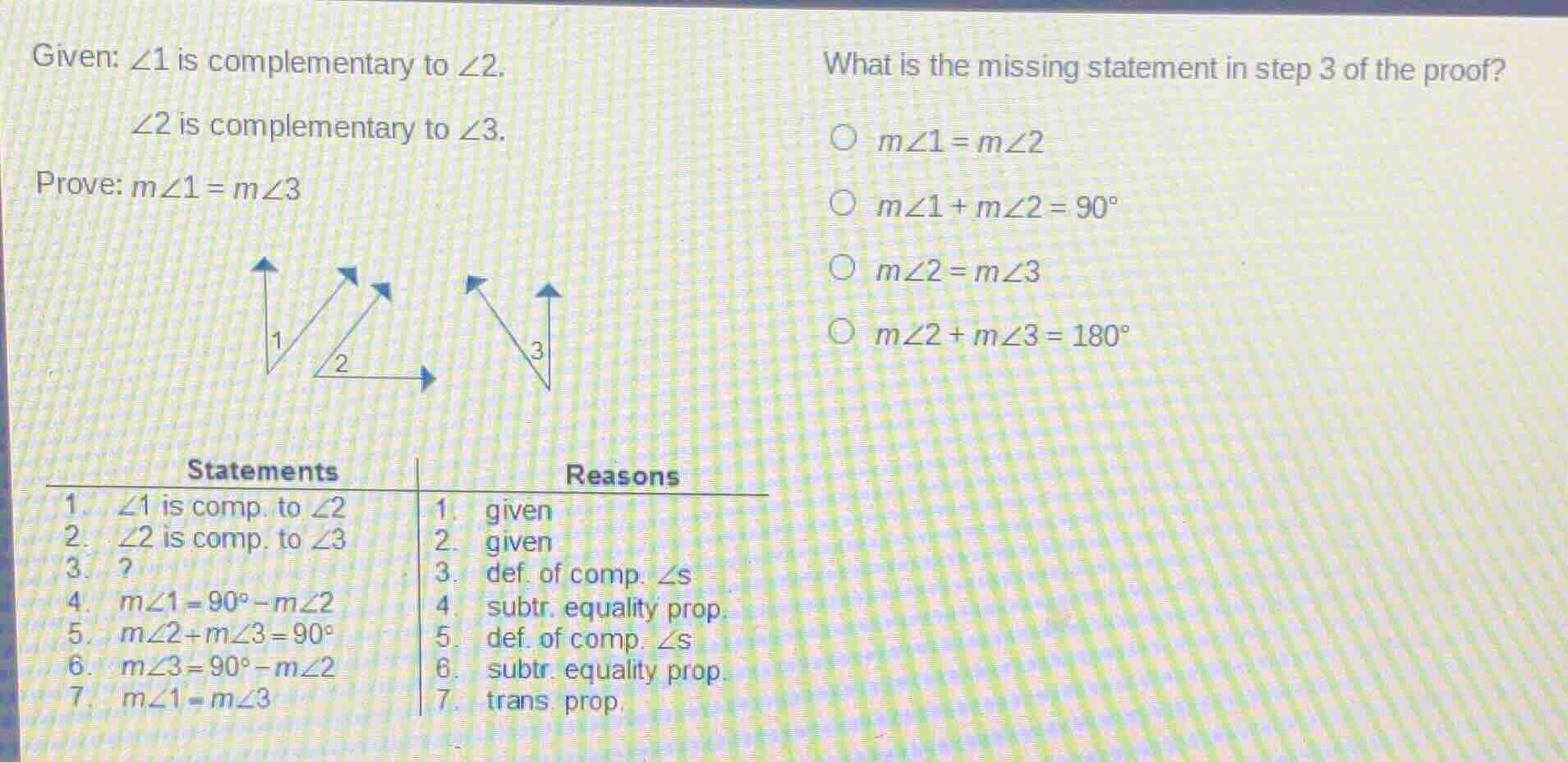
given: ∠1 is complementary to ∠2. ∠2 is complementary to ∠3. prove: ( mangle1 = mangle3 ) what is the missing statement in step 3 of the proof? ( \bigcirc mangle1 = mangle2 ) ( \bigcirc mangle1 + mangle2 = 90^circ ) ( \bigcirc mangle2 = mangle3 ) ( \bigcirc mangle2 + mangle3 = 180^circ ) statements reasons 1. ∠1 is comp. to ∠2 1. given 2. ∠2 is comp. to ∠3 2. given 3.? 3. def. of comp. ∠s 4. ( mangle1 = 90^circ - mangle2 ) 4. subtr. equality prop. 5. ( mangle2 + mangle3 = 90^circ ) 5. def. of comp. ∠s 6. ( mangle3 = 90^circ - mangle2 ) 6. subtr. equality prop. 7. ( mangle1 = mangle3 ) 7. trans prop.
To determine the missing statement in step 3, we use the definition of complementary angles (def. of comp. ∠s). Complementary angles are two angles whose measures add up to \(90^\circ\). Since \( \angle 1 \) is complementary to \( \angle 2 \), by the definition of complementary angles, \( m\angle 1 + m\angle 2 = 90^\circ \). Let's analyze the other options:
- \( m\angle 1 = m\angle 2 \): There's no reason to assume this from the given information (they are complementary, not necessarily equal).
- \( m\angle 2 = m\angle 3 \): We haven't proven this yet; step 3 should be based on the definition of complementary angles for \( \angle 1 \) and \( \angle 2 \), not a conclusion about \( \angle 2 \) and \( \angle 3 \) (that comes later).
- \( m\angle 2 + m\angle 3 = 180^\circ \): This would be true for supplementary angles, but we know \( \angle 2 \) and \( \angle 3 \) are complementary, so their sum should be \(90^\circ\), not \(180^\circ\).
So the correct statement for step 3, using the definition of complementary angles for \( \angle 1 \) and \( \angle 2 \), is \( m\angle 1 + m\angle 2 = 90^\circ \).

Snap & solve any problem in the app
Get step-by-step solutions on Sovi AI
Photo-based solutions with guided steps
Explore more problems and detailed explanations
\( m\angle 1 + m\angle 2 = 90^\circ \) (the second option: \( m\angle 1 + m\angle 2 = 90^\circ \))