QUESTION IMAGE
Question
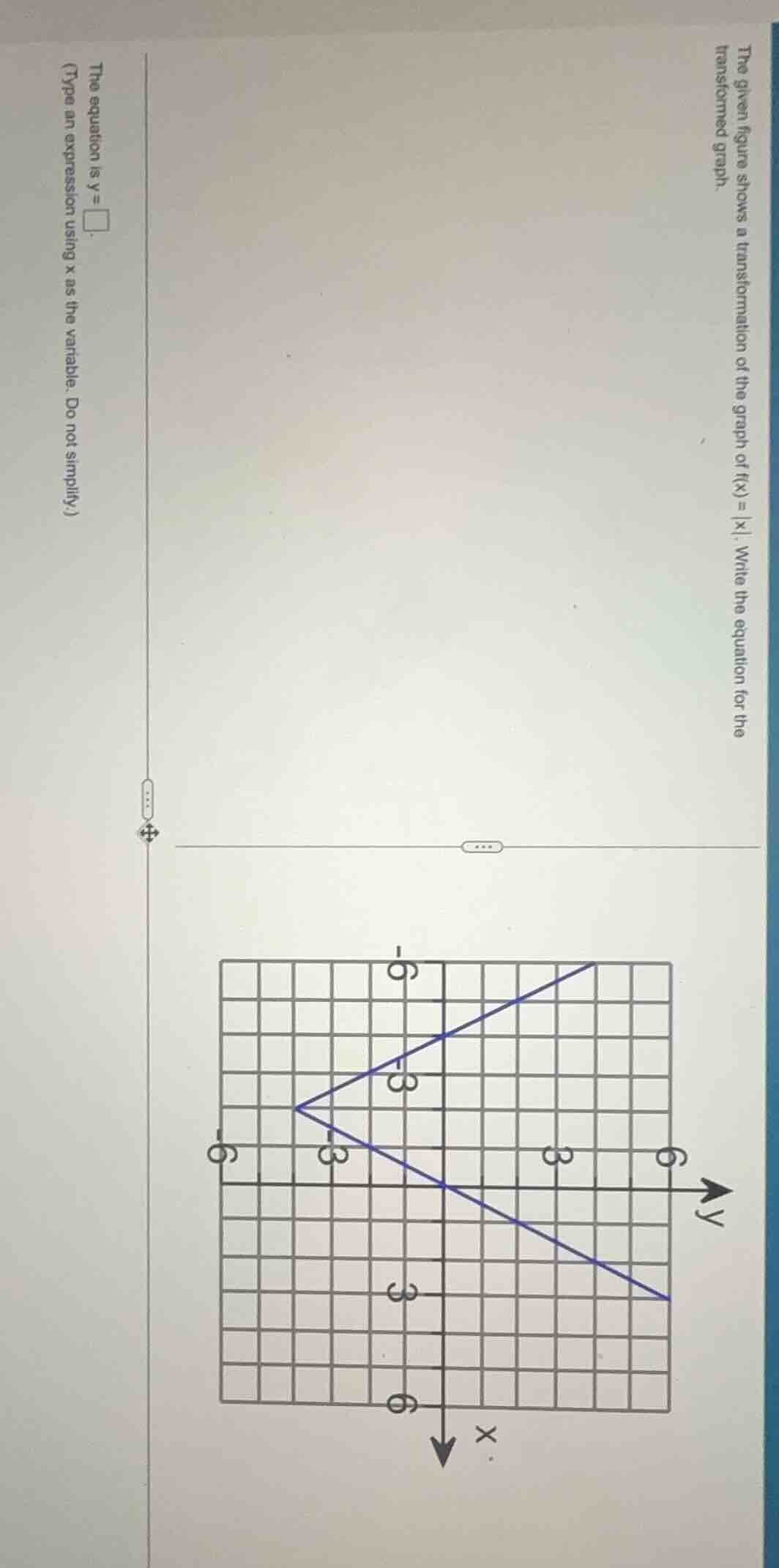
the given figure shows a transformation of the graph of ( f(x) = |x| ). write the equation for the transformed graph.
the equation is ( y = square ).
(type an expression using ( x ) as the variable. do not simplify.)
Step1: Identify the vertex of the transformed graph
The original function \( f(x) = |x| \) has its vertex at \( (0,0) \). From the graph, the vertex of the transformed absolute - value function is at \( (-3,2) \).
Step2: Recall the transformation rules for absolute - value functions
The general form of a transformed absolute - value function is \( y=a|x - h|+k \), where \( (h,k) \) is the vertex of the graph, and \( a \) is a constant that affects the slope. For the parent function \( f(x)=|x| \), when we shift the graph horizontally by \( h \) units (right if \( h>0 \), left if \( h < 0 \)) and vertically by \( k \) units (up if \( k>0 \), down if \( k < 0 \)), and also consider the slope.
The slope of the right - hand side of \( f(x)=|x| \) is \( 1 \), and the slope of the left - hand side is \( - 1 \). Looking at the transformed graph, the slope of the right - hand side line: let's take two points on the right - hand side, say when \( x = 3,y=6 \) and \( x=-3,y = 2 \). The slope \( m=\frac{6 - 2}{3-(-3)}=\frac{4}{6}=\frac{2}{3}\)? Wait, no, maybe a better way. Wait, the original \( f(x)=|x| \) has a vertex at \( (0,0) \), and the transformed vertex is at \( (h,k)=(-3,2) \). Also, let's check the direction of the opening. The graph still opens upwards (since the V - shape is pointing upwards).
The general transformation for \( y = |x| \) to \( y=a|x - h|+k \). Here, \( h=-3 \) (since we shift left 3 units, because \( x - h=x-(-3)=x + 3 \)) and \( k = 2 \) (shift up 2 units). Now, let's check the slope. For the original \( y = |x| \), when \( x>0 \), \( y=x \), slope \( = 1 \). Let's take a point on the transformed graph. Let's see, when \( x=-3 \), \( y = 2 \). When \( x = 0 \), from the graph, let's assume the right - hand side: if we move from \( x=-3,y = 2 \) to \( x = 3,y=6 \), the change in \( y \) is \( 6 - 2=4 \), change in \( x \) is \( 3-(-3)=6 \), slope \(=\frac{4}{6}=\frac{2}{3}\)? Wait, no, maybe I made a mistake. Wait, the original function \( y = |x| \) has a vertex at \( (0,0) \). The transformed function has a vertex at \( (-3,2) \). Also, let's consider the horizontal and vertical shifts first.
The horizontal shift: to get from \( x = 0 \) (vertex of original) to \( x=-3 \) (vertex of transformed), we shift left 3 units, so \( x\to x + 3 \) (because \( y = |x+3| \) would shift left 3 units, vertex at \( (-3,0) \)). Then we shift up 2 units, so \( y=|x + 3|+2 \)? Wait, no, let's check the graph again. Wait, maybe the slope is 1. Wait, the original \( y = |x| \): when \( x = 0,y = 0 \); \( x = 1,y = 1 \); \( x=-1,y = 1 \). The transformed graph: let's take the vertex at \( (-3,2) \). Let's take a point on the right side: when \( x = 0 \), what's \( y \)? From the graph, when \( x = 0 \), \( y=|0 + 3|+2=3 + 2=5 \)? Wait, no, the graph in the picture: looking at the grid, the vertex is at \( (-3,2) \). Let's check the point \( (0,5) \)? Wait, maybe I misread the graph. Wait, the user's graph: the x - axis and y - axis are labeled. Wait, the x - axis is going downwards? Wait, no, the standard coordinate system: x - axis horizontal, y - axis vertical. Wait, the graph has a vertex at \( (-3,2) \). Let's take two points on the right - hand side of the V: for example, when \( x = 3 \), \( y=6 \) and when \( x=-3 \), \( y = 2 \). The slope between these two points is \( m=\frac{6 - 2}{3-(-3)}=\frac{4}{6}=\frac{2}{3}\)? No, that can't be. Wait, maybe the original function \( y = |x| \) is transformed as follows: the vertex is at \( (-3,2) \), and the slope of the right - hand side is 1? Wait, no, let's think again.
The…

Snap & solve any problem in the app
Get step-by-step solutions on Sovi AI
Photo-based solutions with guided steps
Explore more problems and detailed explanations
\( |x + 3|+2 \)