QUESTION IMAGE
Question
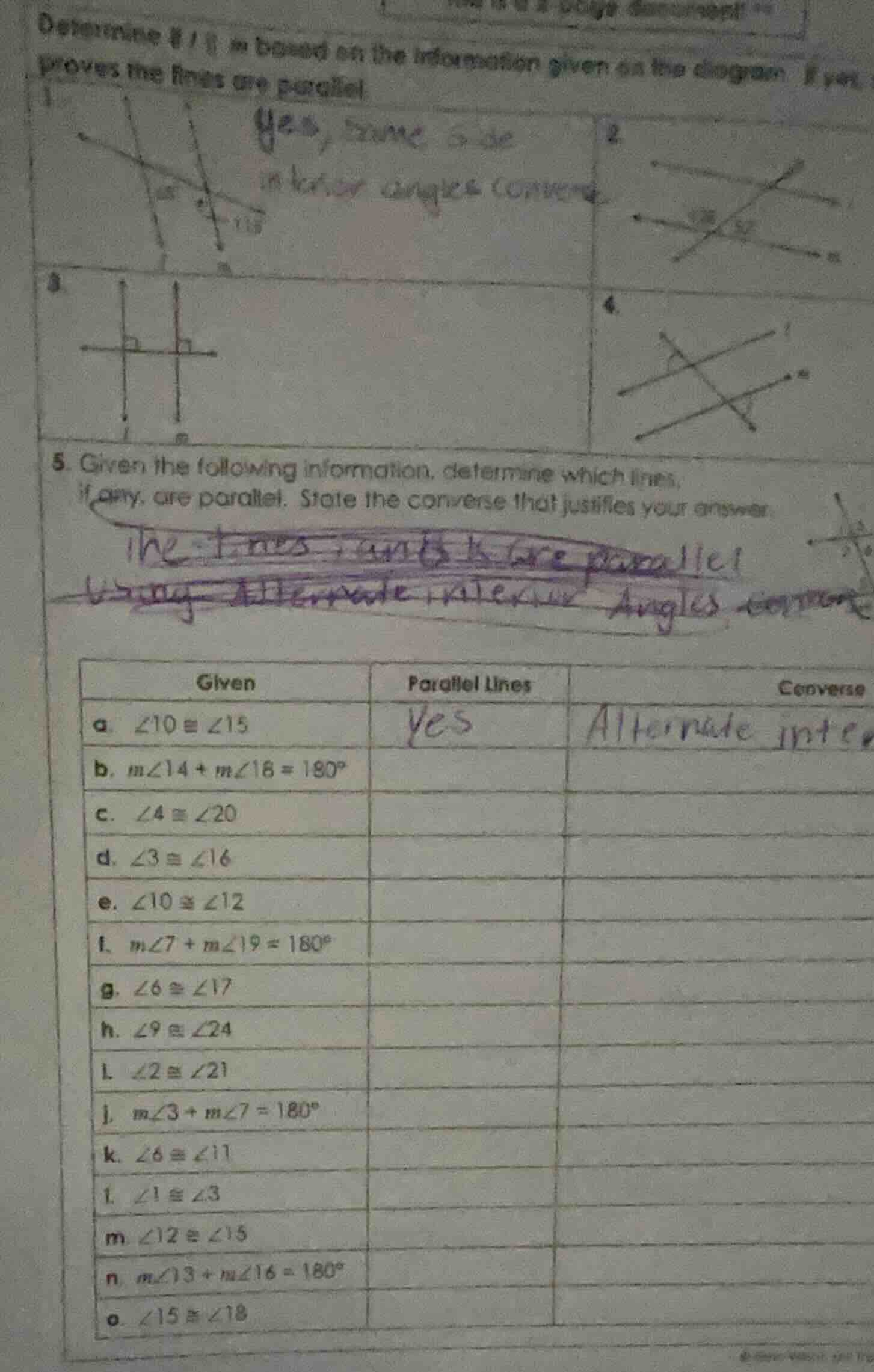
- given the following information, determine which lines, if any, are parallel. state the converse that justifies your answer.
| given | parallel lines | converse |
|---|---|---|
| b. $m\angle 14 + m\angle 18 = 180^\circ$ | ||
| c. $\angle 4 \cong \angle 20$ | ||
| d. $\angle 3 \cong \angle 16$ | ||
| e. $\angle 10 \cong \angle 12$ | ||
| f. $m\angle 7 + m\angle 19 = 180^\circ$ | ||
| g. $\angle 6 \cong \angle 17$ | ||
| h. $\angle 9 \cong \angle 24$ | ||
| i. $\angle 2 \cong \angle 21$ | ||
| j. $m\angle 3 + m\angle 7 = 180^\circ$ | ||
| k. $\angle 6 \cong \angle 11$ | ||
| l. $\angle 1 \cong \angle 3$ | ||
| m. $\angle 12 \cong \angle 15$ | ||
| n. $m\angle 13 + m\angle 16 = 180^\circ$ | ||
| o. $\angle 15 \cong \angle 18$ |
To solve each part, we use the converses of angle - related theorems for parallel lines (Alternate Interior Angles Converse, Same - Side Interior Angles Converse, Corresponding Angles Converse, Alternate Exterior Angles Converse).
Part (b)
Step 1: Identify the theorem
We know that the Same - Side Interior Angles Converse states that if two lines are cut by a transversal and the sum of the measures of a pair of same - side interior angles is \(180^{\circ}\), then the two lines are parallel.
Given \(m\angle14 + m\angle18=180^{\circ}\), \(\angle14\) and \(\angle18\) are same - side interior angles formed by a transversal cutting two lines. Let the two lines be \(a\) and \(b\) (assuming the diagram has lines \(a\) and \(b\) cut by a transversal).
So, the lines are parallel (let's assume the lines are \(a\parallel b\)) by the Same - Side Interior Angles Converse.
Step 2: Fill the table
- Parallel Lines: \(a\parallel b\) (or the relevant lines from the diagram)
- Converse: If two lines are cut by a transversal and the sum of the measures of a pair of same - side interior angles is \(180^{\circ}\), then the two lines are parallel.
Part (c)
Step 1: Identify the theorem
The Alternate Exterior Angles Converse states that if two lines are cut by a transversal and a pair of alternate exterior angles are congruent, then the two lines are parallel.
Given \(\angle4\cong\angle20\), \(\angle4\) and \(\angle20\) are alternate exterior angles formed by a transversal cutting two lines. Let the two lines be \(c\) and \(d\) (assuming the diagram has lines \(c\) and \(d\) cut by a transversal).
So, the lines are parallel (let's assume the lines are \(c\parallel d\)) by the Alternate Exterior Angles Converse.
Step 2: Fill the table
- Parallel Lines: \(c\parallel d\) (or the relevant lines from the diagram)
- Converse: If two lines are cut by a transversal and a pair of alternate exterior angles are congruent, then the two lines are parallel.
Part (d)
Step 1: Identify the theorem
The Alternate Interior Angles Converse states that if two lines are cut by a transversal and a pair of alternate interior angles are congruent, then the two lines are parallel.
Given \(\angle3\cong\angle16\), \(\angle3\) and \(\angle16\) are alternate interior angles formed by a transversal cutting two lines. Let the two lines be \(e\) and \(f\) (assuming the diagram has lines \(e\) and \(f\) cut by a transversal).
So, the lines are parallel (let's assume the lines are \(e\parallel f\)) by the Alternate Interior Angles Converse.
Step 2: Fill the table
- Parallel Lines: \(e\parallel f\) (or the relevant lines from the diagram)
- Converse: If two lines are cut by a transversal and a pair of alternate interior angles are congruent, then the two lines are parallel.
Part (e)
Step 1: Identify the theorem
The Alternate Interior Angles Converse states that if two lines are cut by a transversal and a pair of alternate interior angles are congruent, then the two lines are parallel.
Given \(\angle10\cong\angle12\), \(\angle10\) and \(\angle12\) are alternate interior angles formed by a transversal cutting two lines. Let the two lines be \(g\) and \(h\) (assuming the diagram has lines \(g\) and \(h\) cut by a transversal).
So, the lines are parallel (let's assume the lines are \(g\parallel h\)) by the Alternate Interior Angles Converse.
Step 2: Fill the table
- Parallel Lines: \(g\parallel h\) (or the relevant lines from the diagram)
- Converse: If two lines are cut by a transversal and a pair of alternate interior angles are congruent…

Snap & solve any problem in the app
Get step-by-step solutions on Sovi AI
Photo-based solutions with guided steps
Explore more problems and detailed explanations
To solve each part, we use the converses of angle - related theorems for parallel lines (Alternate Interior Angles Converse, Same - Side Interior Angles Converse, Corresponding Angles Converse, Alternate Exterior Angles Converse).
Part (b)
Step 1: Identify the theorem
We know that the Same - Side Interior Angles Converse states that if two lines are cut by a transversal and the sum of the measures of a pair of same - side interior angles is \(180^{\circ}\), then the two lines are parallel.
Given \(m\angle14 + m\angle18=180^{\circ}\), \(\angle14\) and \(\angle18\) are same - side interior angles formed by a transversal cutting two lines. Let the two lines be \(a\) and \(b\) (assuming the diagram has lines \(a\) and \(b\) cut by a transversal).
So, the lines are parallel (let's assume the lines are \(a\parallel b\)) by the Same - Side Interior Angles Converse.
Step 2: Fill the table
- Parallel Lines: \(a\parallel b\) (or the relevant lines from the diagram)
- Converse: If two lines are cut by a transversal and the sum of the measures of a pair of same - side interior angles is \(180^{\circ}\), then the two lines are parallel.
Part (c)
Step 1: Identify the theorem
The Alternate Exterior Angles Converse states that if two lines are cut by a transversal and a pair of alternate exterior angles are congruent, then the two lines are parallel.
Given \(\angle4\cong\angle20\), \(\angle4\) and \(\angle20\) are alternate exterior angles formed by a transversal cutting two lines. Let the two lines be \(c\) and \(d\) (assuming the diagram has lines \(c\) and \(d\) cut by a transversal).
So, the lines are parallel (let's assume the lines are \(c\parallel d\)) by the Alternate Exterior Angles Converse.
Step 2: Fill the table
- Parallel Lines: \(c\parallel d\) (or the relevant lines from the diagram)
- Converse: If two lines are cut by a transversal and a pair of alternate exterior angles are congruent, then the two lines are parallel.
Part (d)
Step 1: Identify the theorem
The Alternate Interior Angles Converse states that if two lines are cut by a transversal and a pair of alternate interior angles are congruent, then the two lines are parallel.
Given \(\angle3\cong\angle16\), \(\angle3\) and \(\angle16\) are alternate interior angles formed by a transversal cutting two lines. Let the two lines be \(e\) and \(f\) (assuming the diagram has lines \(e\) and \(f\) cut by a transversal).
So, the lines are parallel (let's assume the lines are \(e\parallel f\)) by the Alternate Interior Angles Converse.
Step 2: Fill the table
- Parallel Lines: \(e\parallel f\) (or the relevant lines from the diagram)
- Converse: If two lines are cut by a transversal and a pair of alternate interior angles are congruent, then the two lines are parallel.
Part (e)
Step 1: Identify the theorem
The Alternate Interior Angles Converse states that if two lines are cut by a transversal and a pair of alternate interior angles are congruent, then the two lines are parallel.
Given \(\angle10\cong\angle12\), \(\angle10\) and \(\angle12\) are alternate interior angles formed by a transversal cutting two lines. Let the two lines be \(g\) and \(h\) (assuming the diagram has lines \(g\) and \(h\) cut by a transversal).
So, the lines are parallel (let's assume the lines are \(g\parallel h\)) by the Alternate Interior Angles Converse.
Step 2: Fill the table
- Parallel Lines: \(g\parallel h\) (or the relevant lines from the diagram)
- Converse: If two lines are cut by a transversal and a pair of alternate interior angles are congruent, then the two lines are parallel.
Part (f)
Step 1: Identify the theorem
The Same - Side Interior Angles Converse states that if two lines are cut by a transversal and the sum of the measures of a pair of same - side interior angles is \(180^{\circ}\), then the two lines are parallel.
Given \(m\angle7 + m\angle19 = 180^{\circ}\), \(\angle7\) and \(\angle19\) are same - side interior angles formed by a transversal cutting two lines. Let the two lines be \(i\) and \(j\) (assuming the diagram has lines \(i\) and \(j\) cut by a transversal).
So, the lines are parallel (let's assume the lines are \(i\parallel j\)) by the Same - Side Interior Angles Converse.
Step 2: Fill the table
- Parallel Lines: \(i\parallel j\) (or the relevant lines from the diagram)
- Converse: If two lines are cut by a transversal and the sum of the measures of a pair of same - side interior angles is \(180^{\circ}\), then the two lines are parallel.
Part (g)
Step 1: Identify the theorem
The Corresponding Angles Converse states that if two lines are cut by a transversal and a pair of corresponding angles are congruent, then the two lines are parallel.
Given \(\angle6\cong\angle17\), \(\angle6\) and \(\angle17\) are corresponding angles formed by a transversal cutting two lines. Let the two lines be \(k\) and \(l\) (assuming the diagram has lines \(k\) and \(l\) cut by a transversal).
So, the lines are parallel (let's assume the lines are \(k\parallel l\)) by the Corresponding Angles Converse.
Step 2: Fill the table
- Parallel Lines: \(k\parallel l\) (or the relevant lines from the diagram)
- Converse: If two lines are cut by a transversal and a pair of corresponding angles are congruent, then the two lines are parallel.
Part (h)
Step 1: Identify the theorem
The Corresponding Angles Converse states that if two lines are cut by a transversal and a pair of corresponding angles are congruent, then the two lines are parallel.
Given \(\angle9\cong\angle24\), \(\angle9\) and \(\angle24\) are corresponding angles formed by a transversal cutting two lines. Let the two lines be \(m\) and \(n\) (assuming the diagram has lines \(m\) and \(n\) cut by a transversal).
So, the lines are parallel (let's assume the lines are \(m\parallel n\)) by the Corresponding Angles Converse.
Step 2: Fill the table
- Parallel Lines: \(m\parallel n\) (or the relevant lines from the diagram)
- Converse: If two lines are cut by a transversal and a pair of corresponding angles are congruent, then the two lines are parallel.
Part (i)
Step 1: Identify the theorem
The Alternate Exterior Angles Converse states that if two lines are cut by a transversal and a pair of alternate exterior angles are congruent, then the two lines are parallel.
Given \(\angle2\cong\angle21\), \(\angle2\) and \(\angle21\) are alternate exterior angles formed by a transversal cutting two lines. Let the two lines be \(p\) and \(q\) (assuming the diagram has lines \(p\) and \(q\) cut by a transversal).
So, the lines are parallel (let's assume the lines are \(p\parallel q\)) by the Alternate Exterior Angles Converse.
Step 2: Fill the table
- Parallel Lines: \(p\parallel q\) (or the relevant lines from the diagram)
- Converse: If two lines are cut by a transversal and a pair of alternate exterior angles are congruent, then the two lines are parallel.
Part (j)
Step 1: Identify the theorem
The Same - Side Interior Angles Converse states that if two lines are cut by a transversal and the sum of the measures of a pair of same - side interior angles is \(180^{\circ}\), then the two lines are parallel.
Given \(m\angle3 + m\angle7=180^{\circ}\), \(\angle3\) and \(\angle7\) are same - side interior angles formed by a transversal cutting two lines. Let the two lines be \(r\) and \(s\) (assuming the diagram has lines \(r\) and \(s\) cut by a transversal).
So, the lines are parallel (let's assume the lines are \(r\parallel s\)) by the Same - Side Interior Angles Converse.
Step 2: Fill the table
- Parallel Lines: \(r\parallel s\) (or the relevant lines from the diagram)
- Converse: If two lines are cut by a transversal and the sum of the measures of a pair of same - side interior angles is \(180^{\circ}\), then the two lines are parallel.
Part (k)
Step 1: Identify the theorem
The Alternate Interior Angles Converse states that if two lines are cut by a transversal and a pair of alternate interior angles are congruent, then the two lines are parallel.
Given \(\angle6\cong\angle11\), \(\angle6\) and \(\angle11\) are alternate interior angles formed by a transversal cutting two lines. Let the two lines be \(t\) and \(u\) (assuming the diagram has lines \(t\) and \(u\) cut by a transversal).
So, the lines are parallel (let's assume the lines are \(t\parallel u\)) by the Alternate Interior Angles Converse.
Step 2: Fill the table
- Parallel Lines: \(t\parallel u\) (or the relevant lines from the diagram)
- Converse: If two lines are cut by a transversal and a pair of alternate interior angles are congruent, then the two lines are parallel.
Part (l)
Step 1: Analyze the angles
\(\angle1\) and \(\angle3\) are vertical angles (by the Vertical Angles Theorem, vertical angles are always congruent). The congruence of vertical angles does not imply that two lines are parallel (since vertical angles are congruent regardless of whether the lines are parallel or not). So, no lines are parallel.
Step 2: Fill the table
- Parallel Lines: None
- Converse: N/A (since the angle relationship does not correspond to a parallel - line - determining converse)
Part (m)
Step 1: Identify the theorem
The Corresponding Angles Converse states that if two lines are cut by a transversal and a pair of corresponding angles are congruent, then the two lines are parallel.
Given \(\angle12\cong\angle15\), \(\angle12\) and \(\angle15\) are corresponding angles formed by a transversal cutting two lines. Let the two lines be \(v\) and \(w\) (assuming the diagram has lines \(v\) and \(w\) cut by a transversal).
So, the lines are parallel (let's assume the lines are \(v\parallel w\)) by the Corresponding Angles Converse.
Step 2: Fill the table
- Parallel Lines: \(v\parallel w\) (or the relevant lines from the diagram)
- Converse: If two lines are cut by a transversal and a pair of corresponding angles are congruent, then the two lines are parallel.
Part (n)
Step 1: Identify the theorem
The Same - Side Interior Angles Converse states that if two lines are cut by a transversal and the sum of the measures of a pair of same - side interior angles is \(180^{\circ}\), then the two lines are parallel.
Given \(m\angle13 + m\angle16 = 180^{\circ}\), \(\angle13\) and \(\angle16\) are same - side interior angles formed by a transversal cutting two lines. Let the two lines be \(x\) and \(y\) (assuming the diagram has lines \(x\) and \(y\) cut by a transversal).
So, the lines are parallel (let's assume the lines are \(x\parallel y\)) by the Same - Side Interior Angles Converse.
Step 2: Fill the table
- Parallel Lines: \(x\parallel y\) (or the relevant lines from the diagram)
- Converse: If two lines are cut by a transversal and the sum of the measures of a pair of same - side interior angles is \(180^{\circ}\), then the two lines are parallel.
Part (o)
Step 1: Analyze the angles
\(\angle15\) and \(\angle18\) are vertical angles (by the Vertical Angles Theorem, vertical angles are always congruent). The congruence of vertical angles does not imply that two lines are parallel (since vertical angles are congruent regardless of whether the lines are parallel or not). So, no lines are parallel.
Step 2: Fill the table
- Parallel Lines: None
- Converse: N/A (since the angle relationship does not correspond to a parallel - line - determining converse)
Final Table (Summary)
| Given | Parallel Lines | Converse |
|---|---|---|
| b. \(m\angle14 + m\angle18 = 180^{\circ}\) | (Depends on diagram, e.g., \(a\parallel b\)) | Same - Side Interior Angles Converse |
| c. \(\angle4\cong\angle20\) | (Depends on diagram, e.g., \(c\parallel d\)) | Alternate Exterior Angles Converse |
| d. \(\angle3\cong\angle16\) | (Depends on diagram, e.g., \(e\parallel f\)) | Alternate Interior Angles Converse |
| e. \(\angle10\cong\angle12\) | (Depends on diagram, e.g., \(g\parallel h\)) | Alternate Interior Angles Converse |
| f. \(m\angle7 + m\angle19 = 180^{\circ}\) | (Depends on diagram, e.g., \(i\parallel j\)) | Same - Side Interior Angles Converse |
| g. \(\angle6\cong\angle17\) | (Depends on diagram, e.g., \(k\parallel l\)) | Corresponding Angles Converse |
| h. \(\angle9\cong\angle24\) | (Depends on diagram, e.g., \(m\parallel n\)) | Corresponding Angles Converse |
| i. \(\angle2\cong\angle21\) | (Depends on diagram, e.g., \(p\parallel q\)) | Alternate Exterior Angles Converse |
| j. \(m\angle3 + m\angle7 = 180^{\circ}\) | (Depends on diagram, e.g., \(r\parallel s\)) | Same - Side Interior Angles Converse |
| k. \(\angle6\cong\angle11\) | (Depends on diagram, e.g., \(t\parallel u\)) | Alternate Interior Angles Converse |
| l. \(\angle1\cong\angle3\) | None | N/A |
| m. \(\angle12\cong\angle15\) | (Depends on diagram, e.g., \(v\parallel w\)) | Corresponding Angles Converse |
| n. \(m\angle13 + m\angle16 = 180^{\circ}\) | (Depends on diagram, e.g., \(x\parallel y\)) | Same - Side Interior Angles Converse |
| o. \(\angle15\cong\angle18\) | None | N/A |
(Note: The actual parallel lines depend on the specific diagram which is not fully visible, but the above is the general approach using the relevant angle - parallel line converses)