QUESTION IMAGE
Question
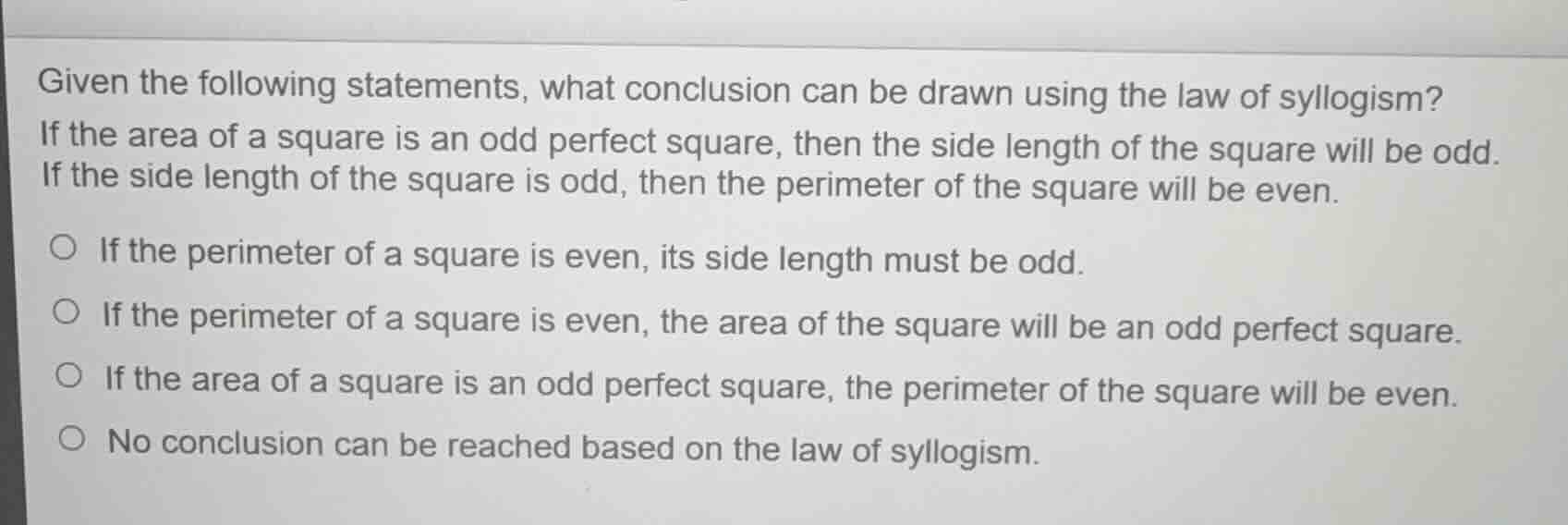
given the following statements, what conclusion can be drawn using the law of syllogism?
if the area of a square is an odd perfect square, then the side length of the square will be odd.
if the side length of the square is odd, then the perimeter of the square will be even.
○ if the perimeter of a square is even, its side length must be odd.
○ if the perimeter of a square is even, the area of the square will be an odd perfect square.
○ if the area of a square is an odd perfect square, the perimeter of the square will be even.
○ no conclusion can be reached based on the law of syllogism.
The law of syllogism states that if we have two conditional statements: "If P, then Q" and "If Q, then R", we can conclude "If P, then R". Here, let P = "the area of a square is an odd perfect square", Q = "the side length of the square is odd", and R = "the perimeter of the square will be even". The given statements fit the syllogism structure, so we can link P directly to R.

Snap & solve any problem in the app
Get step-by-step solutions on Sovi AI
Photo-based solutions with guided steps
Explore more problems and detailed explanations
If the area of a square is an odd perfect square, the perimeter of the square will be even.