QUESTION IMAGE
Question
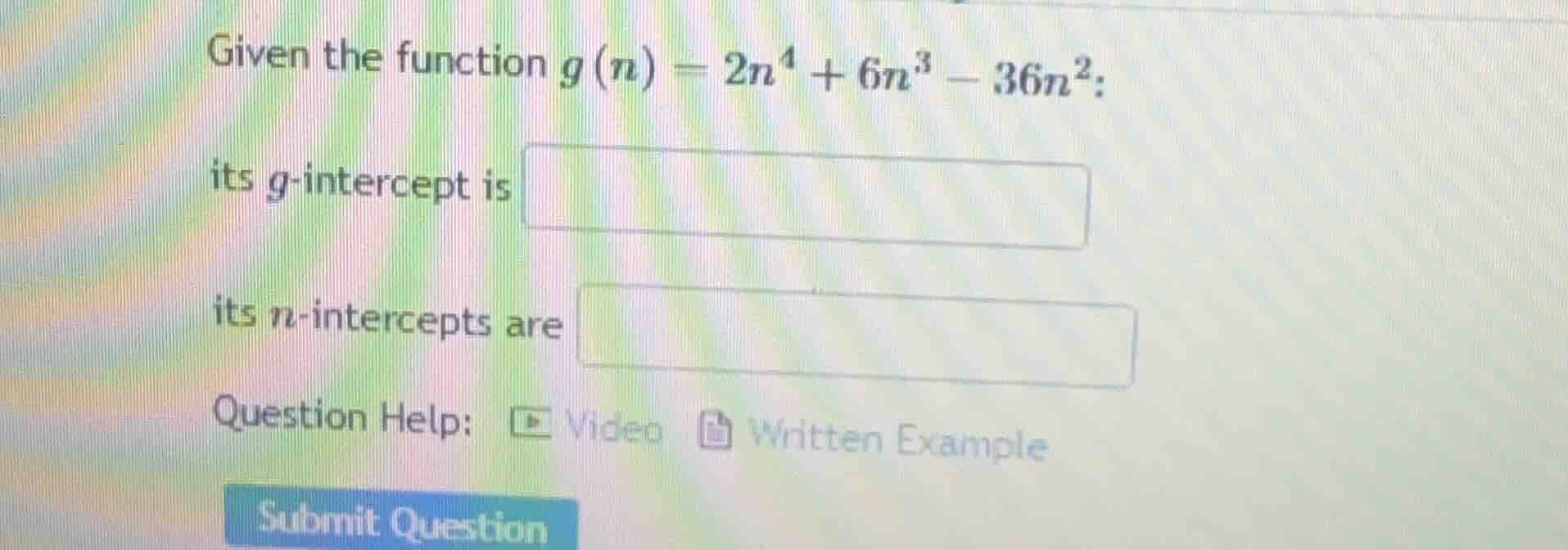
given the function $g(n)=2n^4 + 6n^3 - 36n^2$: its $g$-intercept is its $n$-intercepts are question help: video written example submit question
Part 1: Find the \( g \)-intercept
Step 1: Recall the definition of \( g \)-intercept
The \( g \)-intercept is the value of \( g(n) \) when \( n = 0 \). So we substitute \( n = 0 \) into the function \( g(n)=2n^{4}+6n^{3}-36n^{2} \).
\[
g(0)=2(0)^{4}+6(0)^{3}-36(0)^{2}
\]
Step 2: Simplify the expression
Any number raised to the power of 0 is 1, but 0 raised to any positive power is 0. So \( (0)^{4}=0 \), \( (0)^{3}=0 \), and \( (0)^{2}=0 \). Then:
\[
g(0)=2\times0 + 6\times0-36\times0=0
\]
So the \( g \)-intercept is at the point \( (0,0) \), and the value of the \( g \)-intercept (the \( y \)-value when \( n = 0 \)) is \( 0 \).
Part 2: Find the \( n \)-intercepts
Step 1: Recall the definition of \( n \)-intercepts
The \( n \)-intercepts are the values of \( n \) when \( g(n)=0 \). So we set \( g(n) = 0 \) and solve for \( n \):
\[
2n^{4}+6n^{3}-36n^{2}=0
\]
Step 2: Factor out the greatest common factor (GCF)
The GCF of \( 2n^{4} \), \( 6n^{3} \), and \( - 36n^{2} \) is \( 2n^{2} \). Factoring that out:
\[
2n^{2}(n^{2}+3n - 18)=0
\]
Step 3: Factor the quadratic expression
We need to factor \( n^{2}+3n - 18 \). We look for two numbers that multiply to \( - 18 \) and add up to \( 3 \). The numbers are \( 6 \) and \( - 3 \). So:
\[
n^{2}+3n - 18=(n + 6)(n - 3)
\]
Now our factored form is:
\[
2n^{2}(n + 6)(n - 3)=0
\]
Step 4: Use the zero - product property
The zero - product property states that if \( ab = 0 \), then either \( a = 0 \) or \( b = 0 \). So we set each factor equal to zero:
- For \( 2n^{2}=0 \), dividing both sides by \( 2 \) gives \( n^{2}=0 \), so \( n = 0 \) (with multiplicity 2).
- For \( n + 6=0 \), subtracting \( 6 \) from both sides gives \( n=-6 \).
- For \( n - 3=0 \), adding \( 3 \) to both sides gives \( n = 3 \).

Snap & solve any problem in the app
Get step-by-step solutions on Sovi AI
Photo-based solutions with guided steps
Explore more problems and detailed explanations
s:
- The \( g \)-intercept is \( \boldsymbol{0} \) (the point is \( (0,0) \), and the \( g \)-intercept value is \( 0 \)).
- The \( n \)-intercepts are \( \boldsymbol{n = 0} \) (with multiplicity 2), \( \boldsymbol{n=-6} \), and \( \boldsymbol{n = 3} \) (or in the form of points: \( (0,0) \), \( (-6,0) \), \( (3,0) \)). If we just list the \( n \)-values, they are \( 0,-6,3 \).