QUESTION IMAGE
Question
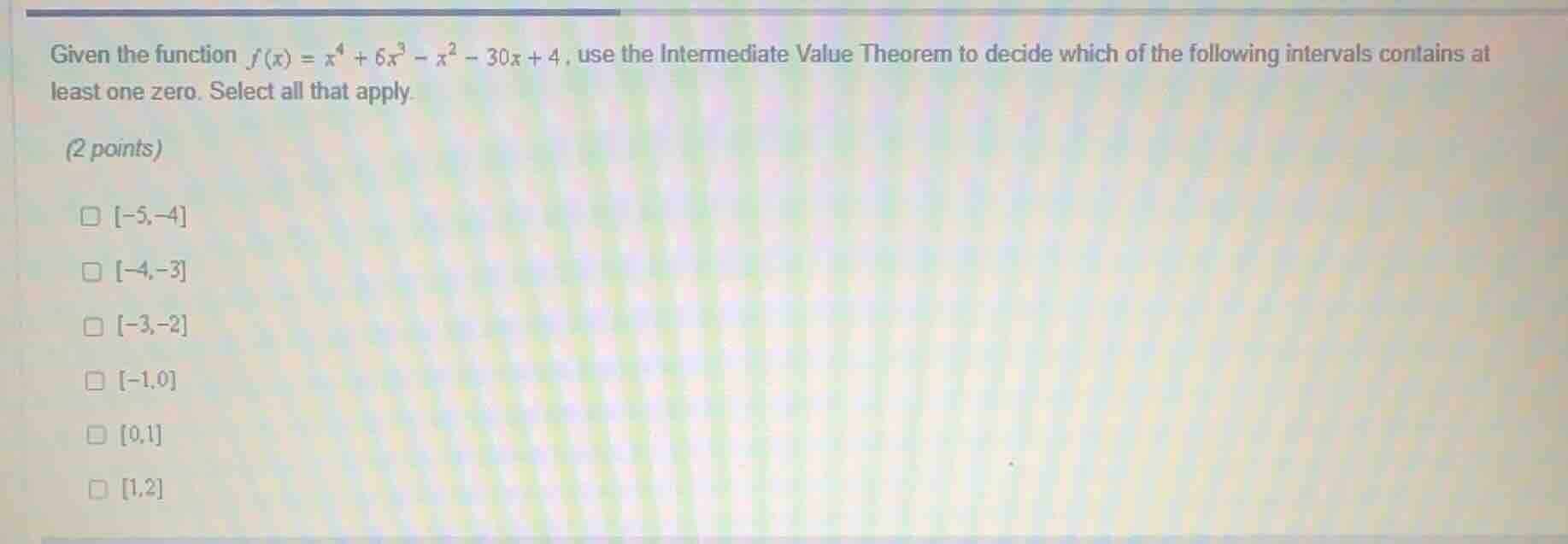
given the function $f(x) = x^4 + 6x^3 - x^2 - 30x + 4$, use the intermediate value theorem to decide which of the following intervals contains at least one zero. select all that apply. (2 points) $-5,-4$ $-4,-3$ $-3,-2$ $-1,0$ $0,1$ $1,2$
The Intermediate Value Theorem states that if a function \( f(x) \) is continuous on a closed interval \([a, b]\), and \( k \) is a number between \( f(a) \) and \( f(b) \), then there exists at least one number \( c \) in the interval \((a, b)\) such that \( f(c) = k \). In particular, if \( f(a) \) and \( f(b) \) have opposite signs, then there is at least one zero of the function in the interval \((a, b)\).
We are given the function \( f(x) = x^4 + 6x^3 - x^2 - 30x + 4 \). We need to evaluate \( f(x) \) at the endpoints of each interval and check if the function values have opposite signs.
Step 1: Evaluate \( f(x) \) at \( x = -5 \) and \( x = -4 \)
For \( x = -5 \):
\[
\]
For \( x = -4 \):
\[
\]
Since \( f(-5) = 4 \) and \( f(-4) = -20 \), and \( 4 \) and \( -20 \) have opposite signs, by the Intermediate Value Theorem, there is at least one zero in the interval \([-5, -4]\).
Step 2: Evaluate \( f(x) \) at \( x = -4 \) and \( x = -3 \)
We already know \( f(-4) = -20 \).
For \( x = -3 \):
\[
\]
Since \( f(-4) = -20 \) and \( f(-3) = 4 \), and \( -20 \) and \( 4 \) have opposite signs, there is at least one zero in the interval \([-4, -3]\).
Step 3: Evaluate \( f(x) \) at \( x = -3 \) and \( x = -2 \)
We know \( f(-3) = 4 \).
For \( x = -2 \):
\[
\]
Since \( f(-3) = 4 \) and \( f(-2) = 28 \), both are positive, so no zero in \([-3, -2]\).
Step 4: Evaluate \( f(x) \) at \( x = -1 \) and \( x = 0 \)
For \( x = -1 \):
\[
\]
For \( x = 0 \):
\[
f(0) = 0^4 + 6(0)^3 - 0^2 - 30(0) + 4 = 4
\]
Both \( f(-1) = 28 \) and \( f(0) = 4 \) are positive, so no zero in \([-1, 0]\).
Step 5: Evaluate \( f(x) \) at \( x = 0 \) and \( x = 1 \)
We know \( f(0) = 4 \).
For \( x = 1 \):
\[
\]
Since \( f(0) = 4 \) and \( f(1) = -20 \), they have opposite signs, so there is at least one zero in \([0, 1]\).
Step 6: Evaluate \( f(x) \) at \( x = 1 \) and \( x = 2 \)
We know \( f(1) = -20 \).
For \( x = 2 \):
\[
\]
Since \( f(1) = -20 \) and \( f(2) = 4 \), they have opposite signs, so there is at least one zero in \([1, 2]\).

Snap & solve any problem in the app
Get step-by-step solutions on Sovi AI
Photo-based solutions with guided steps
Explore more problems and detailed explanations
The intervals that contain at least one zero are:
- \([-5, -4]\)
- \([-4, -3]\)
- \([0, 1]\)
- \([1, 2]\)