QUESTION IMAGE
Question
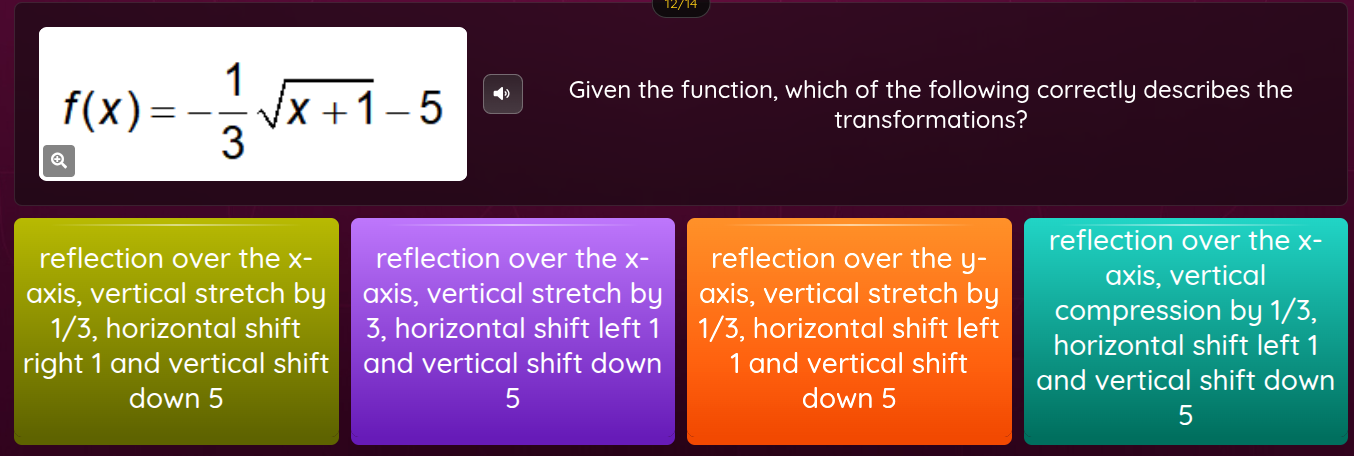
f(x) = -\frac{1}{3}\sqrt{x + 1} - 5 given the function, which of the following correctly describes the transformations? reflection over the x-axis, vertical stretch by 1/3, horizontal shift right 1 and vertical shift down 5; reflection over the x-axis, vertical stretch by 3, horizontal shift left 1 and vertical shift down 5; reflection over the y-axis, vertical stretch by 1/3, horizontal shift left 1 and vertical shift down 5; reflection over the x-axis, vertical compression by 1/3, horizontal shift left 1 and vertical shift down 5
Step1: Recall transformation rules for square root functions
For a function \( y = a\sqrt{b(x - h)}+k \):
- Reflection over x - axis: \( a<0 \)
- Vertical stretch/compression: \( |a|>1 \) (stretch), \( 0<|a|<1 \) (compression)
- Horizontal shift: \( h \) (right if \( h>0 \), left if \( h < 0\))
- Vertical shift: \( k \) (up if \( k>0 \), down if \( k < 0\))
For the function \( f(x)=-\frac{1}{3}\sqrt{x + 1}-5=-\frac{1}{3}\sqrt{1\times(x-(- 1))}+(-5) \)
Step2: Analyze each transformation
- Reflection: The coefficient of the square root term is \( a =-\frac{1}{3}\). Since \( a<0 \), there is a reflection over the x - axis.
- Vertical stretch/compression: \( |a|=\frac{1}{3} \), and since \( 0<\frac{1}{3}<1 \), it is a vertical compression by a factor of \( \frac{1}{3} \).
- Horizontal shift: For the horizontal shift, we look at the expression inside the square root. The function is \( \sqrt{x + 1}=\sqrt{x-(-1)} \), so \( h=-1 \). This means a horizontal shift left by 1 unit (because \( h=-1 \), shifting left when \( h\) is negative in the form \( x - h\)).
- Vertical shift: The constant term is \( k=-5 \), so there is a vertical shift down by 5 units.

Snap & solve any problem in the app
Get step-by-step solutions on Sovi AI
Photo-based solutions with guided steps
Explore more problems and detailed explanations
reflection over the x - axis, vertical compression by 1/3, horizontal shift left 1 and vertical shift down 5 (the fourth option)