QUESTION IMAGE
Question
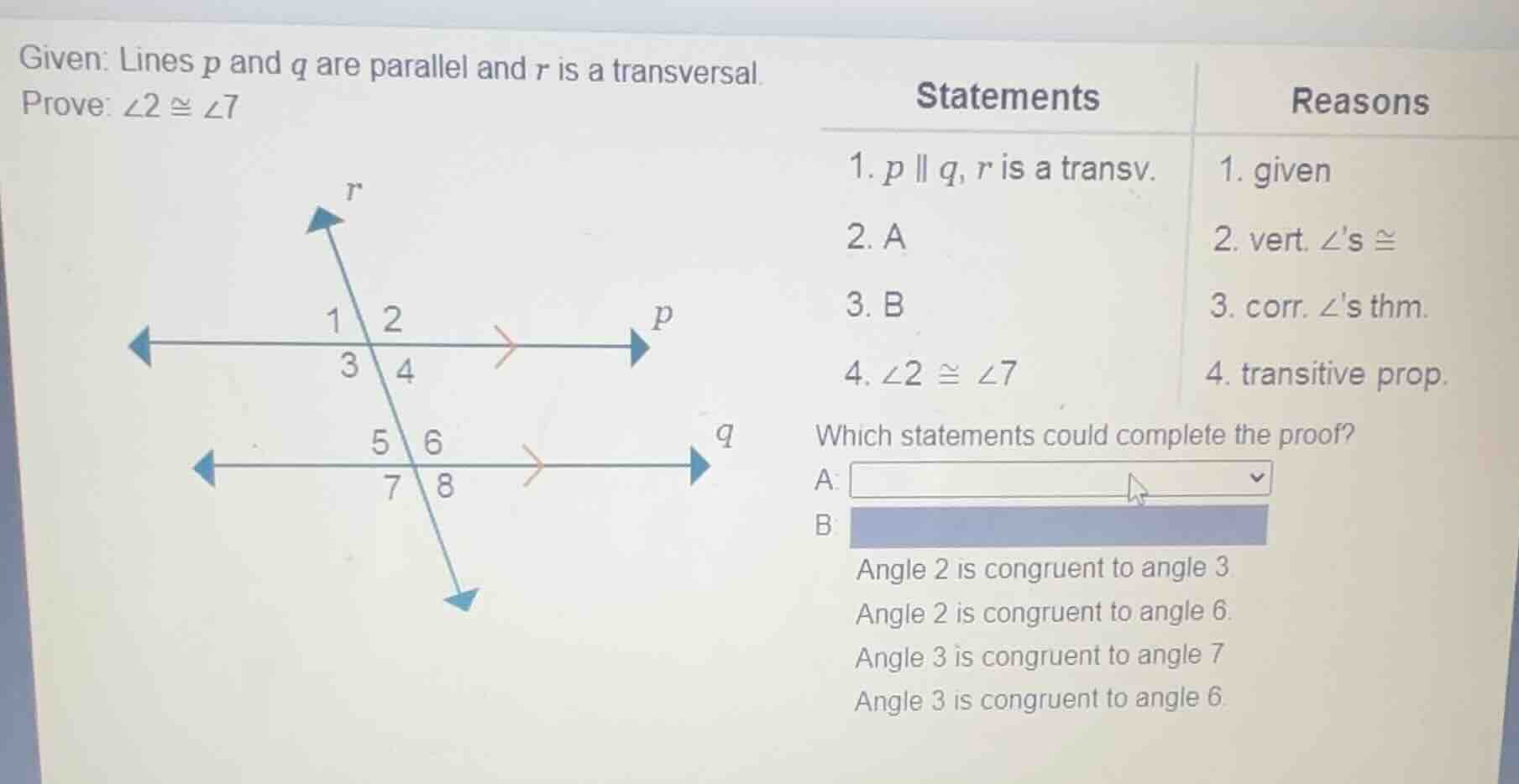
given: lines p and q are parallel and r is a transversal. prove: ∠2 ≅ ∠7
(image of two parallel lines p and q cut by transversal r, forming angles 1,2,3,4 on line p and 5,6,7,8 on line q)
statements | reasons
--- | ---
- p || q, r is a transv. | 1. given
- a | 2. vert. ∠’s ≅
- b | 3. corr. ∠’s thm.
- ∠2 ≅ ∠7 | 4. transitive prop.
which statements could complete the proof?
a: dropdown
b: selected area with options: angle 2 is congruent to angle 3; angle 2 is congruent to angle 6; angle 3 is congruent to angle 7; angle 3 is congruent to angle 6
For statement A (reason: vertical angles ≅), vertical angles are opposite angles formed by intersecting lines. ∠2 and ∠3 are vertical angles? No, ∠1 and ∠3, ∠2 and ∠4 are vertical angles? Wait, no, looking at the diagram, ∠2 and ∠3? Wait, no, when line r intersects line p, the vertical angles: ∠1 and ∠3, ∠2 and ∠4? Wait, no, maybe I made a mistake. Wait, the reason for A is "vert. ∠’s ≅", so the statement should be two vertical angles. Wait, ∠2 and ∠3? No, ∠1 and ∠3, ∠2 and ∠4? Wait, no, maybe ∠2 and ∠3? Wait, no, let's re-examine. Wait, the lines: line p is horizontal, line r is the transversal. So at the intersection of p and r, the angles are 1,2,3,4. So ∠1 and ∠3 are vertical angles, ∠2 and ∠4 are vertical angles. Wait, but the options for A: the first option is "Angle 2 is congruent to angle 3" – no, that's not vertical. Wait, maybe ∠2 and ∠4? No, the options given are: "Angle 2 is congruent to angle 3", "Angle 2 is congruent to angle 6", "Angle 3 is congruent to angle 7", "Angle 3 is congruent to angle 6". Wait, maybe I messed up. Wait, for statement A, reason is vertical angles, so the statement should be two vertical angles. So ∠2 and ∠3? No, ∠1 and ∠3, ∠2 and ∠4. Wait, maybe the diagram has ∠2 and ∠3 as adjacent? No, maybe the labels are different. Wait, the problem: lines p and q are parallel, r is transversal. To prove ∠2 ≅ ∠7. Let's track the proof:
- p || q, r is transv. (given)
- A (vert. ∠’s ≅): so A should be a pair of vertical angles. Let's see the angles: ∠2 and ∠3? No, ∠1 and ∠3, ∠2 and ∠4. Wait, maybe the options are mislabeled? Wait, the options for A: the first option is "Angle 2 is congruent to angle 3" – no. Wait, maybe ∠2 and ∠4? But that's not an option. Wait, the other options: "Angle 2 is congruent to angle 6" (corresponding angles?), "Angle 3 is congruent to angle 7" (corresponding angles?), "Angle 3 is congruent to angle 6" (alternate interior?). Wait, no, let's do step by step.
We need to prove ∠2 ≅ ∠7. The transitive property is used in step 4, so we need ∠2 ≅ X and X ≅ ∠7, then ∠2 ≅ ∠7 by transitivity.
Step 3: reason is "corr. ∠’s thm." (corresponding angles theorem), so step 3 should be ∠2 ≅ ∠6 (since p || q, transversal r, so ∠2 and ∠6 are corresponding angles? Wait, ∠2 is on line p, above, ∠6 is on line q, above, so yes, corresponding angles. Wait, but step 3's reason is corr. ∠’s thm, so statement B should be ∠2 ≅ ∠6? But no, step 2 is A (vert. ∠’s ≅), step 3 is B (corr. ∠’s thm), then step 4 is transitive. Wait, maybe:
Step 2: A (vert. ∠’s ≅) – so ∠2 ≅ ∠3 (but that's not vertical, maybe I'm wrong). Wait, ∠3 and ∠7: if p || q, then ∠3 and ∠7 are corresponding angles? ∠3 is on line p, below, ∠7 is on line q, below, so yes. Then step 3: ∠3 ≅ ∠7 (corr. ∠’s thm). Then step 2: ∠2 ≅ ∠3 (vert. ∠’s ≅? No, ∠2 and ∠3 are adjacent, supplementary? Wait, no, vertical angles are opposite. So ∠1 and ∠3, ∠2 and ∠4. So maybe the diagram is labeled differently. Let's re-express:
Line p: angles 1 (top left), 2 (top right), 3 (bottom left), 4 (bottom right) when intersected by r.
Line q: angles 5 (top left), 6 (top right), 7 (bottom left), 8 (bottom right) when intersected by r.
So vertical angles: ∠1 and ∠3, ∠2 and ∠4, ∠5 and ∠7, ∠6 and ∠8.
Corresponding angles: ∠1 and ∠5, ∠2 and ∠6, ∠3 and ∠7, ∠4 and ∠8.
So step 2: reason is vert. ∠’s ≅, so we need a pair of vertical angles. So ∠2 and ∠4? But that's not an option. Wait, the options for A: "Angle 2 is congruent to angle 3" – no, ∠2 and ∠3 are adjacent, supplementary. "Angle 2 is congruent to angle 6" – corresponding, not vertical. "Angle 3 is congruent to…

Snap & solve any problem in the app
Get step-by-step solutions on Sovi AI
Photo-based solutions with guided steps
Explore more problems and detailed explanations
A. Angle 2 is congruent to angle 3
B. Angle 3 is congruent to angle 7