QUESTION IMAGE
Question
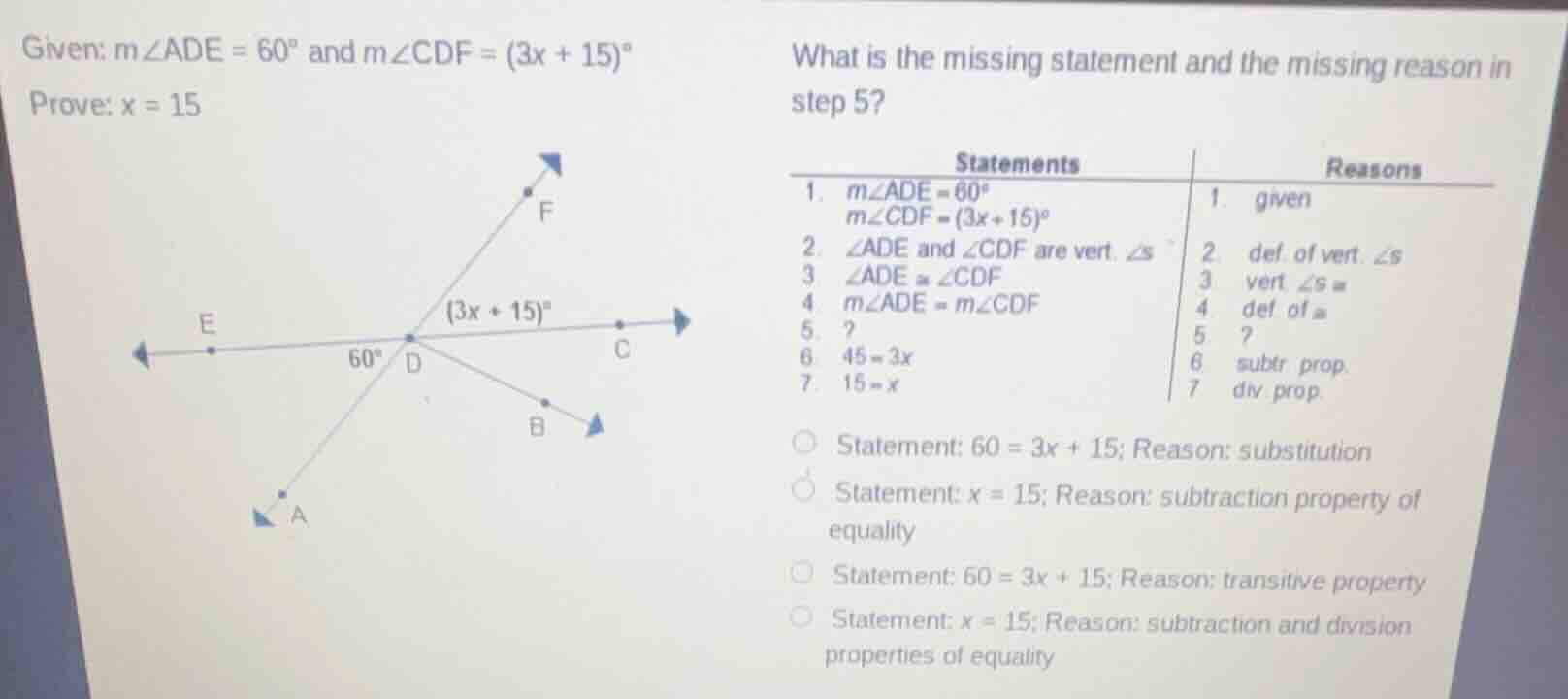
given: ( mangle ade = 60^circ ) and ( mangle cdf = (3x + 15)^circ )
prove: ( x = 15 )
what is the missing statement and the missing reason in
step 5?
statements | reasons
--- | ---
- ( mangle ade = 60^circ )
( mangle cdf = (3x + 15)^circ ) | 1. given
- ( angle ade ) and ( angle cdf ) are vert. ( angle s ) | 2. def. of vert. ( angle s )
- ( angle ade cong angle cdf ) | 3. vert. ( angle s cong )
- ( mangle ade = mangle cdf ) | 4. def of ( cong )
5.? | 5.?
- ( 45 = 3x ) | 6. subtr prop.
- ( 15 = x ) | 7. div prop.
\\( \bigcirc ) statement: ( 60 = 3x + 15 ); reason: substitution
\\( \bigcirc ) statement: ( x = 15 ); reason: subtraction property of
equality
\\( \bigcirc ) statement: ( 60 = 3x + 15 ); reason: transitive property
\\( \bigcirc ) statement: ( x = 15 ); reason: subtraction and division
properties of equality
To find the missing statement and reason in step 5, we analyze the previous steps. Step 4 states \( m\angle ADE = m\angle CDF \). We know \( m\angle ADE = 60^\circ \) (from step 1) and \( m\angle CDF=(3x + 15)^\circ \) (from step 1). By substituting the known measures of the angles into the equation from step 4, we get \( 60 = 3x + 15 \). The reason for this substitution is the substitution property, which allows us to replace \( m\angle ADE \) with 60 and \( m\angle CDF \) with \( 3x + 15 \) in the equation \( m\angle ADE = m\angle CDF \).
Now let's analyze the other options:
- The second option's statement (\( x = 15 \)) and reason (subtraction property of equality) are incorrect because step 5 should come before solving for \( x \) (step 6 is \( 45 = 3x \), which is after subtracting 15 from both sides of \( 60 = 3x + 15 \)).
- The third option's reason (transitive property) is incorrect. The transitive property is for relationships like if \( a = b \) and \( b = c \), then \( a = c \), which is not the case here. We are substituting known values into an equality, not using transitivity.
- The fourth option's statement (\( x = 15 \)) and reason (subtraction and division properties) are incorrect because \( x = 15 \) is the final answer (step 7) and is obtained by division after subtraction, but step 5 should be the substitution step to set up the equation for solving.

Snap & solve any problem in the app
Get step-by-step solutions on Sovi AI
Photo-based solutions with guided steps
Explore more problems and detailed explanations
Statement: \( 60 = 3x + 15 \); Reason: substitution (the first option)