QUESTION IMAGE
Question
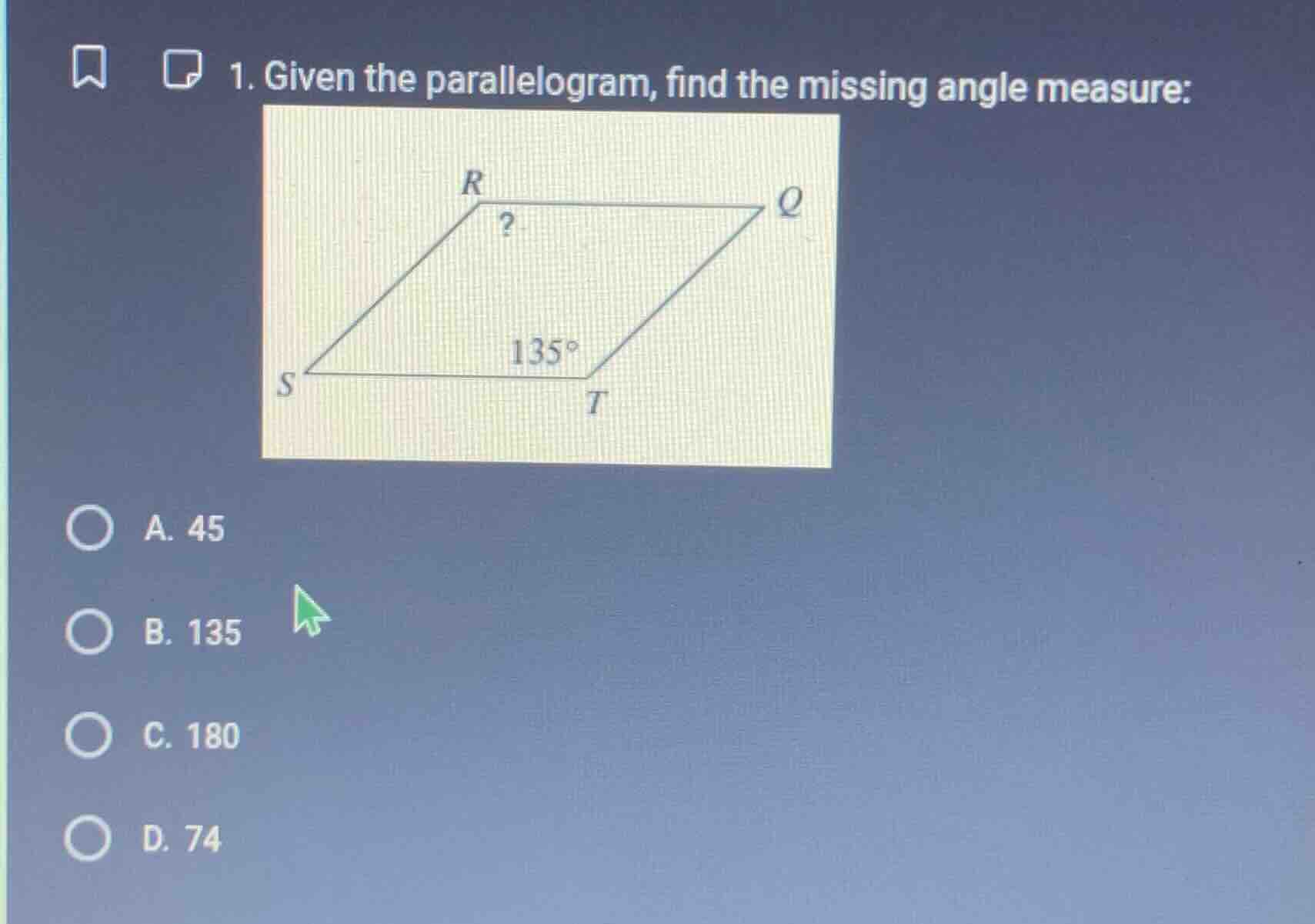
- given the parallelogram, find the missing angle measure: image of parallelogram rqts with angle at t being 135° and angle at r being? a. 45 b. 135 c. 180 d. 74
Step1: Recall parallelogram angle property
In a parallelogram, consecutive angles are supplementary (sum to \(180^\circ\)), and opposite angles are equal. Also, consecutive angles like \(\angle R\) and \(\angle T\) – wait, no, actually, in parallelogram \(RSTQ\), \(RQ \parallel ST\) and \(RS \parallel QT\). So \(\angle R\) and \(\angle T\) are same - side interior angles? Wait, no, actually, in a parallelogram, opposite angles are equal, and consecutive angles are supplementary. Wait, looking at the diagram, \(\angle T\) is \(135^\circ\), and \(\angle R\) is adjacent to \(\angle T\)? Wait, no, in parallelogram \(RSTQ\), sides \(RQ\) and \(ST\) are parallel, and \(RS\) and \(QT\) are parallel. So \(\angle R\) and \(\angle T\): are they opposite or consecutive? Wait, vertices are \(R\), \(Q\), \(T\), \(S\) (assuming the order is \(R - Q - T - S - R\)). So \(RQ\) is parallel to \(ST\), and \(QT\) is parallel to \(RS\). So \(\angle R\) and \(\angle T\) are same - side interior angles? No, actually, in a parallelogram, opposite angles are equal. Wait, maybe I made a mistake. Wait, the correct property: in a parallelogram, opposite angles are equal, and consecutive angles are supplementary. Wait, if \(\angle T = 135^\circ\), and \(\angle R\) is opposite to \(\angle T\)? No, wait, let's label the parallelogram properly. Let's say the parallelogram is \(RQTS\), with \(RQ\) parallel to \(ST\) and \(RS\) parallel to \(QT\). Then \(\angle R\) and \(\angle T\) are same - side interior angles? No, actually, \(\angle R\) and \(\angle S\) are consecutive, \(\angle S\) and \(\angle T\) are consecutive, \(\angle T\) and \(\angle Q\) are consecutive, \(\angle Q\) and \(\angle R\) are consecutive. Wait, no, the sum of consecutive angles in a parallelogram is \(180^\circ\), and opposite angles are equal. Wait, but in the diagram, \(\angle T = 135^\circ\), and we need to find \(\angle R\). Wait, maybe \(\angle R\) and \(\angle T\) are opposite angles? No, that can't be. Wait, no, maybe I got the property wrong. Wait, no, in a parallelogram, opposite angles are equal. So if \(\angle T = 135^\circ\), and \(\angle R\) is opposite to \(\angle T\)? No, that would mean \(\angle R=\angle T = 135^\circ\) because in a parallelogram, opposite angles are equal. Wait, let's confirm: in a parallelogram \(ABCD\), \(\angle A=\angle C\) and \(\angle B = \angle D\), and \(\angle A+\angle B=180^\circ\). So in our case, if \(\angle T\) is like \(\angle B\), then \(\angle R\) is like \(\angle A\), and \(\angle R+\angle T = 180^\circ\)? Wait, no, that contradicts. Wait, maybe the diagram is labeled as \(R\), \(Q\), \(T\), \(S\) in order, so \(RQ\) is top, \(QT\) is right, \(TS\) is bottom, \(SR\) is left. Then \(\angle R\) is at the top - left, \(\angle T\) is at the bottom - right. Wait, no, \(\angle T\) is at the bottom - right, between \(S\), \(T\), \(Q\). So \(ST\) is bottom, \(QT\) is right, \(RQ\) is top, \(SR\) is left. So \(RQ\parallel ST\) and \(SR\parallel QT\). Then \(\angle R\) and \(\angle T\): since \(SR\parallel QT\), and \(ST\) is a transversal, \(\angle R\) and \(\angle T\) are same - side interior angles? No, \(\angle R\) is between \(SR\) and \(RQ\), \(\angle T\) is between \(ST\) and \(QT\). Since \(RQ\parallel ST\) and \(SR\) is a transversal, \(\angle R\) and \(\angle S\) are same - side interior angles (supplementary). And since \(SR\parallel QT\) and \(ST\) is a transversal, \(\angle S\) and \(\angle T\) are same - side interior angles (supplementary). Therefore, \(\angle R=\angle T\) (because \(\angle R + \angle S=180^\circ\) and \(\angle S+\angle…

Snap & solve any problem in the app
Get step-by-step solutions on Sovi AI
Photo-based solutions with guided steps
Explore more problems and detailed explanations
B. 135