QUESTION IMAGE
Question
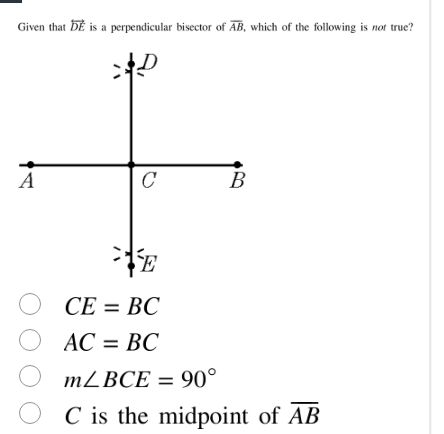
given that \\( \overline{de} \\) is a perpendicular bisector of \\( \overline{ab} \\), which of the following is not true?
\\( ce = bc \\)
\\( ac = bc \\)
\\( m\angle bce = 90^\circ \\)
\\( c \\) is the midpoint of \\( \overline{ab} \\)
Step1: Recall Perpendicular Bisector Properties
A perpendicular bisector of a segment is a line that is perpendicular to the segment and divides it into two equal parts. So, for \(\overline{AB}\) with perpendicular bisector \(\overleftrightarrow{DE}\) intersecting at \(C\):
- \(AC = BC\) (since it's a bisector, it splits \(AB\) into two equal segments).
- \(\angle BCE = 90^\circ\) (since \(DE\) is perpendicular to \(AB\)).
- \(C\) is the midpoint of \(\overline{AB}\) (by definition of a bisector, the intersection point is the midpoint).
Step2: Analyze \(CE = BC\)
There's no property of a perpendicular bisector that states the length of the bisector segment (\(CE\)) is equal to the half - segment of \(AB\) (\(BC\)). \(CE\) is a part of the perpendicular bisector line, and \(BC\) is half of \(AB\). These lengths are not necessarily equal.

Snap & solve any problem in the app
Get step-by-step solutions on Sovi AI
Photo-based solutions with guided steps
Explore more problems and detailed explanations
\(CE = BC\) (the statement that is not true)