QUESTION IMAGE
Question
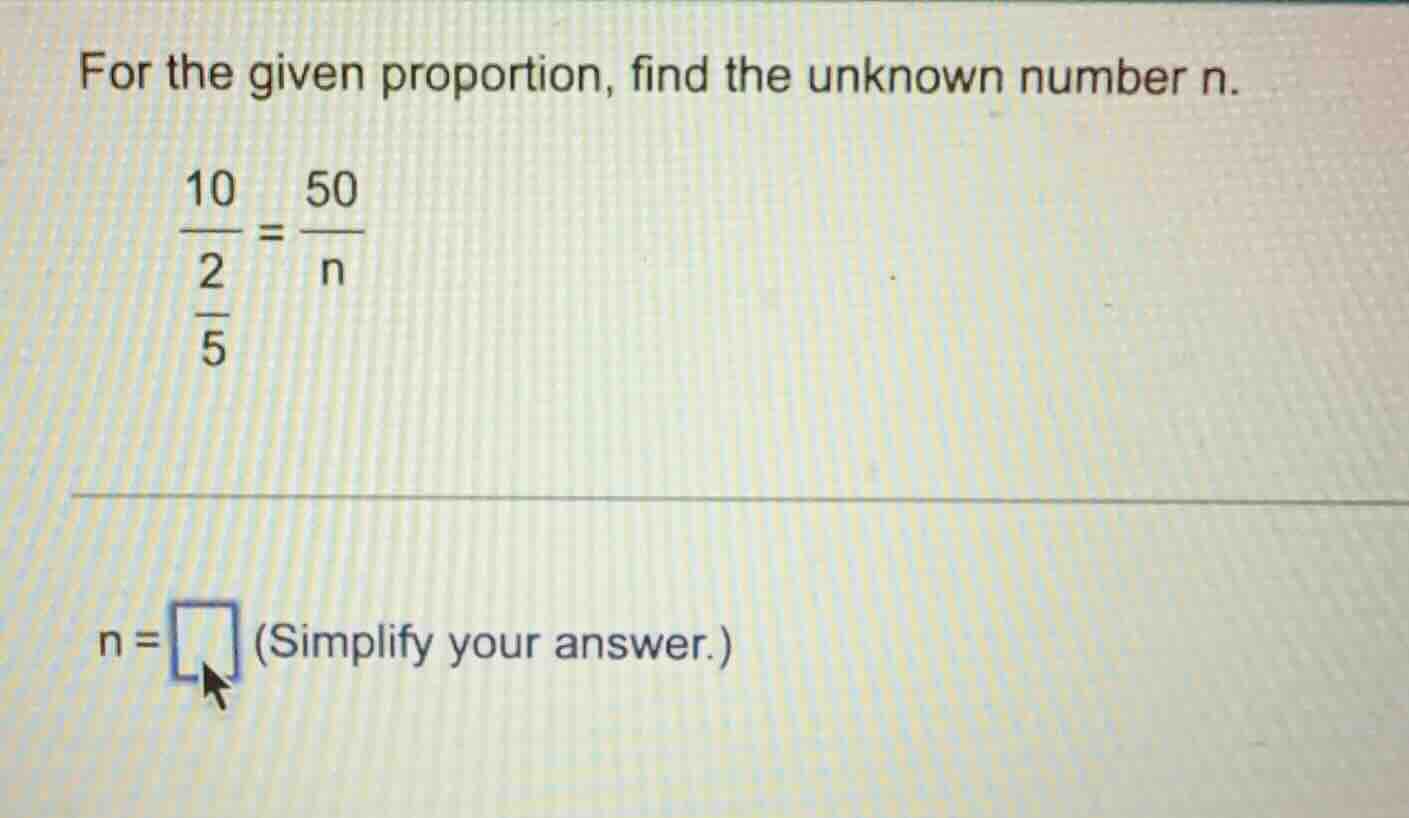
for the given proportion, find the unknown number n.
\\(\frac{\frac{10}{2}}{\frac{5}{5}} = \frac{50}{n}\\)
\\(n = \boxed{}\\) (simplify your answer.)
Step1: Cross - multiply the proportion
Given the proportion \(\frac{10}{\frac{2}{5}}=\frac{50}{n}\), first simplify \(\frac{10}{\frac{2}{5}}\). We know that dividing by a fraction is the same as multiplying by its reciprocal, so \(\frac{10}{\frac{2}{5}} = 10\times\frac{5}{2}\).
\(10\times\frac{5}{2}=\frac{10\times5}{2}=\frac{50}{2} = 25\). So the equation becomes \(25=\frac{50}{n}\).
Now, cross - multiply: \(25\times n=50\times1\) (since \(\frac{50}{n}=25\) can be written as \(25=\frac{50}{n}\), cross - multiplying gives \(25n = 50\)).
Step2: Solve for \(n\)
To solve for \(n\), divide both sides of the equation \(25n = 50\) by 25.
\(n=\frac{50}{25}\)
\(n = 2\)? Wait, no, wait. Wait, let's re - do the first step. Wait, maybe I misread the original proportion. Wait, the original proportion is \(\frac{10}{2/5}=\frac{50}{n}\)? Wait, no, looking at the image, the left - hand side is \(\frac{10}{\frac{2}{5}}\)? Wait, no, maybe the left - hand side is \(\frac{10}{2}\div\frac{5}{1}\)? No, wait, the original problem is \(\frac{10}{\frac{2}{5}}=\frac{50}{n}\)? Wait, no, let's parse the LaTeX correctly. Wait, the user's image shows \(\frac{10}{\frac{2}{5}}=\frac{50}{n}\)? Wait, no, maybe it's a typo, but actually, the standard proportion cross - multiplication: if \(\frac{a}{b}=\frac{c}{d}\), then \(a\times d=b\times c\).
Wait, let's start over. The proportion is \(\frac{10}{\frac{2}{5}}=\frac{50}{n}\). First, simplify \(\frac{10}{\frac{2}{5}}\): dividing by a fraction is multiplying by its reciprocal, so \(10\times\frac{5}{2}=\frac{50}{2}=25\). So we have \(25=\frac{50}{n}\). Cross - multiply: \(25n = 50\), then \(n=\frac{50}{25}=2\)? No, that can't be right. Wait, maybe the original proportion is \(\frac{10}{2}=\frac{50}{n}\) with a \(\frac{5}{1}\) below? Wait, no, maybe the left - hand side is \(\frac{10}{2/5}\), which is \(10\times\frac{5}{2}=25\), and the right - hand side is \(\frac{50}{n}\). So \(25=\frac{50}{n}\), so \(n=\frac{50}{25}=2\)? But that seems too small. Wait, maybe I misread the numerator and denominator. Wait, maybe the left - hand side is \(\frac{10}{2}\) and the right - hand side is \(\frac{50}{n}\), and there is a \(\frac{5}{1}\) below? No, let's use the cross - multiplication rule for proportions. The correct way: if \(\frac{a}{b}=\frac{c}{d}\), then \(a\times d = b\times c\).
Wait, let's assume the proportion is \(\frac{10}{\frac{2}{5}}=\frac{50}{n}\). So \(a = 10\), \(b=\frac{2}{5}\), \(c = 50\), \(d=n\). Then \(a\times d=b\times c\), so \(10\times n=\frac{2}{5}\times50\).
Ah! That's the mistake. I should have used the cross - multiplication formula correctly. So \(10n=\frac{2}{5}\times50\).
Step1: Cross - multiply the proportion
For the proportion \(\frac{10}{\frac{2}{5}}=\frac{50}{n}\), by the cross - multiplication property of proportions (\(\frac{a}{b}=\frac{c}{d}\implies a\times d=b\times c\)), we have \(10\times n=\frac{2}{5}\times50\).
Step2: Simplify the right - hand side
Calculate \(\frac{2}{5}\times50\). \(\frac{2\times50}{5}=\frac{100}{5}=20\). So the equation becomes \(10n = 20\).
Step3: Solve for \(n\)
Divide both sides of the equation \(10n = 20\) by 10.
\(n=\frac{20}{10}=2\)? No, that's still 2. Wait, but that seems odd. Wait, maybe the original proportion is \(\frac{10}{2}=\frac{50}{n}\) with a \(\frac{5}{1}\) in the denominator? No, maybe the left - hand side is \(\frac{10}{2/5}\) which is 25, and the right - hand side is \(\frac{50}{n}\), so \(25=\frac{50}{n}\), so \(n = 2\). Maybe that's correct.
Wait, let's check: \(\frac{10}{\frac{2}{5}}=10\times\frac{5}{2}=25\), and \(\frac{50}{2}…

Snap & solve any problem in the app
Get step-by-step solutions on Sovi AI
Photo-based solutions with guided steps
Explore more problems and detailed explanations
\(n = 2\)