QUESTION IMAGE
Question
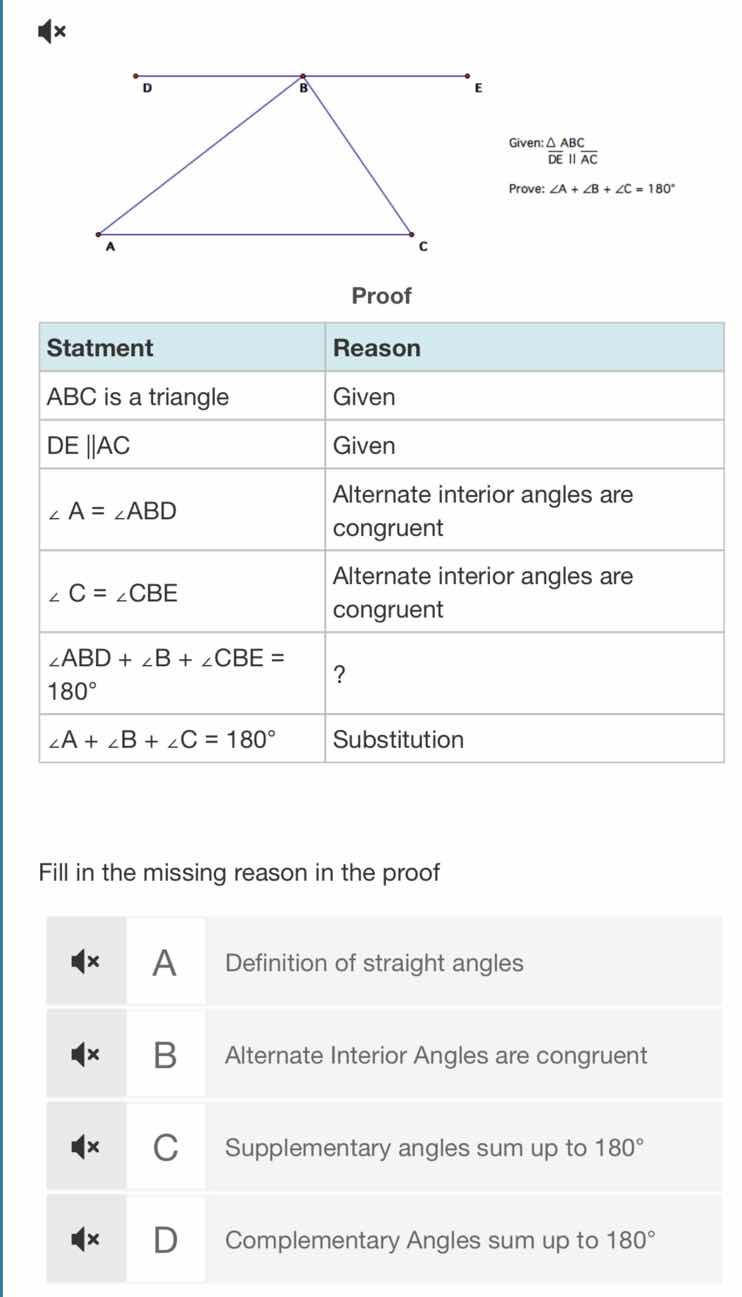
given: \\(\triangle abc\\) \\(de \parallel ac\\) prove: \\(\angle a + \angle b + \angle c = 180^{\circ}\\) proof | statement | reason | | --- | --- | | \\(abc\\) is a triangle | given | | \\(de \parallel ac\\) | given | | \\(\angle a = \angle abd\\) | alternate interior angles are congruent | | \\(\angle c = \angle cbe\\) | alternate interior angles are congruent | | \\(\angle abd + \angle b + \angle cbe = 180^{\circ}\\) |? | | \\(\angle a + \angle b + \angle c = 180^{\circ}\\) | substitution | fill in the missing reason in the proof a definition of straight angles b alternate interior angles are congruent c supplementary angles sum up to \\(180^{\circ}\\) d complementary angles sum up to \\(180^{\circ}\\)
To determine the missing reason, we analyze the statement \(\angle ABD + \angle B + \angle CBE = 180^\circ\). Points \(D\), \(B\), and \(E\) are colinear (since \(DE\) is a straight line), forming a straight angle at \(B\). The definition of a straight angle states that a straight angle measures \(180^\circ\).
- Option B is incorrect because alternate interior angles congruence was already used for \(\angle A=\angle ABD\) and \(\angle C = \angle CBE\), not for the sum of angles at \(B\).
- Option C is incorrect because supplementary angles are two angles that sum to \(180^\circ\), but here we have three angles forming a straight angle, not two supplementary angles.
- Option D is incorrect because complementary angles sum to \(90^\circ\), not \(180^\circ\).
Thus, the correct reason is the definition of straight angles.

Snap & solve any problem in the app
Get step-by-step solutions on Sovi AI
Photo-based solutions with guided steps
Explore more problems and detailed explanations
A. Definition of straight angles