QUESTION IMAGE
Question
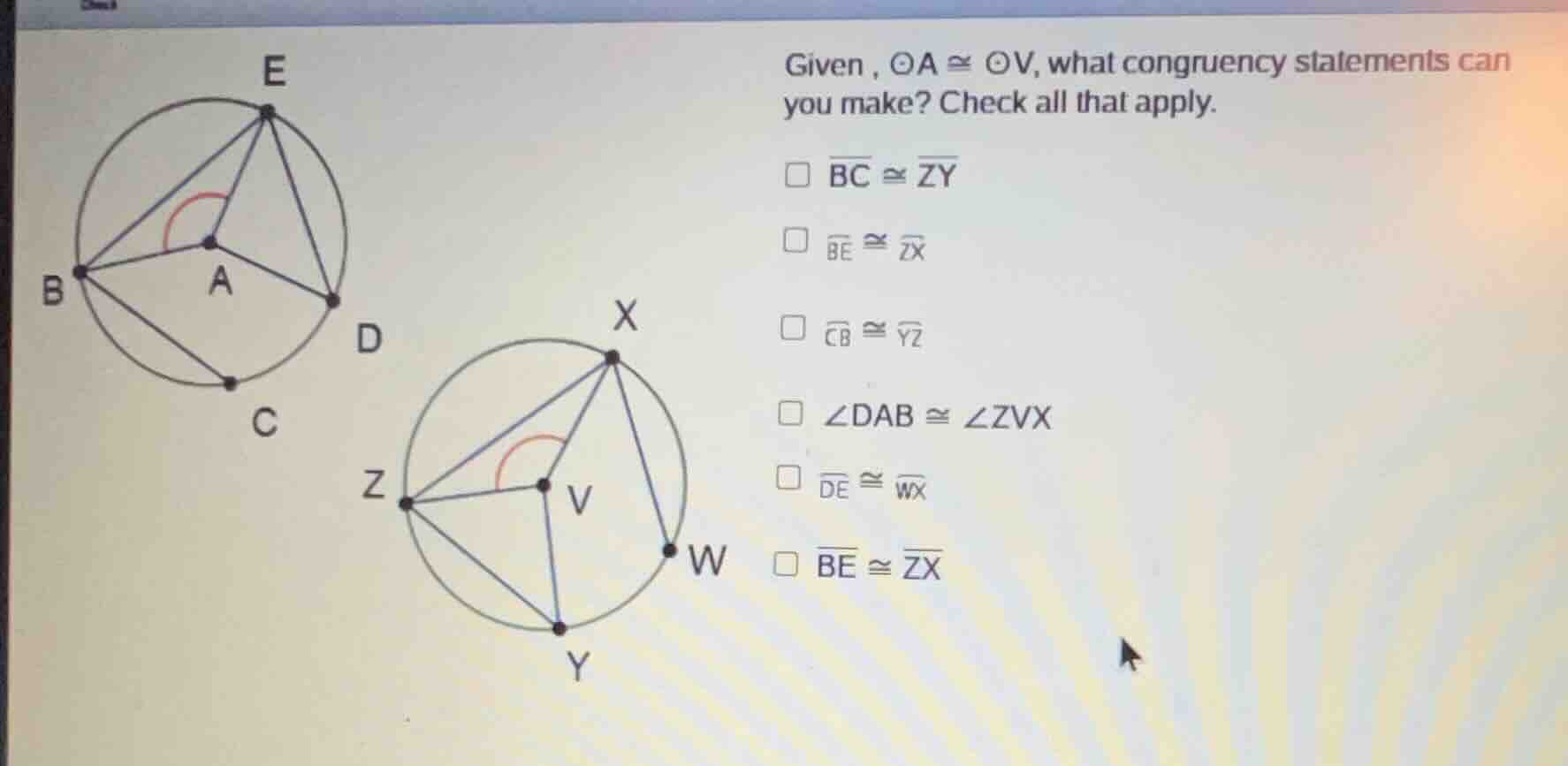
given, ⊙a ≅ ⊙v, what congruency statements can you make? check all that apply. ☐ \\(\overline{bc} \cong \overline{zy}\\) ☐ \\(\widehat{be} \cong \widehat{zx}\\) ☐ \\(\widehat{cb} \cong \widehat{yz}\\) ☐ \\(\angle dab \cong \angle zvx\\) ☐ \\(\widehat{de} \cong \widehat{wx}\\) ☐ \\(\overline{be} \cong \overline{zx}\\)
Step1: Recall congruent circles properties
Congruent circles (\(\odot A \cong \odot V\)) have congruent radii, and congruent central angles intercept congruent arcs, congruent chords.
Step2: Analyze each option
- \(\overline{BC} \cong \overline{ZY}\): Chords in congruent circles? But no info on central angles or arcs for these chords. Unclear.
- \(\widehat{BE} \cong \widehat{ZX}\): Central angles for these arcs? The red angles (central angles) seem corresponding, but need to check arcs. Wait, \(\odot A\) and \(\odot V\) are congruent, so if central angles are congruent, arcs are congruent. Wait, the red angle in \(\odot A\) (e.g., \(\angle BAE\)?) and in \(\odot V\) (e.g., \(\angle ZVX\)?) Wait, no, let's check \(\angle DAB \cong \angle ZVX\) first. \(\angle DAB\) and \(\angle ZVX\) are central angles. If circles are congruent, congruent central angles mean congruent arcs. Then \(\widehat{BE}\) and \(\widehat{ZX}\): Wait, maybe \(\widehat{BE}\) and \(\widehat{ZX}\) have central angles? Wait, no, let's re - evaluate.
- \(\widehat{CB} \cong \widehat{YZ}\): Arcs \(CB\) and \(YZ\) – do their central angles correspond?
- \(\angle DAB \cong \angle ZVX\): Since \(\odot A \cong \odot V\), and if the central angles (the red - marked angles) are corresponding, then \(\angle DAB\) (central angle in \(\odot A\)) and \(\angle ZVX\) (central angle in \(\odot V\)) – if the circles are congruent, and the angles are corresponding (the red markings suggest they are congruent central angles), so \(\angle DAB \cong \angle ZVX\) is true.
- \(\overline{DE} \cong \overline{WX}\): Chords, no info on central angles. Unclear.
- \(\overline{BE} \cong \overline{ZX}\): Chords \(BE\) (in \(\odot A\)) and \(ZX\) (in \(\odot V\)) – since \(\odot A \cong \odot V\), and if the central angles for these chords are congruent (from the red angles, maybe the central angles for \(BE\) and \(ZX\) are congruent as the circles are congruent), so chords would be congruent. Wait, also, \(\widehat{BE}\) and \(\widehat{ZX}\): central angles for these arcs – if \(\angle DAB \cong \angle ZVX\) (central angles), then arcs \(DB\) and \(ZX\)? No, wait, let's correct. The correct options:
- \(\widehat{BE} \cong \widehat{ZX}\): Since \(\odot A \cong \odot V\), and if the central angles for arcs \(BE\) and \(ZX\) are congruent (as the circles are congruent and the red angles suggest corresponding central angles), then arcs are congruent.
- \(\angle DAB \cong \angle ZVX\): Central angles in congruent circles – if the angles are corresponding (marked similarly), then they are congruent.
- \(\overline{BE} \cong \overline{ZX}\): Chords in congruent circles with congruent central angles (from \(\angle DAB \cong \angle ZVX\) - related central angles for \(BE\) and \(ZX\)) are congruent. Wait, maybe I made a mistake earlier. Let's start over.
Congruent circles have:
- Congruent radii.
- Congruent central angles \(\Leftrightarrow\) congruent arcs \(\Leftrightarrow\) congruent chords.
So:
- \(\angle DAB\) and \(\angle ZVX\): These are central angles. Since \(\odot A\cong\odot V\), and the diagram shows corresponding central angles (the red - colored angles), so \(\angle DAB\cong\angle ZVX\) (correct).
- \(\widehat{BE}\) and \(\widehat{ZX}\): The central angles for these arcs (e.g., \(\angle BAE\) and \(\angle ZVX\) – wait, no, maybe \(\angle BAE\) and \(\angle ZVX\) are not, but if \(\angle DAB\cong\angle ZVX\), and if we consider arcs \(BE\) and \(ZX\), maybe the central angles for these arcs are congruent. Wait, actually, in congruent circles, if two central angles are co…

Snap & solve any problem in the app
Get step-by-step solutions on Sovi AI
Photo-based solutions with guided steps
Explore more problems and detailed explanations
\(\widehat{BE} \cong \widehat{ZX}\), \(\angle DAB \cong \angle ZVX\), \(\overline{BE} \cong \overline{ZX}\) (the checkboxes for these options should be selected).