QUESTION IMAGE
Question
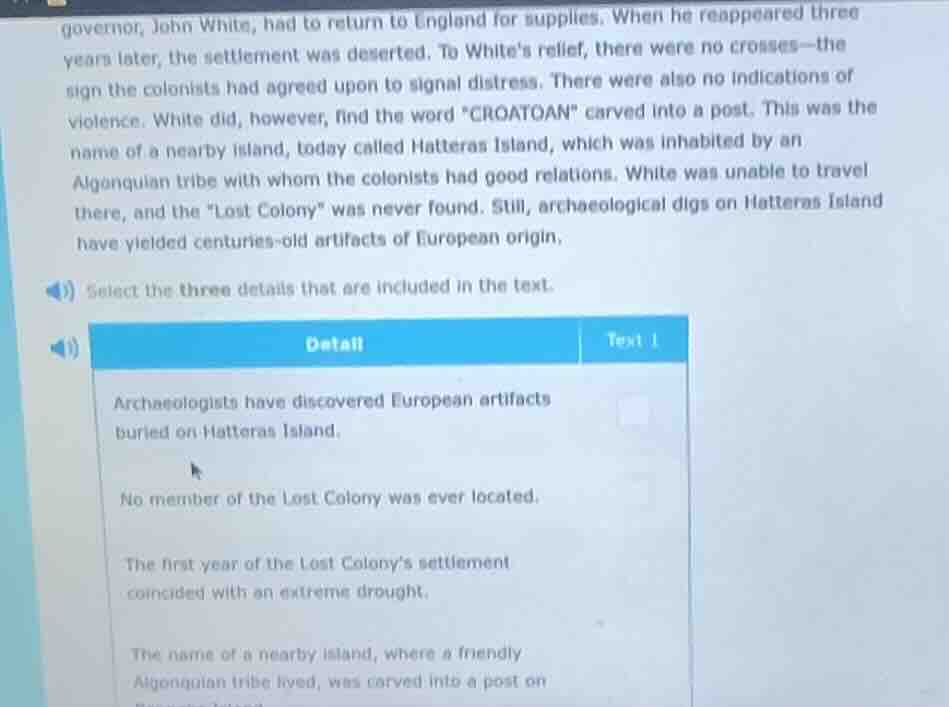
governor, john white, had to return to england for supplies. when he reappeared three years later, the settlement was deserted. to whites relief, there were no crosses—the sign the colonists had agreed upon to signal distress. there were also no indications of violence. white did, however, find the word \croatoan\ carved into a post. this was the name of a nearby island, today called hatteras island, which was inhabited by an algonquian tribe with whom the colonists had good relations. white was unable to travel there, and the \lost colony\ was never found. still, archaeological digs on hatteras island have yielded centuries-old artifacts of european origin.
- select the three details that are included in the text.
detail text 1
archaeologists have discovered european artifacts buried on hatteras island.
no member of the lost colony was ever located.
the first year of the lost colonys settlement coincided with an extreme drought.
the name of a nearby island, where a friendly algonquian tribe lived, was carved into a post on
- Match each detail to the text content:
- The text states "archaeological digs on Hatteras Island have yielded centuries-old artifacts of European origin" which matches the first detail.
- The text says "the 'Lost Colony' was never found" which aligns with "No member of the Lost Colony was ever located."
- The text notes White found "the word 'CROATOAN' carved into a post. This was the name of a nearby island... inhabited by an Algonquian tribe with whom the colonists had good relations" which matches the fourth detail.
- The third detail about a drought is not mentioned in the provided text.

Snap & solve any problem in the app
Get step-by-step solutions on Sovi AI
Photo-based solutions with guided steps
Explore more problems and detailed explanations
- Archaeologists have discovered European artifacts buried on Hatteras Island.
- No member of the Lost Colony was ever located.
- The name of a nearby island, where a friendly Algonquian tribe lived, was carved into a post on [the settlement site].