QUESTION IMAGE
Question
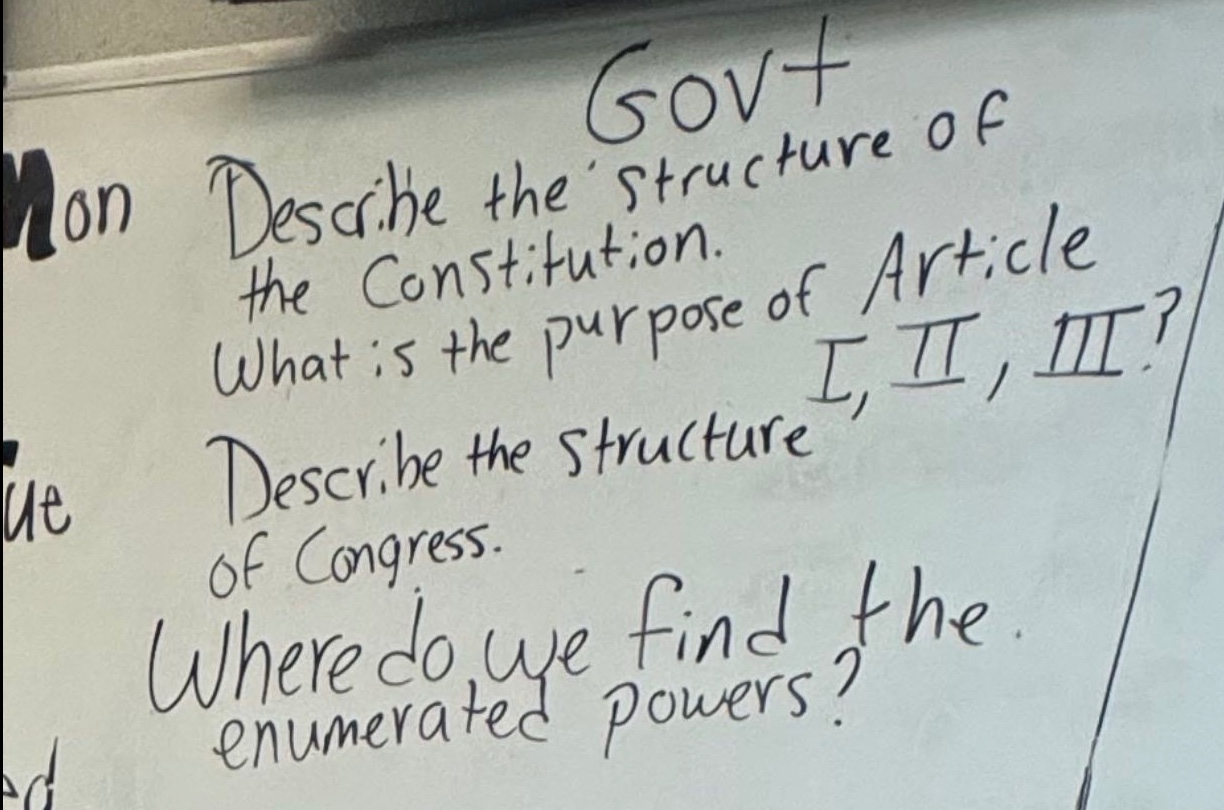
govt
describe the structure of the constitution.
what is the purpose of article i, ii, iii?
describe the structure of congress.
where do we find the enumerated powers?
Brief Explanations
- Structure of the U.S. Constitution: It starts with the Preamble (statement of purpose), followed by 7 Articles (establishing government structure), then 27 Amendments (changes to the original text, including the Bill of Rights as the first 10).
- Purpose of Articles I, II, III:
- Article I: Establishes the legislative branch (Congress) and defines its powers.
- Article II: Establishes the executive branch (President) and outlines executive powers and duties.
- Article III: Establishes the judicial branch (federal courts, including the Supreme Court) and defines judicial authority.
- Structure of U.S. Congress: It is a bicameral (two-chamber) legislature: the Senate (2 senators per state, 100 total, 6-year terms) and the House of Representatives (number of members based on state population, 435 total, 2-year terms).
- Enumerated Powers Location: The enumerated (explicitly listed) powers of Congress are found in Article I, Section 8 of the U.S. Constitution.

Snap & solve any problem in the app
Get step-by-step solutions on Sovi AI
Photo-based solutions with guided steps
Explore more problems and detailed explanations
- The U.S. Constitution has three core parts:
- Preamble: A concise statement of the document's foundational goals.
- 7 Articles: Lay out the structure, powers, and limits of the three federal government branches, plus rules for federal-state relations, amendment processes, and ratification.
- 27 Amendments: Formal changes to the original text, starting with the 10 amendments of the Bill of Rights.
- Article I, II, III purposes:
- Article I: Creates and defines the legislative branch (Congress) and its lawmaking powers.
- Article II: Establishes the executive branch (President) to enforce laws, and outlines executive authority, election rules, and duties.
- Article III: Sets up the federal judicial branch (Supreme Court and lower federal courts) to interpret laws and handle federal legal disputes.
- U.S. Congress is bicameral:
- Senate: 100 total members (2 per U.S. state), serving 6-year staggered terms.
- House of Representatives: 435 total members, allocated by state population, serving 2-year terms.
- Enumerated powers are located in Article I, Section 8 of the U.S. Constitution.