QUESTION IMAGE
Question
grade 8 structures & mechanical systems and control
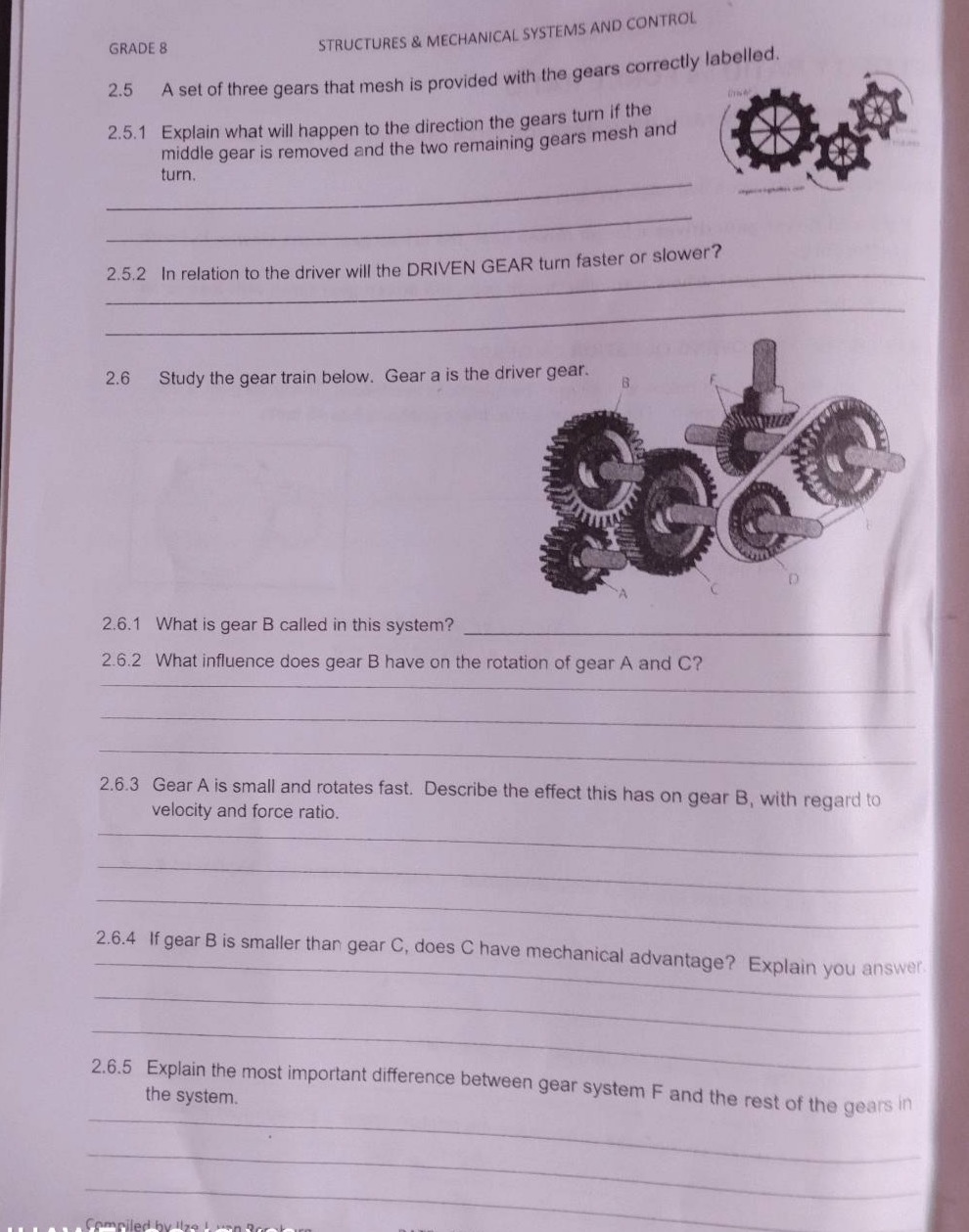
2.5 a set of three gears that mesh is provided with the gears correctly labelled.
2.5.1 explain what will happen to the direction the gears turn if the middle gear is removed and the two remaining gears mesh and turn.
2.5.2 in relation to the driver will the driven gear turn faster or slower?
2.6 study the gear train below. gear a is the driver gear.
2.6.1 what is gear b called in this system?
2.6.2 what influence does gear b have on the rotation of gear a and c?
2.6.3 gear a is small and rotates fast. describe the effect this has on gear b, with regard to velocity and force ratio.
2.6.4 if gear b is smaller than gear c, does c have mechanical advantage? explain you answer.
2.6.5 explain the most important difference between gear system f and the rest of the gears in the system.
2.5.1
When two gears mesh directly (without a middle gear), adjacent meshing gears rotate in opposite directions. Initially, with three gears, the first and third rotate in the same direction (middle gear reverses direction). Removing the middle gear makes the two remaining gears mesh directly, so their rotation directions will be opposite.
The speed of a driven gear relative to the driver depends on the number of teeth (or gear size). If the driven gear has more teeth than the driver, it turns slower; fewer teeth, faster. When the middle gear (idler, doesn't change speed ratio) is removed, we compare the driver and the new driven gear. Typically, in a three - gear setup, the first and third gears: if the driver is, say, small and the original third is large, removing the middle (idler) and meshing driver and original third (now driven) – if the driven gear has more teeth than the driver, it turns slower; if less, faster. But generally, when two gears mesh, the smaller gear (driver) makes the larger gear (driven) turn slower (since more teeth mean each tooth on the driver moves a tooth on the driven, so a larger driven gear takes more driver rotations to complete one rotation).
Gear B is between gear A (driver) and gear C. A gear that is between a driver and another driven gear, used to transfer motion without changing the speed ratio (just direction, or to bridge the gap) is called an idler gear.

Snap & solve any problem in the app
Get step-by-step solutions on Sovi AI
Photo-based solutions with guided steps
Explore more problems and detailed explanations
The two remaining gears will turn in opposite directions (compared to the initial setup where the first and third turned the same way with the middle gear; now, direct meshing causes opposite rotation).