QUESTION IMAGE
Question
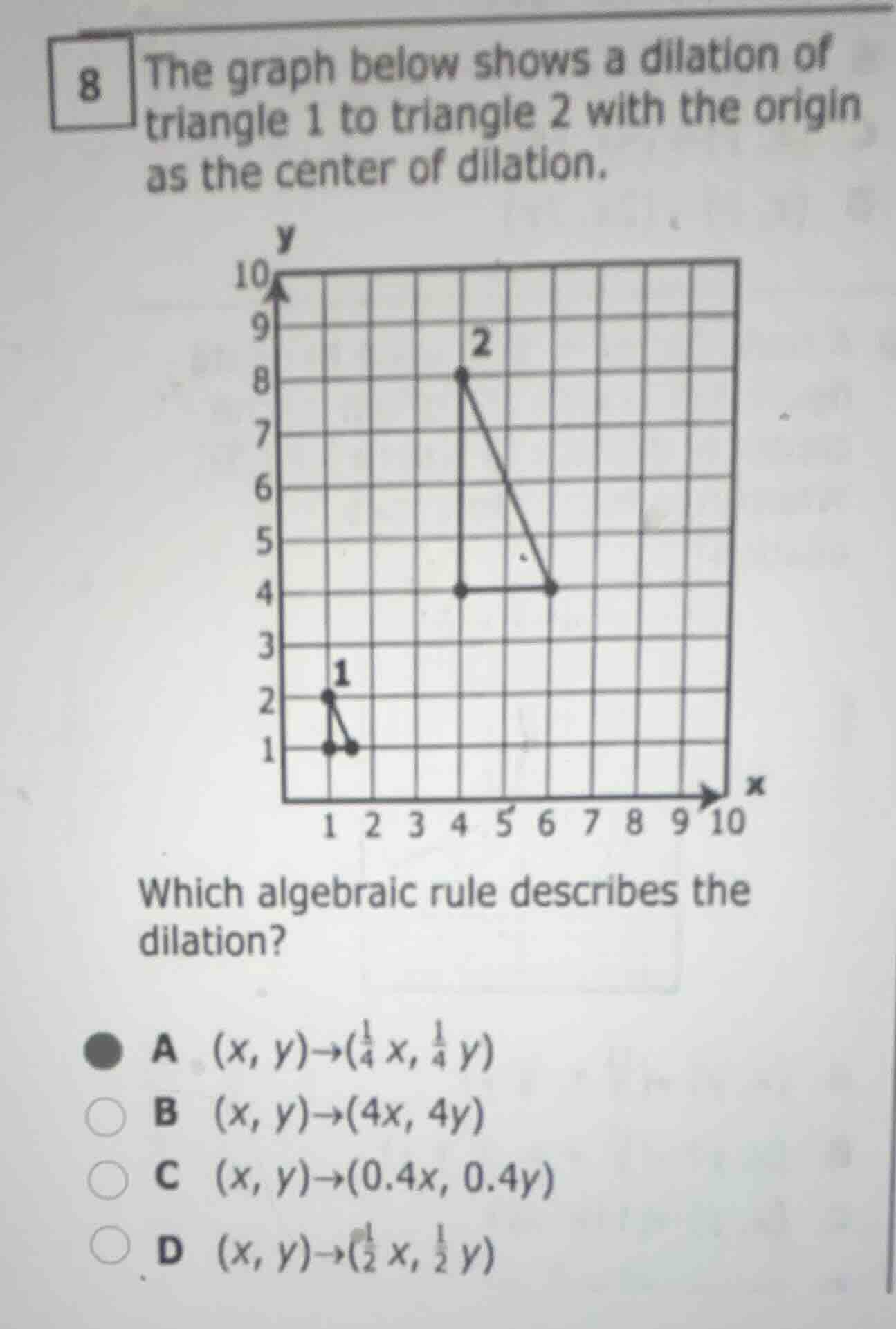
8 the graph below shows a dilation of triangle 1 to triangle 2 with the origin as the center of dilation. which algebraic rule describes the dilation? a ((x, y)\to(\frac{1}{4} x, \frac{1}{4} y)) b ((x, y)\to(4x, 4y)) c ((x, y)\to(0.4x, 0.4y)) d ((x, y)\to(\frac{1}{2} x, \frac{1}{2} y))
Step1: Identify a vertex from each triangle
Take a vertex from triangle 1 and its corresponding vertex in triangle 2. For example, in triangle 1, let's take the vertex at (1, 2), and in triangle 2, the corresponding vertex is at (4, 8).
Step2: Determine the scale factor
To find the scale factor \( k \), we divide the coordinates of the image (triangle 2) by the coordinates of the pre - image (triangle 1). For the x - coordinate: \( \frac{4}{1}=4 \), for the y - coordinate: \( \frac{8}{4} = 2\)? Wait, no, let's take another vertex. Let's take the vertex of triangle 1 at (1,1) and the corresponding vertex in triangle 2 at (4,4). Then for x - coordinate: \( \frac{4}{1}=4 \), for y - coordinate: \( \frac{4}{1}=4 \). Another vertex: triangle 1 at (2,1), triangle 2 at (6,4)? Wait, no, looking at the graph, triangle 1 has vertices at (1,1), (1,2), (2,1) and triangle 2 has vertices at (4,4), (4,8), (6,4). So for the vertex (1,1) in triangle 1, the corresponding vertex in triangle 2 is (4,4). So the transformation is \( (x,y)\to(4x,4y) \) because when \( x = 1,y = 1 \), \( 4x=4 \), \( 4y = 4 \); when \( x=1,y = 2 \), \( 4x = 4 \), \( 4y=8 \); when \( x = 2,y=1 \), \( 4x=8 \)? Wait, no, the third vertex of triangle 2 is (6,4). Wait, maybe I misread the vertices. Let's re - examine: Triangle 1: points at (1,1), (1,2), (2,1). Triangle 2: points at (4,4), (4,8), (6,4). So for (1,1) to (4,4): \( 4=4\times1 \), \( 4 = 4\times1 \); (1,2) to (4,8): \( 4=4\times1 \), \( 8=4\times2 \); (2,1) to (6,4): Wait, \( 6 = 3\times2 \), \( 4=4\times1 \). Wait, maybe I made a mistake. Wait, the center of dilation is the origin. Wait, no, the center of dilation is the origin? Wait, the problem says "the origin as the center of dilation", but the triangles are not centered at the origin. Wait, maybe the vertices of triangle 1 are (1,1), (1,2), (2,1) and triangle 2 are (4,4), (4,8), (6,4). Let's check the scale factor. The distance from the center of dilation (origin) to (1,1) is \( \sqrt{1^2 + 1^2}=\sqrt{2} \), and to (4,4) is \( \sqrt{4^2+4^2}=\sqrt{32}=4\sqrt{2} \). The ratio of distances is \( \frac{4\sqrt{2}}{\sqrt{2}} = 4 \). Similarly, distance from origin to (1,2) is \( \sqrt{1 + 4}=\sqrt{5} \), distance to (4,8) is \( \sqrt{16 + 64}=\sqrt{80}=4\sqrt{5} \), ratio is 4. Distance from origin to (2,1) is \( \sqrt{4 + 1}=\sqrt{5} \), distance to (6,4) is \( \sqrt{36+16}=\sqrt{52}=2\sqrt{13} \)? Wait, no, maybe the center of dilation is not the origin? Wait, the problem says "the origin as the center of dilation". Wait, maybe my vertex identification is wrong. Let's look at the coordinates again. The grid has x from 1 to 10 and y from 1 to 10. Triangle 1: at x = 1, y = 1; x = 1, y = 2; x = 2, y = 1. Triangle 2: at x = 4, y = 4; x = 4, y = 8; x = 6, y = 4. So the vector from the center of dilation (origin) to (1,1) is \( \vec{v_1}=(1,1) \), and to (4,4) is \( \vec{v_2}=(4,4)=4\times(1,1) \). The vector from origin to (1,2) is \( (1,2) \), and to (4,8) is \( (4,8)=4\times(1,2) \). The vector from origin to (2,1) is \( (2,1) \), and to (6,4) is \( (6,4)=3\times(2, \frac{4}{3}) \). Wait, that's not 4 times. Wait, maybe the center of dilation is not the origin? But the problem says it is. Wait, maybe I misread the vertices. Let's check the y - axis: triangle 1 has a vertex at y = 2, triangle 2 at y = 8. 8/2 = 4. x - axis: triangle 1 has a vertex at x = 1, triangle 2 at x = 4. 4/1=4. Another vertex: triangle 1 at x = 2, triangle 2 at x = 6? No, 6/2 = 3. Wait, no, maybe the vertices of triangle 1 are (1,1), (1,2), (2,1) and triangle 2 are (4,4), (4,8), (6,4). So t…

Snap & solve any problem in the app
Get step-by-step solutions on Sovi AI
Photo-based solutions with guided steps
Explore more problems and detailed explanations
B. \((x, y)\to(4x, 4y)\)